
This paper-thin chip turns invisible light into a steerable beam
A microscopic, motionless chip can now change the color of light and aim it like a steerable spotlight—ushering in a new era of ultra-compact photonic technology.
- Date:
- February 5, 2026
- Source:
- Advanced Science Research Center, GC/CUNY
- Summary:
- Researchers have built a paper-thin chip that converts infrared light into visible light and directs it precisely, all without mechanical motion. The design overcomes a long-standing efficiency-versus-control problem in light-shaping materials. This opens the door to tiny, highly efficient light sources integrated directly onto chips.
- Share:
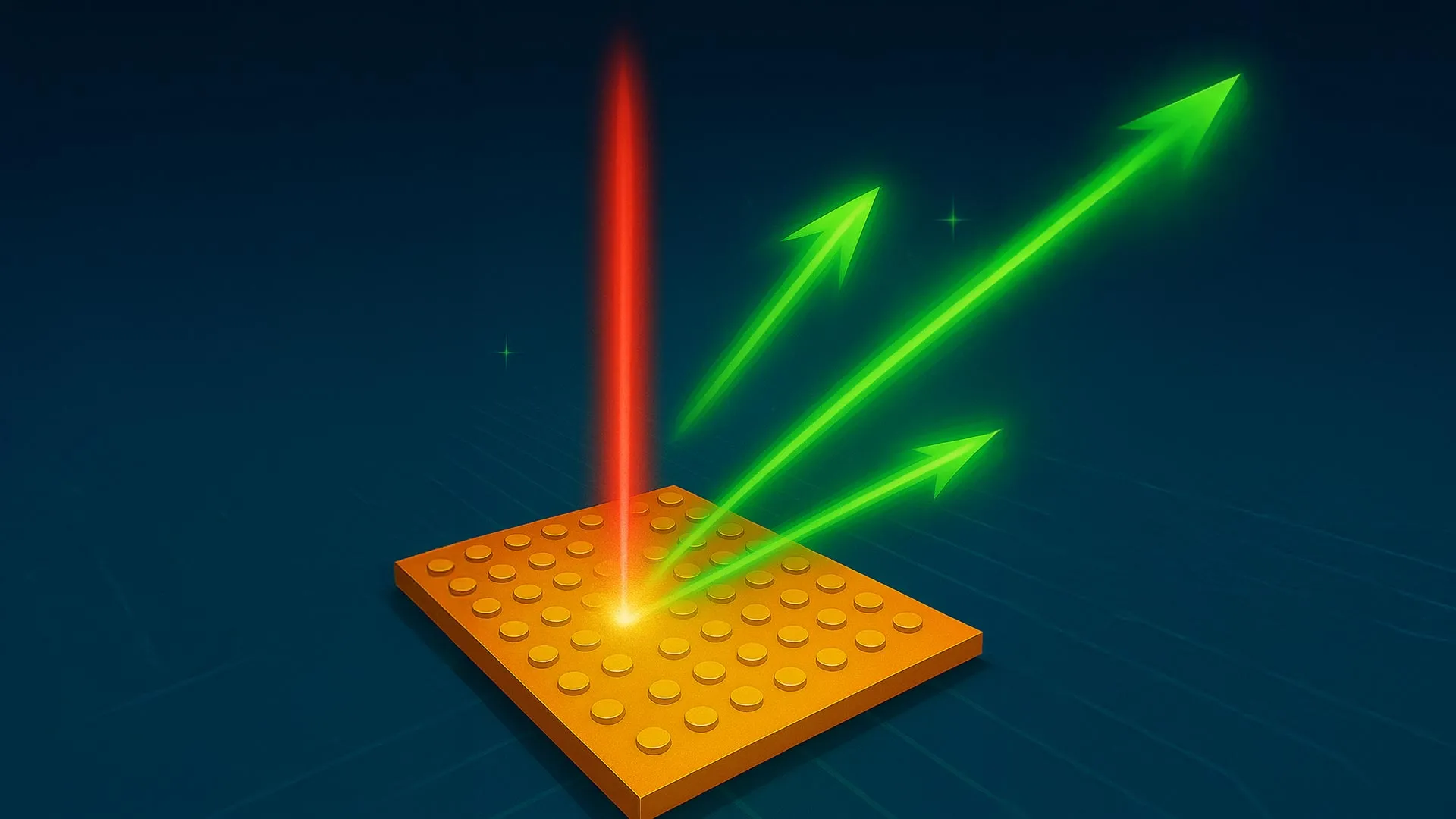
Creating extremely small devices that can precisely guide and control light is a key challenge for many emerging technologies. Scientists at the Advanced Science Research Center at the CUNY Graduate Center (CUNY ASRC) have now made an important advance by developing a metasurface that can convert invisible infrared light into visible light and direct it in specific directions without relying on any moving parts. Their findings are described in a new study published in the journal eLight.
The new metasurface takes the form of an ultra thin chip covered with tiny structures that are smaller than the wavelength of light itself. When an infrared laser strikes the surface, the chip shifts the light to a higher color (or frequency) and releases it as a tightly focused beam. The direction of that beam can be adjusted simply by changing the polarization of the incoming light.
In laboratory tests, the researchers converted infrared light with a wavelength of about 1530 nanometers, similar to what is used in fiber optic communication systems, into visible green light near 510 nanometers. They were also able to guide the outgoing beam toward selected angles with high precision.
"Think of it as a flat, microscopic spotlight that not only changes the color of light but also points the beam wherever you want, all on a single chip," said Andrea Alù, founding director of the CUNY ASRC Photonics Initiative and Distinguished Professor at the CUNY Graduate Center. "By making different parts of the surface work together, we get both very efficient conversion of light and precise control over where that light goes."
Solving a Longstanding Engineering Challenge
Metasurfaces have long been used by engineers to bend, focus, and shape light using flat, nanoscale structures. However, these systems typically face a difficult tradeoff.
Some designs offer fine control by adjusting light at each individual point on the surface, but they are not very efficient at strengthening the light signal. Other designs allow light waves to interact across the entire surface, which can greatly boost efficiency, but this approach often sacrifices detailed control over the shape and direction of the beam.
The new device developed at CUNY is the first to overcome this limitation for nonlinear light generation, a process in which one color of light is converted into another. The chip uses a collective resonance known as a quasi bound state in the continuum to trap and intensify the incoming infrared light across the whole surface. At the same time, each tiny structural element is rotated in a carefully planned pattern, allowing the outgoing light to acquire a position dependent phase similar to the effect of a built in lens or prism.
Efficient Beam Steering Without Moving Parts
Thanks to this design, the metasurface generates third harmonic light, meaning the outgoing light has three times the frequency of the incoming beam, while also steering that light in specific directions. Changing the polarization of the incoming beam reverses the steering direction, providing a simple and effective way to control where the light goes.
As a result, the third harmonic signal produced by the chip is about 100 times more efficient than what is achieved by similar beam shaping devices that lack these collective resonances.
Toward Compact Light Sources and Integrated Optics
Being able to efficiently create and direct new colors of light on a flat chip opens the door to many practical applications.
"This platform opens a path to ultra-compact light sources and beam-steering elements for technologies like LiDAR, quantum light generation, and optical signal processing, all integrated directly on a chip," said lead author Michele Cotrufo, a former postdoctoral fellow at CUNY and now an assistant professor at the University of Rochester. "Because the concept is driven by geometry, not by one specific material, it can be applied to many other nonlinear materials and across different colors of light, including the ultraviolet."
The researchers add that future versions of the technology could involve stacking or combining multiple metasurfaces, each optimized slightly differently, to work efficiently across a wider range of wavelengths.
This research was supported by the U.S. Department of Defense, the Simons Foundation, and the European Research Council.
Story Source:
Materials provided by Advanced Science Research Center, GC/CUNY. Note: Content may be edited for style and length.
Journal Reference:
- Michele Cotrufo, Luca Carletti, Adam Overvig, Andrea Alù. Nonlinear nonlocal metasurfaces. eLight, 2026; 6 (1) DOI: 10.1186/s43593-025-00116-7
Cite This Page: