
A spinning gyroscope could finally unlock ocean wave energy
A floating device with a spinning gyroscope could unlock wave energy like never before.
- Date:
- February 18, 2026
- Source:
- The University of Osaka
- Summary:
- Ocean waves are a vast and steady source of renewable energy, but capturing their power efficiently has long frustrated engineers. A researcher at The University of Osaka has now explored a bold new approach: a gyroscopic wave energy converter that uses a spinning flywheel inside a floating structure to turn wave motion into electricity. By harnessing gyroscopic precession—the subtle wobble of a spinning object under force—the system can be tuned to absorb energy across a wide range of wave conditions.
- Share:
Ocean waves represent one of the largest and most consistent sources of renewable energy on Earth. Despite their promise, converting wave motion into usable electricity has proven difficult. Most existing wave energy devices perform well only under specific wave conditions, limiting their effectiveness in the constantly shifting environment of the open sea. This challenge has driven researchers to search for more adaptable and efficient technologies.
A researcher at The University of Osaka has taken a close look at a new approach known as a gyroscopic wave energy converter (GWEC). The study evaluated whether this design could realistically support large scale electricity generation. The results were published this month in the Journal of Fluid Mechanics.
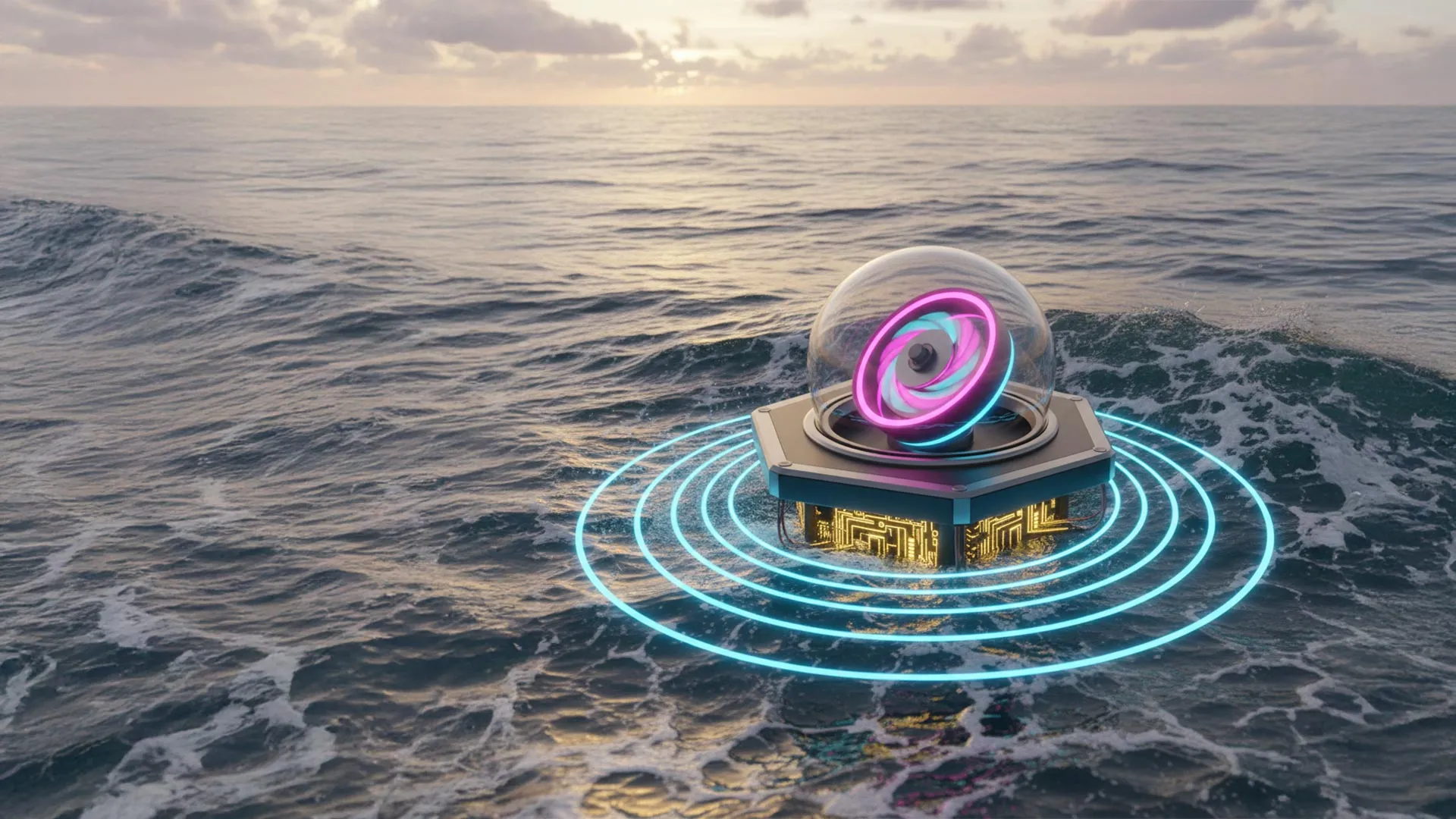
Unlike traditional systems, the GWEC relies on a spinning flywheel housed inside a floating platform. As the structure moves with the waves, the rotating flywheel converts that motion into electrical power. Because the flywheel operates as a gyroscope, its behavior can be adjusted to capture energy efficiently across a wide range of wave frequencies rather than being limited to a narrow band.
How Gyroscopic Precession Generates Electricity
The system works by taking advantage of gyroscopic precession, which occurs when a spinning object reacts to an outside force. When waves cause the floating platform to pitch (move up and down), the spinning flywheel shifts its orientation through precession (changing the direction it is spinning in). That motion is connected to a generator, allowing the device to produce electricity.
"Wave energy devices often struggle because ocean conditions are constantly changing," says Takahito Iida, author of the study. "However, a gyroscopic system can be controlled in a way that maintains high energy absorption, even as wave frequencies vary."
Modeling Maximum Wave Energy Efficiency
To better understand how the system behaves, the researcher used linear wave theory to model the interaction among ocean waves, the floating structure, and the gyroscope. By analyzing these linked dynamics, the team identified the ideal settings for the flywheel's rotational speed and the generator's controls. The analysis showed that, when properly tuned, the GWEC can reach the theoretical maximum energy absorption efficiency of one half at any wave frequency.
"This efficiency limit is a fundamental constraint in wave energy theory," explains Iida. "What is exciting is that we now know that it can be reached across broadband frequencies, not just at a single resonant condition."
Simulations Confirm Real World Performance
The findings were further tested through numerical simulations in both the frequency and time domains. Additional time domain simulations also incorporated nonlinear gyroscopic behavior to explore possible performance limits. These results confirmed that the device maintains strong efficiency near its resonance frequency, meaning it performs best when its motion aligns with the natural rhythm of the waves.
By clarifying how to fine tune the gyroscope's operating parameters, the research offers practical guidance for building more flexible and efficient wave energy systems. As the world looks for dependable renewable energy solutions to address climate goals, innovations like this could help tap into the enormous, largely unused energy stored in the oceans.
Story Source:
Materials provided by The University of Osaka. Note: Content may be edited for style and length.
Journal Reference:
- Takahito Iida. Linear analysis of a gyroscopic wave energy converter: absorbing half of the wave energy over broadband frequencies. Journal of Fluid Mechanics, 2026; 1029 DOI: 10.1017/jfm.2026.11172
Cite This Page: