
NASA is searching for hidden caves to build its first Moon base
- Date:
- October 8, 2026
- Source:
- NASA
- Summary:
- NASA is preparing for humanity’s first Moon base with three investigations that will hunt for underground shelters, uncover hidden ice, and track dangerous conditions on the lunar surface. The findings could reveal how astronauts can survive and thrive on the Moon while laying the groundwork for future journeys to Mars.
- Share:
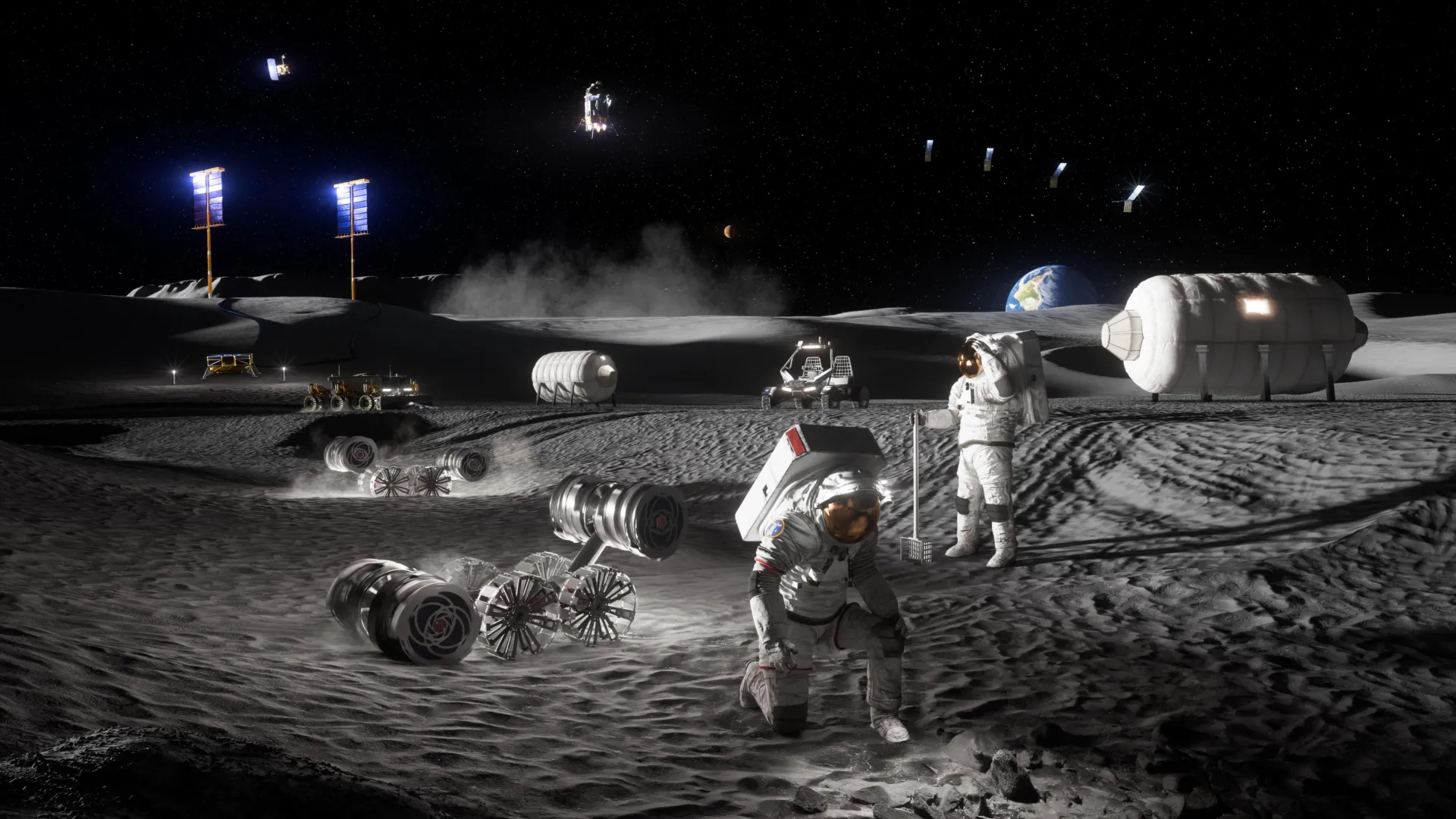
NASA is moving closer to establishing humanity's first Moon base with the selection of three scientific investigations designed to answer some of the biggest questions about living on the lunar surface. The missions will search for underground caves that could shelter astronauts, investigate hidden deposits of lunar ice, and monitor environmental hazards that could threaten future explorers.
The new instruments and technologies were selected through NASA's Payloads and Research Investigations on the Surface of the Moon (PRISM) program. They will be delivered to the lunar surface through the agency's CLPS (Commercial Lunar Payload Services) initiative as part of its Moon Base Program.
Each investigation will address a different challenge of establishing a lasting human presence on the Moon. Researchers will examine potential natural shelters, identify resources that astronauts could use, and study dangerous conditions that future habitats and equipment will need to withstand. Together, the findings will support NASA's Artemis and Moon Base programs as the agency works toward long-term lunar exploration.
"NASA Science is building the ultimate interplanetary survival guide to ensure that science goes first to the lunar surface to provide our future astronaut crews with the vital information, resources, and safety precautions needed ahead of time to survive the night on the Moon," said Nicky Fox, associate administrator, Science Mission Directorate, at NASA Headquarters in Washington. "These PRISM selections will directly help NASA minimize risks to our astronauts while maximizing our agency goals as we set up humanity's first lunar outpost in preparation for sending the first astronauts to Mars."
Monitoring Moonquakes and Other Lunar Hazards
The first investigation, Lunar Environment Monitoring Station -- South Pole (LEMS-SP), will establish an autonomous station to track environmental conditions and potential threats over an extended period.
One of its tasks will be detecting micrometeoroids, tiny pieces of space debris that strike the lunar surface. Unlike Earth, the Moon lacks a substantial atmosphere capable of burning up most incoming objects, making these impacts a concern for future equipment and habitats.
The station will also measure the abundance of volatiles, substances that readily turn into gas, within the Moon's extremely thin outer layer of gases. Tracking these materials will help scientists better understand how the lunar environment changes over time.
Another important instrument will be a short-period seismometer, designed to detect vibrations and seismic activity, including moonquakes. These measurements could reveal hazards that NASA must consider when designing structures and installing sensitive equipment on the lunar surface.
By collecting information about impacts, seismic activity, and the surrounding environment, LEMS-SP could help engineers develop safer and more reliable infrastructure for a permanent Moon base.
The investigation will be led by Dr. Mehdi Benna of the University of Maryland, Baltimore County.
Searching for Hidden Caves Beneath the Moon
The second investigation will explore one of the Moon's most intriguing possibilities: enormous underground passages that could serve as natural shelters for astronauts.
Known as Geophysical Instruments for Marius Lunar pit Investigation (GIMLI), the mission will examine the Marius Hills Pit, an opening in the lunar surface that may connect to an extensive underground lava tube.
Lava tubes form when the outer surface of flowing lava cools and hardens while molten rock continues moving beneath it. Once the lava drains away, it can leave behind hollow tunnels. Scientists believe similar formations may exist beneath parts of the Moon's volcanic terrain.
GIMLI will use geophysical measurements to investigate what lies beneath the pit and determine whether it connects to a larger underground passage. The findings will also provide new insights into the volcanic processes that shaped the lunar landscape.
If large underground spaces are confirmed, they could offer an important advantage for future human exploration.
The lunar surface is exposed to intense temperature changes, harmful ionizing radiation, and frequent impacts from tiny space rocks. Underground lava tubes could provide more stable temperatures and natural shielding from these dangers.
Instead of relying entirely on protective structures built on the surface, future astronauts might be able to use some of the Moon's existing geological formations as shelters.
Confirming the presence and size of these underground spaces could therefore influence where NASA considers placing future habitats and how those habitats are designed.
Dr. Nathaniel Putzig of the Planetary Science Institute will serve as the principal investigator for GIMLI.
Hunting for Hidden Ice and Usable Moon Resources
The third investigation will focus on another resource that could be essential to a lasting human presence on the Moon: water ice.
The Depth Imager with Spectral and Color Optics (DISCO) payload is designed to make the first direct measurements from the lunar surface of ice preserved inside small, exceptionally cold regions known as micro-cold traps.
These areas can remain cold enough for ice to persist because they receive little or no direct sunlight. Identifying where the ice is located, how much exists, and how it is distributed could help scientists understand whether it can become a practical resource for future lunar missions.
Water brought from Earth is expensive to transport into space. Finding accessible ice on the Moon could eventually allow astronauts to obtain water locally and potentially process it into oxygen and hydrogen for other uses.
DISCO will also investigate the physical properties of the lunar surface.
One challenge is understanding what happens when a spacecraft lands. Rocket exhaust can blast dust and loose material away from the ground, potentially affecting nearby equipment and structures.
Researchers will also examine the stability of the terrain to better understand how safely astronauts, robotic vehicles, and other equipment can move across the surface.
Combining these measurements will help NASA develop safer landing and surface operations while advancing technologies that could turn lunar ice into a useful resource for the Moon Base Program.
Dr. Ariel Deutsch of NASA's Ames Research Center in California's Silicon Valley will lead the DISCO investigation.
Building the Foundation for Humanity's First Moon Base
Together, the three investigations will address some of the most important challenges of establishing a sustained human presence beyond Earth.
LEMS-SP will help scientists understand environmental threats, GIMLI will investigate whether underground lava tubes could provide natural protection, and DISCO will examine potential water resources and the behavior of the lunar surface.
The results could influence everything from the placement of future habitats to the design of equipment and the development of systems that allow astronauts to make use of resources already available on the Moon.
"Each new PRISM selection strengthens our ability to deliver ambitious, transformative science to the lunar surface," said Brad Bailey, director of the Exploration Science Strategy Integration Office in NASA's Science Mission Directorate. "These investigations exemplify how Artemis and Moon Base are expanding the frontier of lunar exploration, advancing innovative technologies, deepening our understanding of the Moon's environment, and paving the way for future astronaut missions."
NASA is working to increase the frequency of its lunar missions as it prepares to establish a Moon base. These missions will deliver scientific instruments and new technologies intended to expand American leadership in space science, support a sustained lunar presence, and prepare for more ambitious human exploration.
The agency's CLPS initiative plays a central role in that effort by partnering with American companies to transport scientific, exploration, and technology payloads to the Moon's surface and orbit.
Beyond helping astronauts live and work on the Moon, the knowledge gained from these investigations could prove essential to NASA's longer-term goal of sending humans to Mars.
Cite This Page: