
Stressed rats keep returning to cannabis and scientists know why
- Date:
- December 11, 2025
- Source:
- Washington State University
- Summary:
- Rats with naturally high stress levels were far more likely to self-administer cannabis when given access. Behavioral testing showed that baseline stress hormones were the strongest predictor of cannabis-seeking behavior. Lower cognitive flexibility and low endocannabinoid levels also contributed to increased use. The results hint at possible early indicators of vulnerability to drug misuse.
- Share:
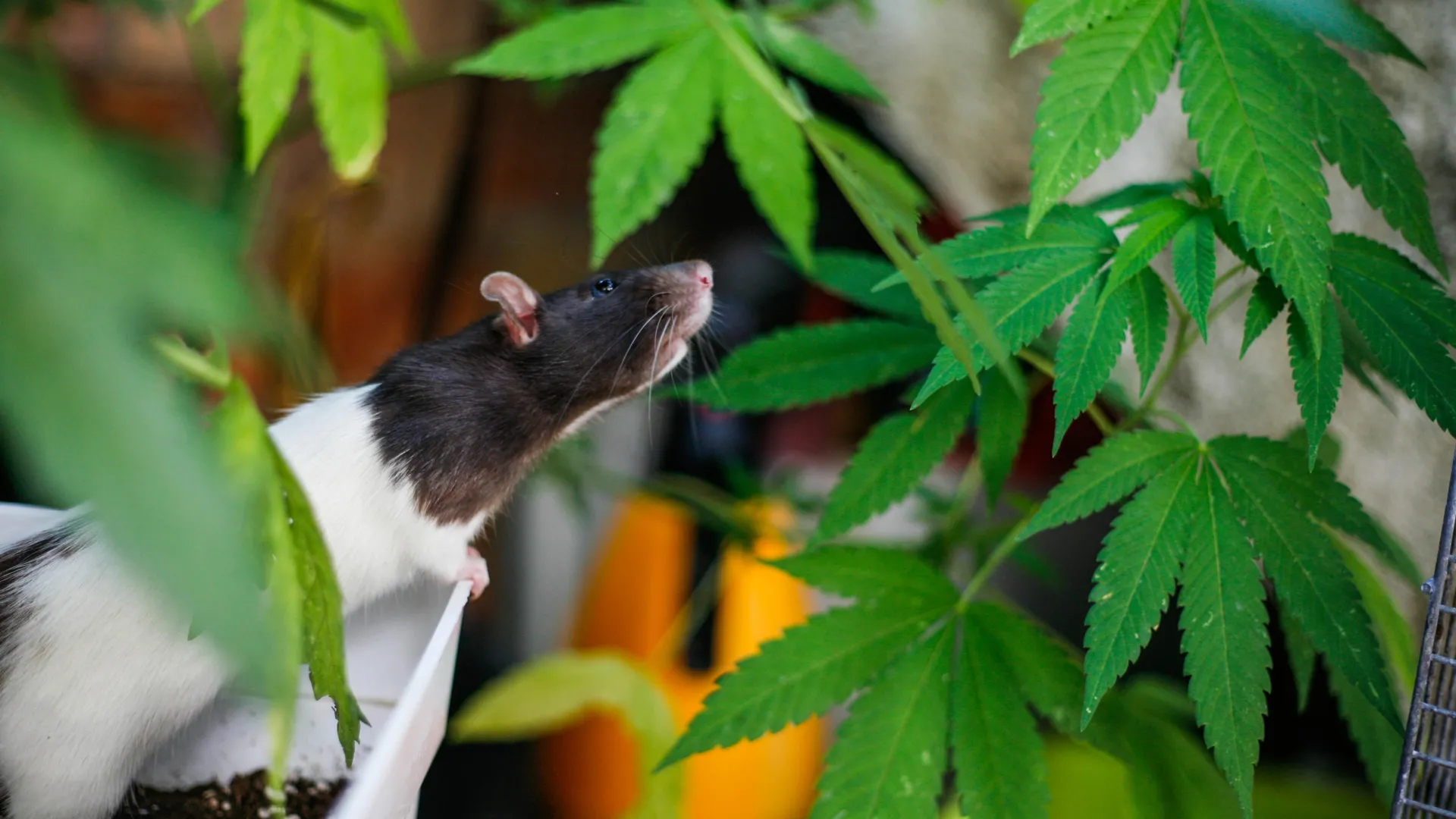
It isn't just people -- when given the chance rats may also use cannabis to cope with stress, according to a study by researchers at Washington State University.
Published in the journal Neuropsychopharmacology, the study set out to investigate which animals would actively seek out cannabis and why. The researchers discovered that rats with naturally higher stress levels were much more likely to repeatedly self-administer the commonly used recreational drug.
"We ran rats through this extensive battery of behavioral and biological tests, and what we found was that when we look at all of these different factors and all the variables that we measured, stress levels seem to matter the most when it comes to cannabis use," said Ryan McLaughlin, associate professor in WSU's College of Veterinary Medicine.
How the experiments tested cannabis seeking behavior
To better understand which traits might influence cannabis use, McLaughlin and his team of undergraduate and graduate student researchers examined a wide range of characteristics, including social behavior, sex, thinking abilities, reward sensitivity, and arousal. From these measurements they built a behavioral profile for each rat. Over a three-week period, the animals were then observed for one hour a day while they had a choice to self-administer cannabis by poking their nose into a vapor port, which released a three-second burst of cannabis vapor into an air-tight chamber.
During each daily session, the student researchers recorded how many "nose-pokes" each rat performed. They then compared those counts with baseline stress hormone levels and found a clear relationship: rats that poked more often tended to have higher starting levels of stress hormones.
Stress hormones as predictors of cannabis use
The team measured the stress hormone corticosterone in the rats, which is the rodent equivalent of the human stress hormone cortisol. They found that animals with higher natural corticosterone levels were much more inclined to self-administer cannabis.
"If you want to really boil it down, there are baseline levels of stress hormones that can predict rates of cannabis self-administration, and I think that only makes sense given that the most common reason that people habitually use cannabis is to cope with stress," McLaughlin said.
He emphasized that the key factor was the rats' resting, baseline stress levels rather than short-term spikes that occur during exercise or mentally demanding tasks. When the researchers measured stress hormone levels after exposing the rats to a stressor, those values did not show a meaningful connection to cannabis-seeking behavior.
Cognitive flexibility and motivation for cannabis
The study also uncovered strong links between how often rats self-administered cannabis and their performance on tests of "cognitive flexibility," which refers to the ability to adapt when rules or conditions change.
"Animals that were less flexible in shifting between rules, when we tested them in a cognitive task, tended to show stronger rates of cannabis-seeking behavior," he said. "So, animals that rely more heavily on visual cues to guide their decision making, those rats, when we tested their motivation to self-administer cannabis vapor, were also very highly motivated rats."
Endocannabinoids, THC, and biological vulnerability
In addition to baseline stress, the researchers found another pattern involving a combination of high morning corticosterone levels and low endocannabinoid levels, which was also associated with cannabis self-administration, although this link was weaker than the effect of baseline stress.
Endocannabinoids are compounds that the body produces on demand to help maintain internal stability and balance, known as homeostasis.
"There's some thought behind why people might be more prone to use cannabis, and that maybe THC serves as a reasonable substitute for endocannabinoids in individuals that have lower endocannabinoid levels," McLaughlin said. "So, perhaps there's more of a drive to supplement that with cannabis."
Cannabis use, addiction risk, and early warning markers
With more and more states decriminalizing cannabis and legalizing recreational cannabis, McLaughlin said it is increasingly important to understand how the drug affects the brain and behavior, and how patterns of drug abuse can develop.
"Our findings highlight potential early or pre-use markers that could one day support screening and prevention strategies," McLaughlin said. "I could certainly envision a scenario where having an assessment of baseline cortisol might provide some level of insight into whether there's an increased propensity for you to develop problematic drug use patterns later in life."
Story Source:
Materials provided by Washington State University. Note: Content may be edited for style and length.
Journal Reference:
- Ginny I. Park, Alexandra N. Malena, Nicholas C. Glodosky, Zachary D. G. Fisher, Carrie Cuttler, Savannah H. M. Lightfoot, Samantha L. Baglot, Cayden Murray, Matthew N. Hill, Ryan J. McLaughlin. Identifying behavioral and biological predictors of cannabis vapor self-administration in rats. Neuropsychopharmacology, 2025; DOI: 10.1038/s41386-025-02286-x
Cite This Page: