
Scientists prove “impossible” Earth-to-space quantum link is feasible
Quantum satellites may soon rely on Earth-based transmitters instead of generating signals in space.
- Date:
- December 17, 2025
- Source:
- University of Technology Sydney
- Summary:
- Researchers have shown that quantum signals can be sent from Earth up to satellites, not just down from space as previously believed. This breakthrough could make global quantum networks far more powerful, affordable, and practical.
- Share:
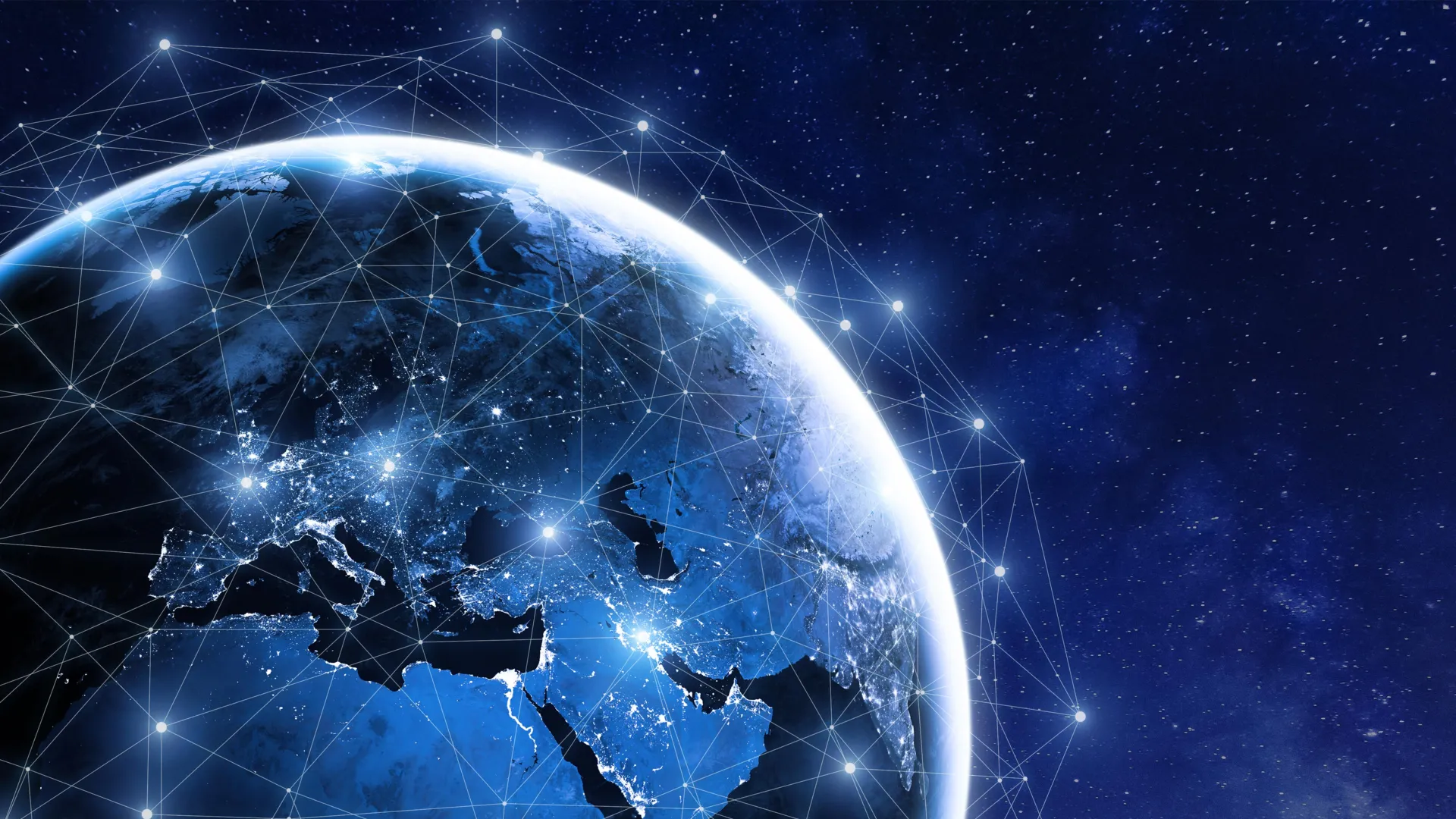
Quantum satellites are best known for sending entangled particles of light from orbit down to ground stations, a method used to create extremely secure communication links. New research now shows that the process can also work in reverse, with quantum signals sent from Earth up to a satellite, an approach long considered impractical.
This finding removes several major limitations facing today's quantum satellite systems. Equipment on the ground can draw on far more power, is simpler to service, and can produce much stronger signals. These advantages could be critical for building future networks that link quantum computers through satellites acting as relays.
Study Details and Recent Milestones
The research, titled "Quantum entanglement distribution via uplink satellite channels," by Professor Simon Devitt, Professor Alexander Solntsev and a research team from the University of Technology Sydney (UTS), was recently published in the journal Physical Review Research.
Quantum satellite communication has already seen important advances. China's Micius satellite, launched in 2016, enabled the first demonstrations of quantum-encrypted data sent from space. In 2025, the Jinan-1 microsatellite pushed this work further by establishing a 12,900 km quantum connection between China and South Africa.
Why Uplink Quantum Communication Was Dismissed
"Current quantum satellites create entangled pairs in space and then send each half of the pair down to two places on Earth -- called a 'downlink'," said Professor Solntsev. "It's mostly used for cryptography, where only a few photons (particles of light) are needed to generate a secret key."
Scientists largely ignored the opposite approach, in which entangled photons are produced on Earth and transmitted upward. This idea was seen as unrealistic because of expected losses, interference, and the scattering of light as it travels through the atmosphere.
Modeling the "Impossible" Scenario
"The idea is to fire two single particles of light from separate ground stations to a satellite orbiting 500 km above Earth, traveling at about 20,000 km per hour, so that they meet so perfectly as to undergo quantum interference. Is this even possible?" said Professor Devitt.
According to the researchers, careful modeling suggests the answer is yes. "Surprisingly, our modeling showed that an uplink is feasible. We included real-world effects such as background light from the Earth and sunlight reflections from the Moon, atmospheric effects and the imperfect alignment of optical systems," he said.
Toward a Scalable Quantum Internet
The team says the idea could be tested soon using drones or balloon-mounted receivers, providing a stepping stone toward large-scale quantum networks that span nations and continents using small satellites in low Earth orbit.
"A quantum internet is a very different beast from current nascent cryptographic applications. It's the same primary mechanism but you need significantly more photons -- more bandwidth -- to connect quantum computers," said Professor Devitt.
The uplink strategy may offer a practical solution. "The uplink method could provide that bandwidth. The satellite only needs a compact optical unit to interfere incoming photons and report the result, rather than quantum hardware to produce the trillions upon trillions of photons per second needed to overcome losses to the ground, allowing for a high-bandwidth quantum link. That keeps costs and size down and makes the approach more practical."
Quantum Entanglement as Everyday Infrastructure
Professor Devitt compares the long-term vision to modern electricity. "In the future, quantum entanglement is going to be a bit like electricity. A commodity that we talk about that powers other things. It's generated and transmitted in a way that is often invisible to the user; we just plug in our appliances and use it. This will ultimately be the same for large quantum entanglement networks. There will be quantum devices that plug into an entanglement source as well as a power source, utilizing both to do something useful," he said.
The project combines expertise from the UTS Faculty of Engineering and IT and the Faculty of Science, bringing together specialists in quantum networking, systems modeling, and photonics. It demonstrates how collaboration across disciplines at UTS is helping address some of the most demanding challenges in emerging technology.
Story Source:
Materials provided by University of Technology Sydney. Note: Content may be edited for style and length.
Journal Reference:
- S. Srikara, Hudson Leone, Alexander S. Solntsev, Simon J. Devitt. Quantum entanglement distribution via uplink satellite channels. Physical Review Research, 2025; 7 (4) DOI: 10.1103/v3p1-kz4h
Cite This Page: