
This tiny chip could change the future of quantum computing
- Date:
- December 26, 2025
- Source:
- University of Colorado at Boulder
- Summary:
- A new microchip-sized device could dramatically accelerate the future of quantum computing. It controls laser frequencies with extreme precision while using far less power than today’s bulky systems. Crucially, it’s made with standard chip manufacturing, meaning it can be mass-produced instead of custom-built. This opens the door to quantum machines far larger and more powerful than anything possible today.
- Share:
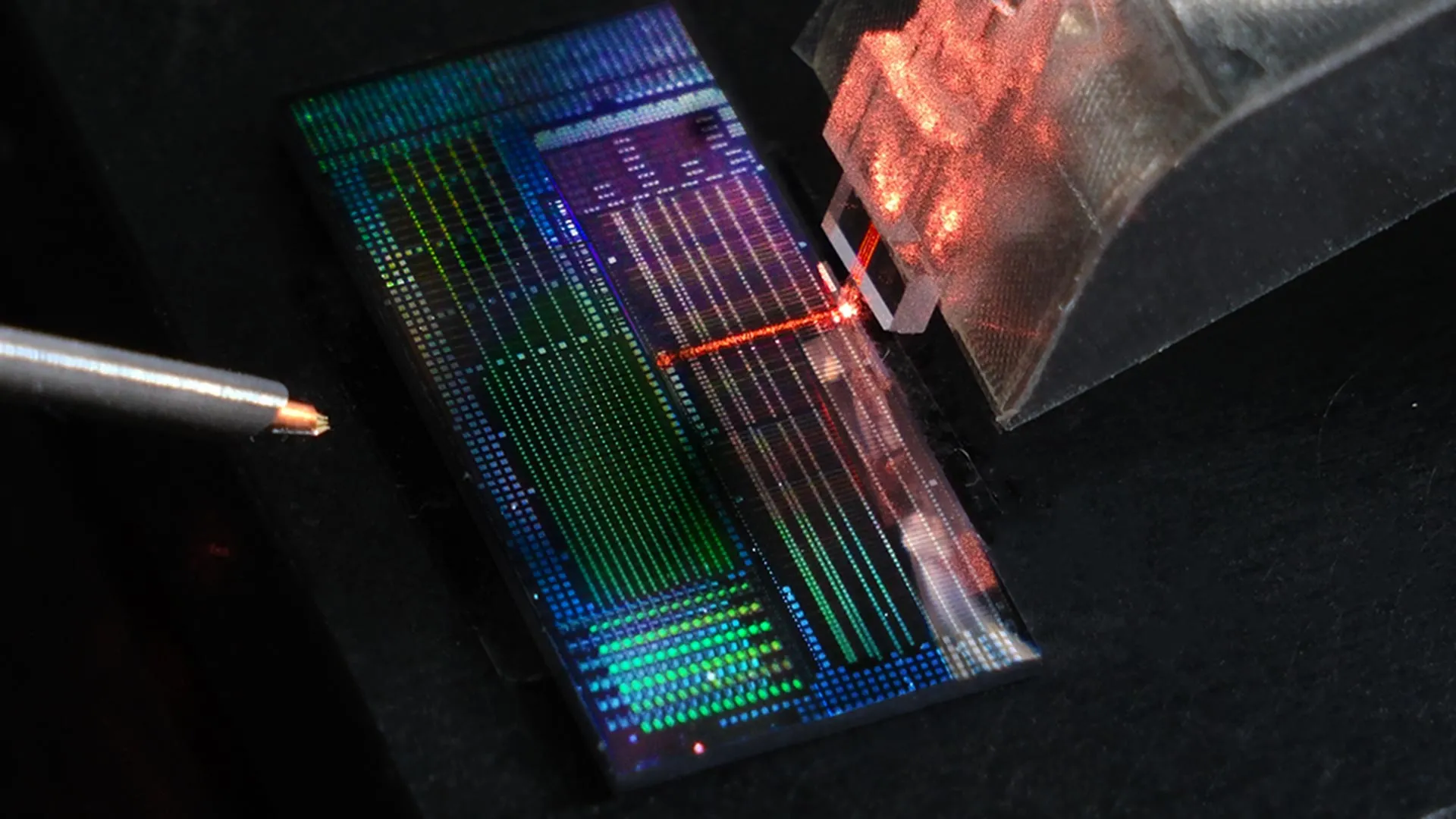
Researchers have achieved a significant step forward in quantum computing by developing a device that is almost 100 times thinner than the width of a human hair. The work, published in the journal Nature Communications, introduces a new type of optical phase modulator designed to precisely control laser light. This capability is essential for running future quantum computers that may rely on thousands or even millions of qubits -- the fundamental units used to store and process quantum information.
Just as important as its size is how the device is made. Instead of relying on custom-built laboratory equipment, the researchers used scalable manufacturing methods similar to those that produce the processors found in computers, smartphones, vehicles, and household appliances -- essentially any technology powered by electricity (even toasters). This approach makes the device far more practical to produce in large numbers.
A Tiny Device Built for Real-World Scale
The research was led by Jake Freedman, an incoming PhD student in the Department of Electrical, Computer and Energy Engineering, alongside Matt Eichenfield, professor and Karl Gustafson Endowed Chair in Quantum Engineering. The team also collaborated with scientists from Sandia National Laboratories, including co-senior author Nils Otterstrom. Together, they created a device that combines small size, high performance, and low cost, making it suitable for mass production.
At the heart of the technology are microwave-frequency vibrations that oscillate billions of times per second. These vibrations allow the chip to manipulate laser light with remarkable precision.
By directly controlling the phase of a laser beam, the device can generate new laser frequencies that are both stable and efficient. This level of control is a key requirement not only for quantum computing, but also for emerging fields such as quantum sensing and quantum networking.
Why Quantum Computers Need Ultra-Precise Lasers
Some of the most promising quantum computing designs use trapped ions or trapped neutral atoms to store information. In these systems, each atom acts as a qubit. Researchers interact with these atoms by directing carefully tuned laser beams at them, effectively giving instructions that allow calculations to take place. For this to work, each laser must be adjusted with extreme precision, sometimes to within billionths of a percent.
"Creating new copies of a laser with very exact differences in frequency is one of the most important tools for working with atom- and ion-based quantum computers," Freedman said. "But to do that at scale, you need technology that can efficiently generate those new frequencies."
Currently, these precise frequency shifts are produced using large, table-top devices that require substantial microwave power. While effective for small experiments, these systems are impractical for the massive number of optical channels needed in future quantum computers.
"You're not going to build a quantum computer with 100,000 bulk electro-optic modulators sitting in a warehouse full of optical tables," Eichenfield said. "You need some much more scalable ways to manufacture them that don't have to be hand-assembled and with long optical paths. While you're at it, if you can make them all fit on a few small microchips and produce 100 times less heat, you're much more likely to make it work."
Lower Power Use, Less Heat, More Qubits
The new device generates laser frequency shifts through efficient phase modulation while using about 80 times less microwave power than many existing commercial modulators. Lower power consumption means less heat, which allows more channels to be packed closely together, even onto a single chip.
Taken together, these advantages transform the chip into a scalable system capable of coordinating the precise interactions atoms need to perform quantum calculations.
Built With the Same Technology as Modern Microchips
One of the project's most important achievements is that the device was manufactured entirely in a fabrication facility, or fab, the same type of environment used to produce advanced microelectronics.
"CMOS fabrication is the most scalable technology humans have ever invented," Eichenfield said.
"Every microelectronic chip in every cell phone or computer has billions of essentially identical transistors on it. So, by using CMOS fabrication, in the future, we can produce thousands or even millions of identical versions of our photonic devices, which is exactly what quantum computing will need."
According to Otterstorm, the team took modulator technologies that were once bulky, expensive, and power intensive and redesigned them to be smaller, more efficient, and easier to integrate.
"We're helping to push optics into its own 'transistor revolution,' moving away from the optical equivalent of vacuum tubes and towards scalable integrated photonic technologies," Otterstorm said.
Toward Fully Integrated Quantum Photonic Chips
The researchers are now working on fully integrated photonic circuits that combine frequency generation, filtering, and pulse shaping on a single chip. This effort moves the field closer to a complete, operational quantum photonic platform.
Next, the team plans to partner with quantum computing companies to test these chips inside advanced trapped-ion and trapped-neutral-atom quantum computers.
"This device is one of the final pieces of the puzzle," Freedman said. "We're getting close to a truly scalable photonic platform capable of controlling very large numbers of qubits."
The project received support from the U.S. Department of Energy through the Quantum Systems Accelerator program, a National Quantum Initiative Science Research Center.
Story Source:
Materials provided by University of Colorado at Boulder. Note: Content may be edited for style and length.
Journal Reference:
- Jacob M. Freedman, Matthew J. Storey, Daniel Dominguez, Andrew Leenheer, Sebastian Magri, Nils T. Otterstrom, Matt Eichenfield. Gigahertz-frequency acousto-optic phase modulation of visible light in a CMOS-fabricated photonic circuit. Nature Communications, 2025; 16 (1) DOI: 10.1038/s41467-025-65937-z
Cite This Page: