
Astronomers measure the mass of a rogue planet drifting through the galaxy
- Date:
- January 4, 2026
- Source:
- American Association for the Advancement of Science (AAAS)
- Summary:
- Scientists have discovered a rogue planet roaming the Milky Way after combining observations from Earth and a space telescope. This rare dual perspective allowed them to weigh the planet and pinpoint where it lies in the galaxy. With a mass similar to Saturn, the planet likely formed around a star before being thrown out. The finding opens a new window into how planets are lost to interstellar space.
- Share:
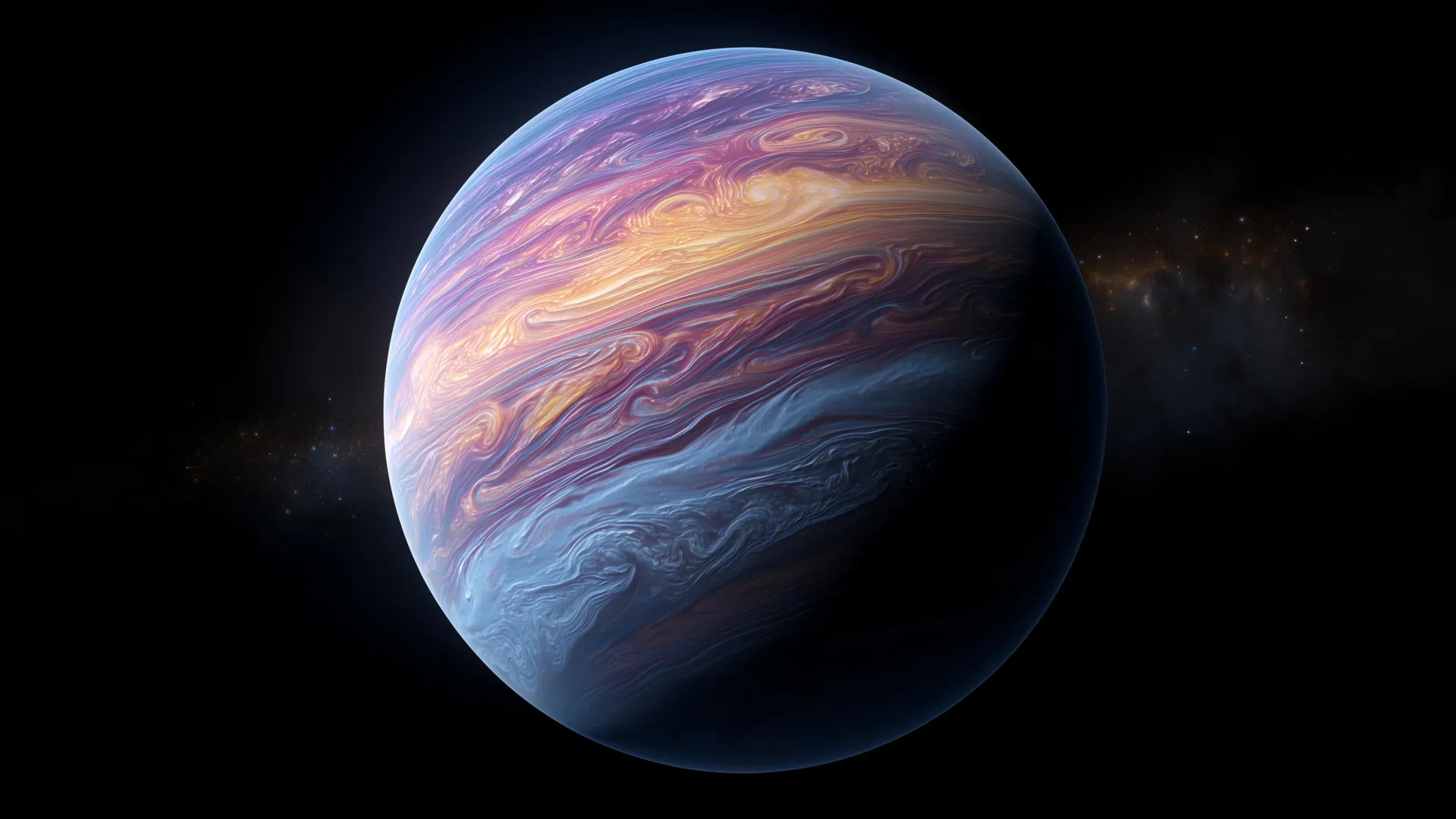
A new study shows that astronomers have directly measured the mass and distance of a newly discovered free-floating planet by observing it at the same time from Earth and from space. This combined approach made it possible to capture details that are usually missing for these faint objects. The results help explain the many different ways planets can be knocked out of their original systems and sent drifting through interstellar space. So far, only a small number of free-floating planets have been identified, but that number is expected to grow in the coming years. According to Gavin Coleman in a related Perspective, the upcoming NASA Nancy Grace Roman Space Telescope campaign, scheduled for launch in 2027, could play a major role. As Coleman notes, "Simultaneous space- and ground-based observations of microlensing events could be applied in the planning of future exploratory missions and could lead to a better understanding of how planets form across the Galaxy."
Most known planets orbit one or more stars, but evidence is mounting that some worlds travel through the galaxy on their own. These lonely objects are known as free-floating or rogue planets, and they have no identified stellar companion. Because they produce very little light, astronomers usually detect them only by watching how their gravity briefly alters the light from a distant background star. This effect is called microlensing. One major challenge with microlensing is that it usually does not reveal how far away the planet is, which makes it hard to calculate its mass independently. As a result, many details about this hidden population of solitary planets have remained uncertain.
In the new research, Subo Dong and colleagues describe the discovery of a free-floating planet spotted during a short microlensing event. What makes this finding unusual is that the event was observed at the same time from Earth and from space. The team used data from several ground-based surveys along with observations from the Gaia space telescope. Small differences in the timing of the light seen from these widely separated locations made it possible to measure the microlensing parallax. When combined with finite-source point-lens modeling, this information allowed the researchers to determine both the planet's mass and where it is located in the galaxy.
The planet has a mass about 22 percent that of Jupiter and lies roughly 3,000 parsecs from the center of the Milky Way. With a mass similar to Saturn, the researchers suggest that it most likely formed within a planetary system rather than developing on its own like a small star or brown dwarf. Scientists think that low-mass rogue planets are born around stars and later forced out of their orbits by gravitational disturbances, such as close encounters with other planets or unstable stellar companions.
Story Source:
Materials provided by American Association for the Advancement of Science (AAAS). Original written by Walter Beckwith. Note: Content may be edited for style and length.
Journal Reference:
- Subo Dong, Zexuan Wu, Yoon-Hyun Ryu, Andrzej Udalski, Przemek Mróz, Krzysztof A. Rybicki, Simon T. Hodgkin, Łukasz Wyrzykowski, Laurent Eyer, Thomas Bensby, Ping Chen, Sharon X. Wang, Andrew Gould, Hongjing Yang, Michael D. Albrow, Sun-Ju Chung, Cheongho Han, Kyu-Ha Hwang, Youn Kil Jung, In-Gu Shin, Yossi Shvartzvald, Jennifer C. Yee, Weicheng Zang, Dong-Jin Kim, Chung-Uk Lee, Byeong-Gon Park, Radosław Poleski, Jan Skowron, Michał K. Szymański, Igor Soszyński, Paweł Pietrukowicz, Szymon Kozłowski, Dorota M. Skowron, Krzysztof Ulaczyk, Mariusz Gromadzki, Milena Ratajczak, Patryk Iwanek, Marcin Wrona, Mateusz J. Mróz, Guy Rixon, Diana L. Harrison, Elmé Breedt. A free-floating-planet microlensing event caused by a Saturn-mass object. Science, 2026; 391 (6780): 96 DOI: 10.1126/science.adv9266
Cite This Page: