
A simple chemistry trick could end forever plastic
An idea borrowed from DNA could finally give plastics an expiration date.
- Date:
- January 4, 2026
- Source:
- Rutgers University
- Summary:
- Seeing plastic trash while hiking inspired a Rutgers chemist to rethink why synthetic plastics last forever while natural polymers don’t. By mimicking tiny structural features used in DNA and proteins, researchers designed plastics that remain durable but can be triggered to fall apart naturally. The breakdown speed can be precisely tuned, from days to years, or switched on with light or simple chemical signals. The discovery could reshape everything from food packaging to medicine delivery.
- Share:
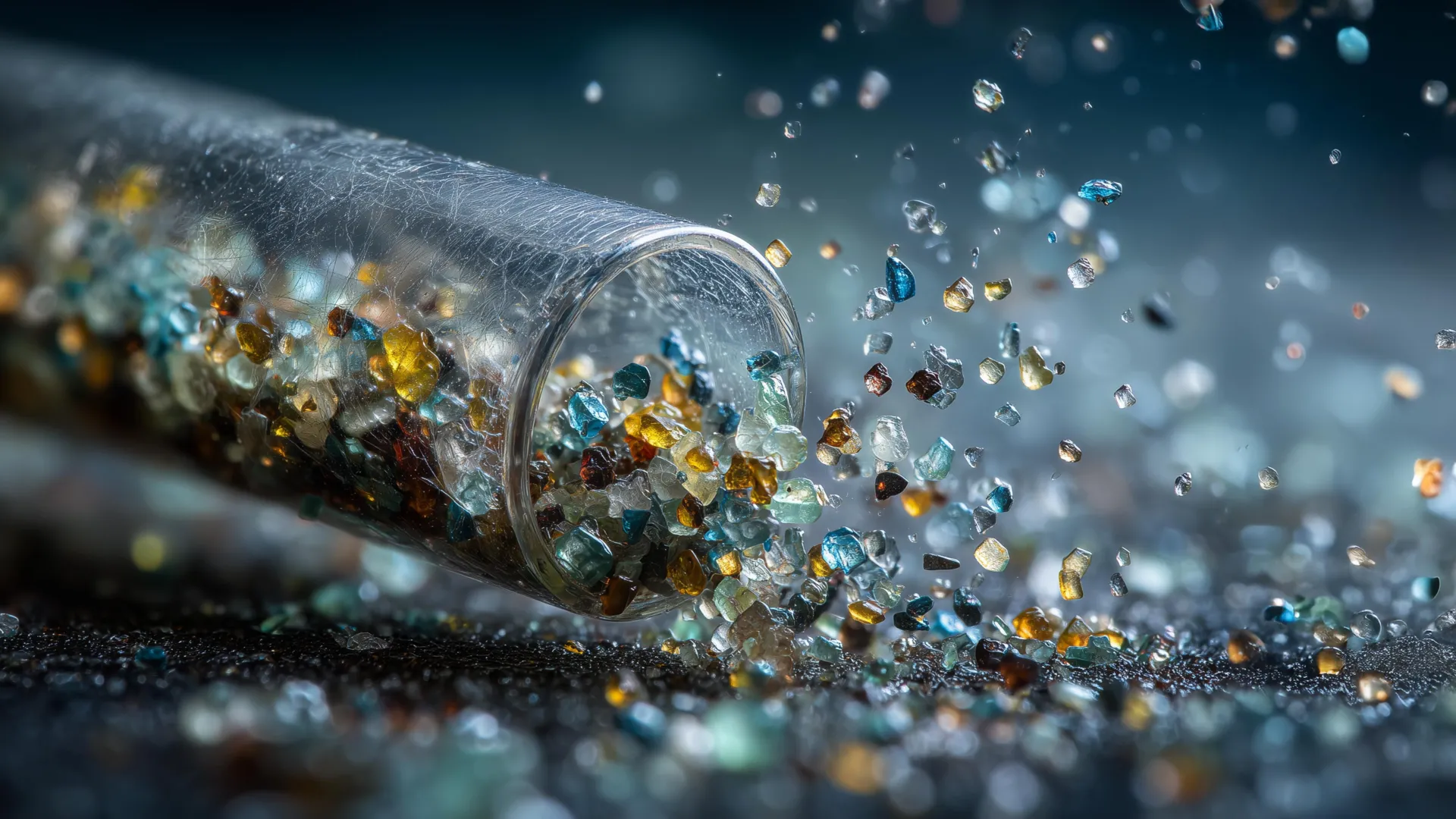
Yuwei Gu was walking through Bear Mountain State Park in New York when an unexpected sight caught his attention. Plastic bottles were scattered along the trail, with more drifting across a nearby lake. Seeing plastic waste in such a natural setting stopped the Rutgers chemist in his tracks and set his mind racing.
Gu began thinking about polymers, long chainlike molecules that make up both natural materials and modern plastics. DNA and RNA are polymers, and so are proteins and cellulose. The difference is that nature's polymers eventually break down, while synthetic plastics often remain in the environment for decades or longer.
"Biology uses polymers everywhere, such as proteins, DNA, RNA and cellulose, yet nature never faces the kind of long-term accumulation problems we see with synthetic plastics," said Gu, an assistant professor in the Department of Chemistry and Chemical Biology in the Rutgers School of Arts and Sciences.
Standing there in the woods, the reason suddenly became clear to him.
"The difference has to lie in chemistry," he said.
Copying Nature's Built-In Exit Strategy
Gu realized that if natural polymers can perform their function and then disappear, human-made plastics might be able to do the same. He already knew that biological polymers contain small built-in chemical features that help their bonds break apart at the right moment.
"I thought, what if we copy that structural trick?" he said. "Could we make human-made plastics behave the same way?"
That question led to a breakthrough. In a study published in Nature Chemistry, Gu and his Rutgers colleagues showed that using this nature-inspired approach allows plastics to break down under everyday conditions, without requiring high heat or harsh chemicals.
"We wanted to tackle one of the biggest challenges of modern plastics," Gu said. "Our goal was to find a new chemical strategy that would allow plastics to degrade naturally under everyday conditions without the need for special treatments."
How Polymers and Chemical Bonds Work
Polymers are made of many repeating units linked together, much like beads on a string. Plastics fall into this category, as do DNA, RNA and proteins. DNA and RNA consist of chains of smaller units known as nucleotides, while proteins are built from amino acids.
What holds these units together are chemical bonds, which act like glue at the molecular level. In polymers, these bonds connect one building block to the next. Strong bonds give plastics their durability, but they also make them difficult to break down once discarded. Gu's research focused on designing bonds that stay strong during use but become easier to break later when degradation is desired.
Programmable Plastics With Built-In Weak Points
This research does more than make plastics degradable. It makes their breakdown programmable.
The key discovery involved carefully arranging parts of the plastic's chemical structure so they sit in just the right positions to begin breaking apart when triggered. Gu compares the idea to folding a piece of paper so it tears easily along a crease. By effectively "pre-folding" the structure at a molecular level, the plastic can fall apart thousands of times faster than usual.
Despite this built-in vulnerability, the plastic's overall chemical composition remains unchanged. That means it stays strong and useful until the moment degradation is activated.
"Most importantly, we found that the exact spatial arrangement of these neighboring groups dramatically changes how fast the polymer degrades," Gu said. "By controlling their orientation and positioning, we can engineer the same plastic to break down over days, months or even years."
Matching Plastic Lifetimes to Real-World Uses
This level of control allows plastics to be designed with lifespans that fit their purpose. Food packaging might only need to last a single day, while automotive components must hold up for many years. The researchers showed that degradation can be built in from the start or activated later using ultraviolet light or metal ions.
The potential applications extend well beyond reducing plastic pollution. Gu said the same chemistry could lead to timed drug delivery capsules or coatings that erase themselves after a set period.
"This research not only opens the door to more environmentally responsible plastics but also broadens the toolbox for designing smart, responsive polymer-based materials across many fields," he said.
Safety Testing and the Road Ahead
For Gu, the long-term vision is simple. Plastics should do their job and then disappear.
"Our strategy provides a practical, chemistry-based way to redesign these materials so they can still perform well during use but then break down naturally afterward," he said.
Early laboratory tests indicate that the liquid produced when the plastics break down is not toxic, though Gu emphasized that further testing is needed to confirm long-term safety.
Looking back, Gu said he was surprised that an idea sparked during a quiet hike actually worked.
"It was a simple thought, to copy nature's structure to accomplish the same goal," he said. "But seeing it succeed was incredible."
Expanding the Research
Gu and his team are now pushing the research further. They are closely examining whether the small fragments left behind after plastic breakdown pose any risk to living organisms or ecosystems, ensuring safety across the entire life cycle of the material.
They are also exploring how their chemical approach could be applied to conventional plastics and integrated into existing manufacturing processes. At the same time, they are testing whether the method can be used to create capsules that release medication at carefully controlled times.
While technical challenges remain, Gu believes that continued development, along with collaboration with plastic manufacturers focused on sustainability, could bring this chemistry into everyday products.
Other Rutgers scientists who contributed to the study included: Shaozhen Yin, a doctoral student in the Gu lab who is first author on the paper; Lu Wang, an associate professor in the Department of Chemistry and Chemical Biology; Rui Zhang, a doctoral student in Wang's lab; N. Sanjeeva Murthy, a research associate professor at the Laboratory for Biomaterials Research; and Ruihao Zhou, a former visiting undergraduate student.
Story Source:
Materials provided by Rutgers University. Note: Content may be edited for style and length.
Journal Reference:
- Shaozheng Yin, Rui Zhang, Ruihao Zhou, N. Sanjeeva Murthy, Lu Wang, Yuwei Gu. Conformational preorganization of neighbouring groups modulates and expedites polymer self-deconstruction. Nature Chemistry, 2025; DOI: 10.1038/s41557-025-02007-3
Cite This Page: