
SETI watched a pulsar flicker for months and found space keeps shifting
By decoding the slow twinkle of a pulsar’s radio light, scientists are turning cosmic interference into a powerful tool for precision astronomy and the search for extraterrestrial signals.
- Date:
- January 6, 2026
- Source:
- SETI Institute
- Summary:
- A distant pulsar’s radio signal flickers as it passes through space, much like stars twinkle in Earth’s atmosphere. By monitoring this effect for 10 months, researchers watched the pattern slowly evolve as gas, Earth, and the pulsar all moved. Those changes create minuscule delays in the signal, but measuring them helps keep pulsars incredibly precise. The findings also aid SETI scientists in spotting signals that truly come from beyond Earth.
- Share:
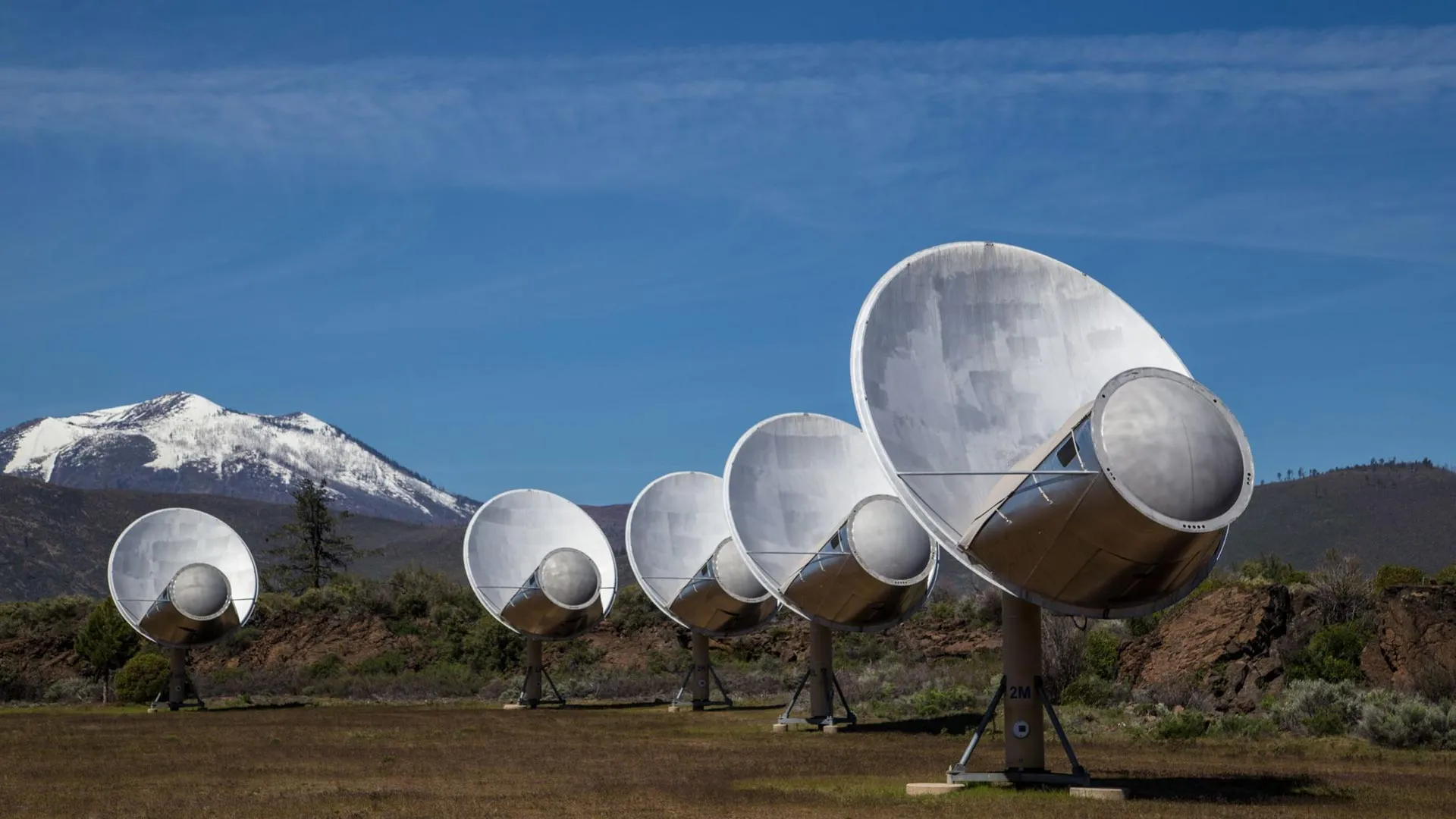
For nearly a year, a research team led by the SETI Institute closely followed the pulsar PSR J0332+5434 (also called B0329+54). Their goal was to understand how the pulsar's radio signal appears to "twinkle" as it travels through clouds of gas on its way to Earth. Using the Allen Telescope Array (ATA), the scientists collected data across radio frequencies from 900 to 1956 MHz. Over time, they detected slow but pronounced changes in this twinkling behavior, known as scintillation.
Pulsars are the dense, rapidly spinning leftovers of massive stars that exploded long ago. As they rotate, they emit radio flashes at extremely steady intervals. Because of this remarkable regularity, astronomers can use powerful radio telescopes to measure the exact arrival times of these pulses and search for subtle patterns linked to phenomena such as low-frequency gravitational waves.
As the radio waves cross interstellar space, however, they do not travel unimpeded. Gas between stars scatters the signals, spreading them out and causing slight delays before they reach Earth. These shifts can be incredibly small, sometimes only tens of nanoseconds (a nanosecond is one-billionth of a second). Correcting for these tiny, ever-changing delays is essential for keeping pulsar timing as accurate as possible.
How Space Makes Pulsars "Twinkle"
Much like stars shimmer when seen through Earth's atmosphere, pulsar radio signals also flicker as they move through space. Clouds of electrons between the pulsar and Earth create patterns of brighter and dimmer signal strength across different radio frequencies. These patterns do not stay the same. They change as the pulsar, the intervening gas, and Earth all move relative to one another.
This shifting scintillation directly affects when each pulse arrives. Stronger twinkling corresponds to larger delays. By repeatedly observing a single bright, nearby pulsar, the researchers were able to watch these patterns evolve and translate them into precise timing corrections. Those corrections can then be applied to experiments that demand the highest possible accuracy.
Benefits for Astronomy and the Search for Technosignatures
"Pulsars are wonderful tools that can teach us much about the universe and our own stellar neighborhood," said project leader Grayce Brown, a SETI Institute intern. "Results like these help not just pulsar science, but other fields of astronomy as well, including SETI."
All radio signals that pass through interstellar space experience scintillation. For SETI researchers, understanding this effect is especially useful. Strong scintillation can help distinguish natural cosmic signals from radio interference created by human technology.
Long-Term Observations Reveal Changing Patterns
The ATA study relied on a broad range of radio frequencies and many short observing sessions). Nearly every day for about 300 days, the team measured the scintillation bandwidth (the size of the bright spots in the twinkling pattern). They found that the strength of scintillation varied noticeably over periods lasting from days to several months. The data also pointed to an overall cycle lasting roughly 200 days.
In addition, the researchers introduced a new, more reliable way to estimate how scintillation changes with radio frequency. This approach took full advantage of the ATA's ability to observe across a wide bandwidth.
Why the Allen Telescope Array Matters
"The Allen Telescope Array is perfectly designed for studying pulsar scintillation due to its wide bandwidths and ability to commit to projects that need to run for long stretches of time," said Dr. Sofia Sheikh, co-author and Technosignature Research Scientist at the SETI Institute.
By following a pulsar's signal as it travels through space, these observations offer insight into the pulsar itself, Earth's motion, and the material in between. That knowledge helps scientists better separate ordinary radio interference from signals that could have an artificial origin.
Story Source:
Materials provided by SETI Institute. Note: Content may be edited for style and length.
Journal Reference:
- Grayce C. Brown, Sofia Z. Sheikh, Luigi F. Cruz, Wael Farah, Vishal Gajjar, Christian Gilbertson, Brandon Grimaldo, Michael T. Lam, Sofia L. Marquez, Maura McLaughlin, Alexander W. Pollak, Andrew Siemion, Gurmehar Singh. Long-term Monitoring of Scintillation in the Pulsar J0332 5434. The Astrophysical Journal, 2025; 995 (1): 120 DOI: 10.3847/1538-4357/ae0fff
Cite This Page: