
Something was pumping enormous energy into a young galaxy cluster
A young galaxy cluster has been found blazing with extreme heat far earlier than expected in cosmic history.
- Date:
- January 7, 2026
- Source:
- University of British Columbia
- Summary:
- Scientists have detected a surprisingly hot galaxy cluster dating back to the universe’s infancy. The cluster formed far earlier and burned far hotter than current models predict. Researchers believe supermassive black holes may have rapidly heated the surrounding gas. The finding could force a major rethink of how galaxy clusters grow.
- Share:
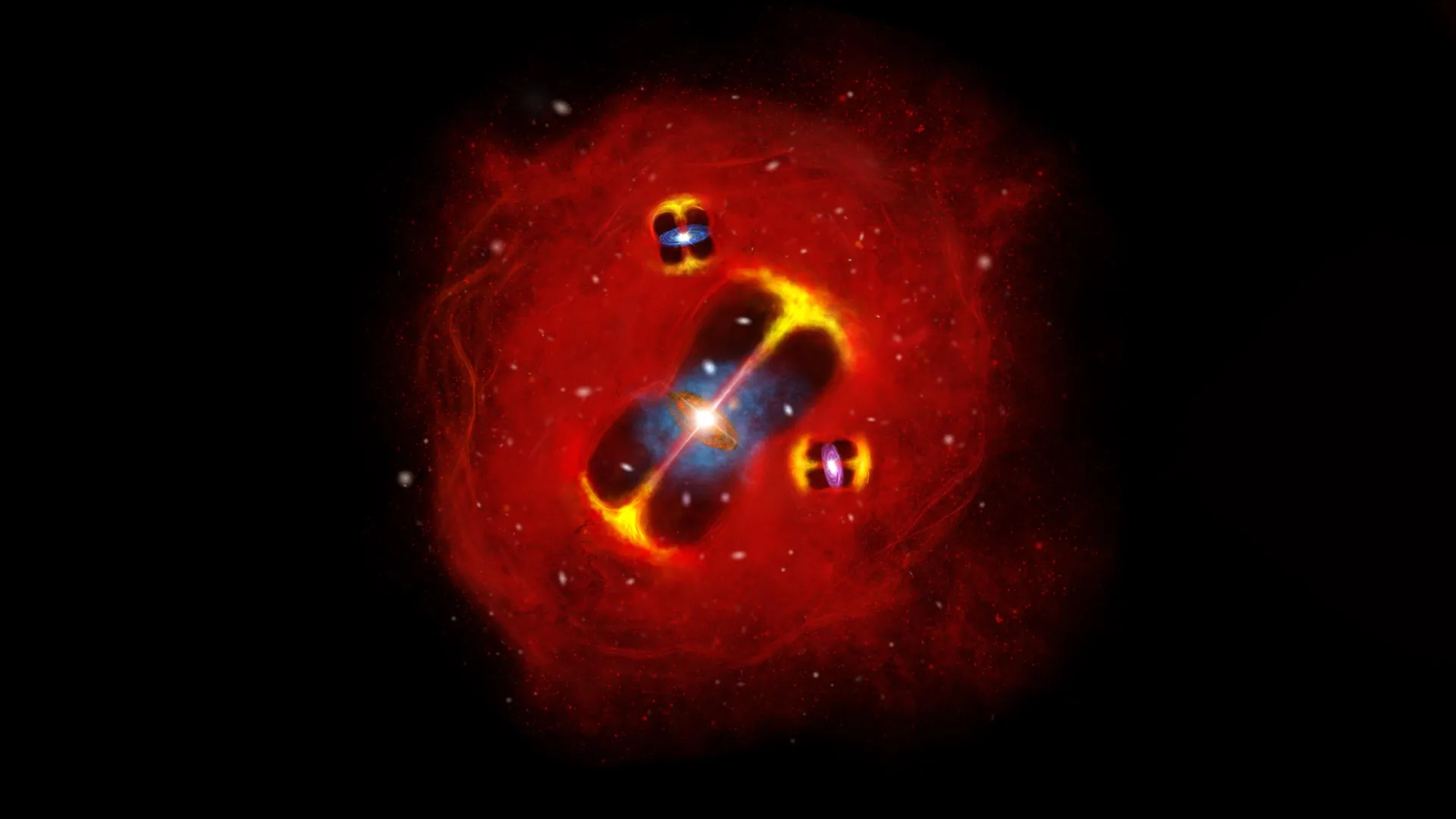
A team of astronomers from several countries, led by researchers in Canada, has identified a galaxy cluster that appears far earlier and far hotter than current science predicts. The cluster is filled with intensely hot gas and existed just 1.4 billion years after the Big Bang. According to established theories, galaxy clusters at this stage should not yet reach such extreme temperatures.
The findings, published on January 5 in Nature, raise serious challenges for widely accepted models of galaxy cluster formation. Those models suggest that clusters gradually heat up over time and only reach these temperatures much later, after becoming larger and more stable.
"We didn't expect to see such a hot cluster atmosphere so early in cosmic history," said lead author Dazhi Zhou, a PhD candidate in the UBC department of physics and astronomy. "In fact, at first I was skeptical about the signal as it was too strong to be real. But after months of verification, we've confirmed this gas is at least five times hotter than predicted, and even hotter and more energetic than what we find in many present-day clusters."
Dr. Scott Chapman, a co-author and professor at Dalhousie University who carried out the research while at the National Research Council of Canada (NRC), said the results point to powerful activity in the young universe. "This tells us that something in the early universe, likely three recently discovered supermassive black holes in the cluster, were already pumping huge amounts of energy into the surroundings and shaping the young cluster, much earlier and more strongly than we thought."
Investigating a Baby Galaxy Cluster
To make the discovery, the researchers looked back roughly 12 billion years to study a young galaxy cluster known as SPT2349-56. Observations were carried out using the Atacama Large Millimeter/submillimeter Array (ALMA), a network of radio telescopes that includes instruments designed, built, and tested by the NRC.
Despite its age, this cluster is already remarkably large. Its central region spans about 500,000 light years, similar in size to the halo surrounding the Milky Way. The cluster contains more than 30 active galaxies packed closely together and is producing new stars at a rate more than 5,000 times higher than that of our own galaxy.
To measure the heat within the cluster, the team relied on a technique known as the Sunyaev-Zeldovich effect. This approach allows scientists to estimate the thermal energy of the intracluster medium:the gas existing between the galaxies of a given cluster.
"Understanding galaxy clusters is the key to understanding the biggest galaxies in the universe," said Dr. Chapman, who is also a UBC affiliate professor. "These massive galaxies mostly reside in clusters, and their evolution is heavily shaped by the very strong environment of the clusters as they form, including the intracluster medium."
How Supermassive Black Holes May Be Heating Clusters
Current theories suggest that the gas making up the intracluster medium slowly gathers and heats up as gravity pulls an unstable galaxy cluster inward over time. As the cluster matures, this process is expected to produce a stable and hot environment. The new observations suggest a much more violent beginning, where heating happens earlier and more rapidly than predicted.
Zhou and his colleagues now plan to study how the different forces inside the cluster work together. "We want to figure out how the intense star formation, the active black holes and this overheated atmosphere interact, and what it tells us about how present galaxy clusters were built," Zhou said. "How can all of this be happening at once in such a young, compact system?"
Story Source:
Materials provided by University of British Columbia. Note: Content may be edited for style and length.
Journal Reference:
- Dazhi Zhou, Scott C. Chapman, Manuel Aravena, Pablo Araya-Araya, Melanie Archipley, Jared Cathey, Roger P. Deane, Luca Di Mascolo, Raphael Gobat, Thomas R. Greve, Ryley Hill, Seonwoo Kim, Kedar A. Phadke, Vismaya R. Pillai, Ana C. Posses, Christian L. Reichardt, Manuel Solimano, Justin S. Spilker, Nikolaus Sulzenauer, Veronica J. Dike, Joaquin D. Vieira, David Vizgan, George C. P. Wang, Axel Weiß. Sunyaev–Zeldovich detection of hot intracluster gas at redshift 4.3. Nature, 2026; DOI: 10.1038/s41586-025-09901-3
Cite This Page: