
A faint signal from the Universe’s dark ages could reveal dark matter
- Date:
- January 20, 2026
- Source:
- University of Tsukuba
- Summary:
- After the Big Bang, the Universe entered a long, dark period before the first stars formed. During this era, hydrogen emitted a faint radio signal that still echoes today. New simulations show this signal could be slightly altered by dark matter, leaving behind a measurable fingerprint. Future radio telescopes on the Moon may be able to detect it and shed light on one of astronomy’s greatest mysteries.
- Share:
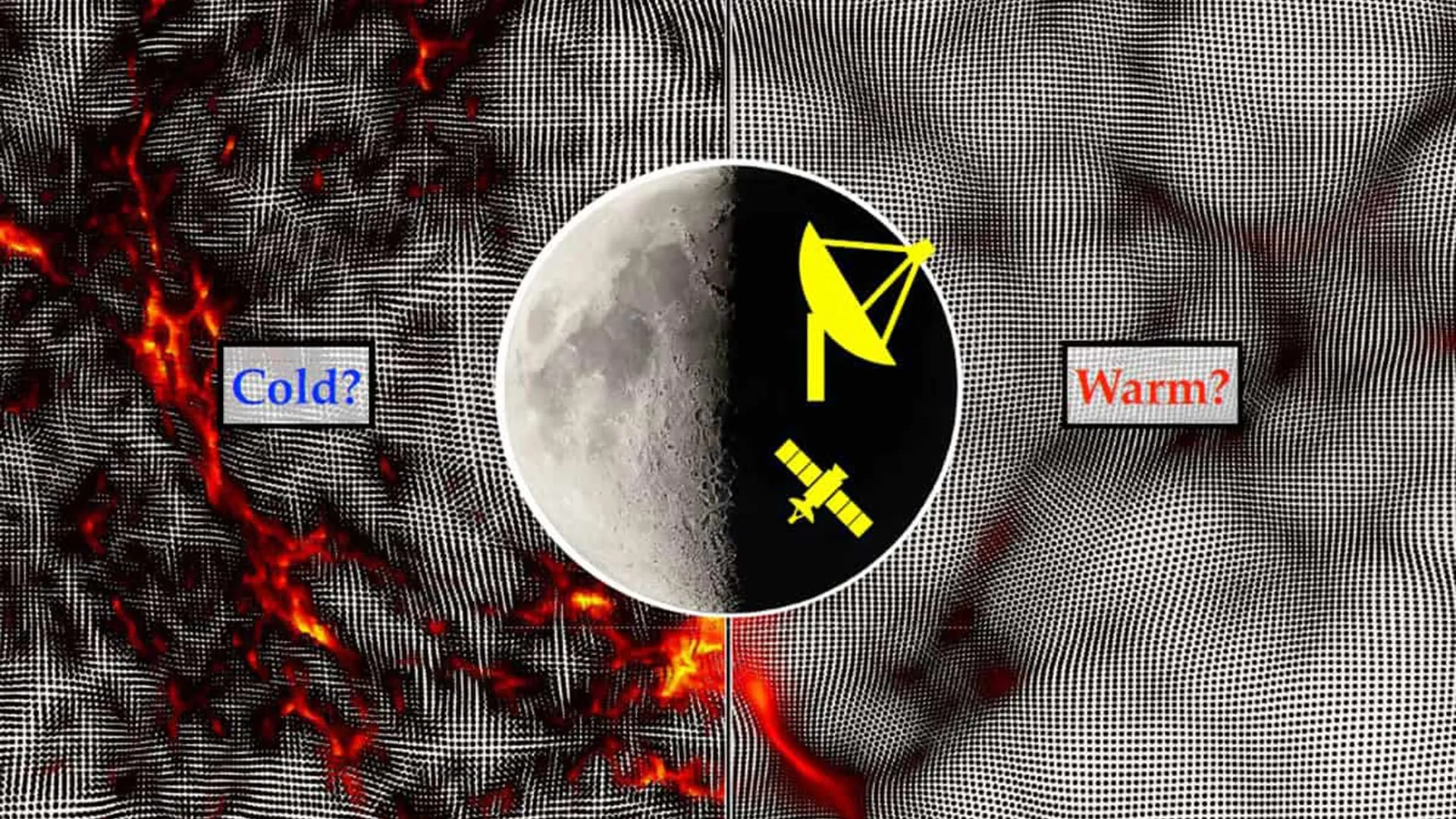
The Universe began about 13.8 billion years ago with the Big Bang, a moment of extremely rapid expansion. Roughly 400,000 years later, after the cosmos cooled enough for atoms to form, it entered a long and quiet phase known as the "Dark Ages." This period lasted for around 0.1 billion years, ending only when the first stars and galaxies finally ignited and began producing light.
Although the Universe was dark during this time, it was not completely silent. Scientists believe hydrogen atoms emitted very faint radio waves with a wavelength of 21 cm. These signals are thought to preserve valuable information about the earliest stages of cosmic history.
Simulating the Early Universe and Dark Matter
Using advanced numerical simulations, researchers from the University of Tsukuba and The University of Tokyo explored how this 21-cm signal might behave under different theories of dark matter. Dark matter is an unseen form of matter that makes up about 80% of all matter in the Universe.
By recreating the structure and movement of gas and dark matter in the young Universe on powerful supercomputers, the research team was able to predict the strength of the radio emission during the Dark Ages with unprecedented accuracy.
What the Signal Could Reveal About Dark Matter
The simulations suggest that hydrogen gas during the Dark Ages produced a distinct signal with a brightness temperature of roughly 1 millikelvin (one-thousandth of a degree) when averaged across the sky. Importantly, dark matter is expected to cause variations in this signal of a similar size.
Measuring the overall radio signal across a wide frequency range of about 45 MHz could therefore provide critical information about dark matter, including the mass and speed of its particles.
Why Scientists Are Looking to the Moon
To detect such an extremely weak signal, astronomers need a location free from interference caused by Earth's atmosphere and human technology. Several upcoming lunar missions, including Japan's Tsukuyomi Project, aim to place radio telescopes on the Moon for this reason.
If these lunar instruments succeed in capturing the ancient radio signal, they could offer a powerful new way to investigate the nature of dark matter and deepen our understanding of how the Universe began.
Funding and Acknowledgments
H.P. was supported in part by grant NSF PHY-2309135 to the Kavli Institute for Theoretical Physics (KITP). N.Y. acknowledges financial support from JSPS International Leading Research 23K20035. R.B. and N.Y. acknowledge JSPS Invitational Fellowship S24099.
Story Source:
Materials provided by University of Tsukuba. Note: Content may be edited for style and length.
Journal Reference:
- Hyunbae Park, Rennan Barkana, Naoki Yoshida, Sudipta Sikder, Rajesh Mondal, Anastasia Fialkov. The signature of subgalactic dark matter clumping in the global 21-cm signal of hydrogen. Nature Astronomy, 2025; 9 (11): 1723 DOI: 10.1038/s41550-025-02637-0
Cite This Page: