
This small soil upgrade cut locust damage and doubled yields
- Date:
- January 24, 2026
- Source:
- Arizona State University
- Summary:
- Locust swarms can wipe out crops across entire regions, threatening food supplies and livelihoods. Now, scientists working with farmers in Senegal have shown that improving soil health can dramatically reduce locust damage. By enriching soil with nitrogen, crops become less appealing to the insects, leading to fewer locusts, less plant damage, and harvests that doubled in size.
- Share:
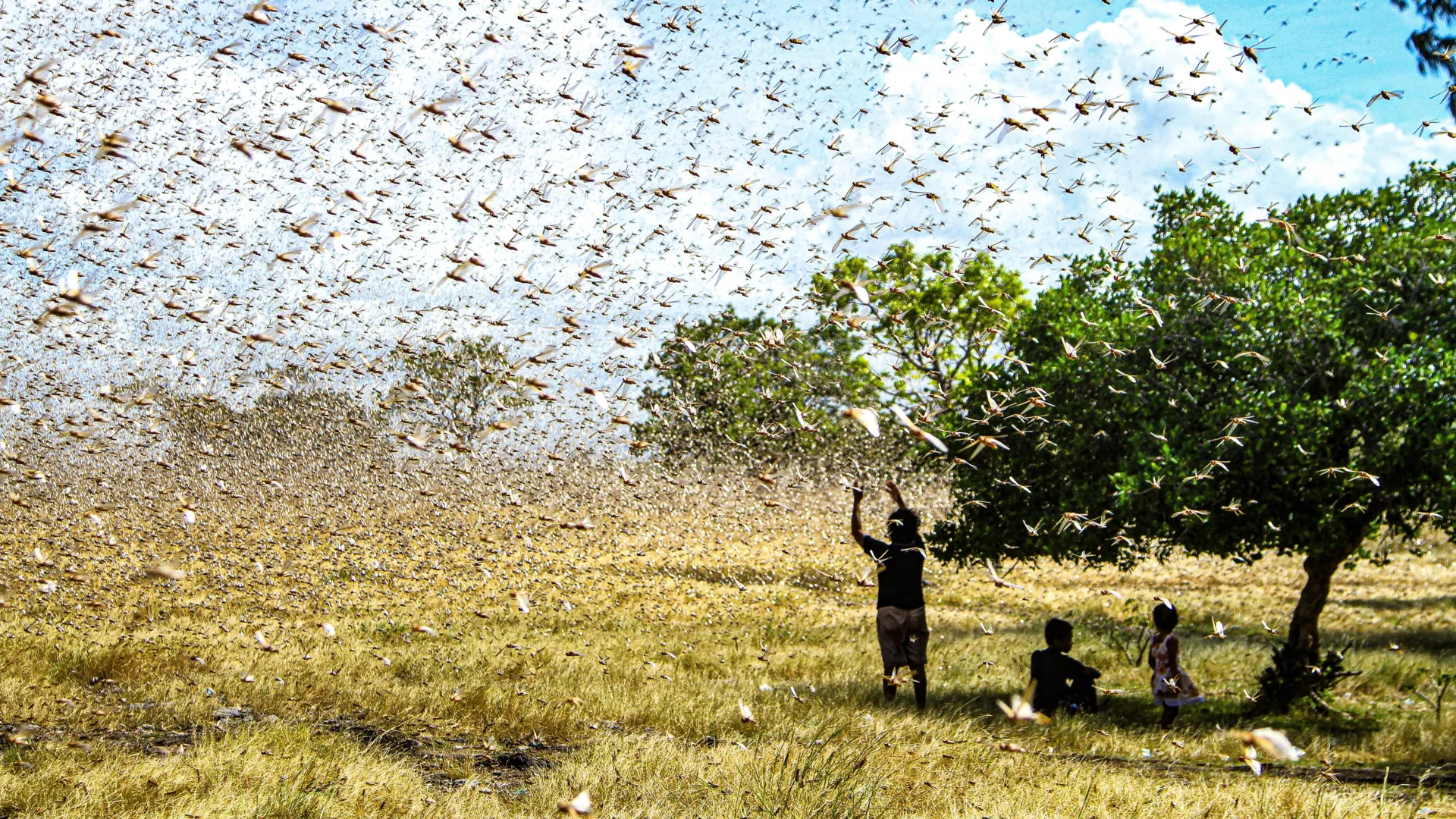
"They're very destructive when there's a lot of them, but one-on-one, what's not to love?" says Arianne Cease. She is referring to locusts.
Cease leads Arizona State University's Global Locust Initiative, where she studies how locusts behave and how their destructive swarms can be controlled. While her research focuses on reducing damage to crops and communities, she also brings a deep respect for the insects themselves.
Locust Swarms Remain a Global Threat
For many people, locust swarms evoke images of ancient plagues, but the danger is very real today. Around the world, swarms can devastate crops across vast regions, wipe out livelihoods, and in some areas disrupt education and long term economic prospects for children. A single swarm can span hundreds of square miles -- roughly the size of a major city such as New York City or Phoenix.
That is why Cease and her international research team paid close attention when they identified a straightforward, soil-based way to reduce locust feeding. The scientists realized early on that the approach could have life changing consequences. To their knowledge, this is the first study to test the method in real farming environments and show that it works outside the lab.
Testing the Idea With Farmers in Senegal
The researchers partnered with farmers in Senegal who regularly face outbreaks of the Senegalese grasshopper. Unlike the desert locust, this species does not form massive swarms, but its frequent appearances and smaller groupings can cause even greater harm to local farmers. These communities had previously collaborated with Cease and pushed for a larger field study.
Each farmer planted two plots of millet -- one treated with nitrogen fertilizer and one left untreated.
The contrast was clear. Fertilized plots had fewer locusts, reduced crop damage, and harvests that were twice as large as those from untreated fields.
"This breakthrough represents an important step forward in the sustainable management of migratory pests, offering a community-based tool that expands the available treatment options," says Cease, who is also an associate professor in the ASU School of Sustainability and School of Life Sciences.
The study published in the journal Scientific Reports. Associate Professor Mamour Touré of Université Gaston Berger in Saint-Louis, Senegal, served as lead author, while Cease was the principal investigator for the USAID-supported project.
"The results are of major importance to the scientific community and also to Senegalese farmers," Touré says. "The study gave them a better understanding of grasshoppers and locusts, as well as a practical way to control them at the local level."
Why Soil Quality Shapes Locust Behavior
The Global Locust Initiative is part of the Julie Ann Wrigley Global Futures Laboratory and focuses on the many systems that influence locust outbreaks. Environmental conditions, insect biology and behavior, economic pressures, public policy, and land management all contribute to cycles of destruction -- and also create opportunities to interrupt them.
After more than 15 years of research, Cease uncovered a consistent pattern. Crops grown in nutrient-poor soil tend to encourage locust outbreaks because those plants contain high levels of carbohydrates and very little protein.
"This carbohydrate bias, or the 'donut diet,' is optimal for populations of locusts and swarming grasshoppers," Cease says. Much like endurance athletes who rely on carbohydrates for energy, locusts depend on carb-heavy plants to fuel their long-distance movement.
Plants grown in nitrogen-rich soil tell a different story. They contain more protein and fewer carbohydrates, making them difficult food for locusts. Their bodies struggle to process the excess protein and fail to get enough energy to thrive.
Protein-Packed Plants Prevent Pests
These findings led to a key question. Could shifting the balance of protein and carbohydrates in crops prevent locust damage? Earlier lab experiments and field observations hinted that it might, but the idea had never been tested on working farms. For Cease, that gap made the next step obvious.
Two Senegalese villages that had collaborated with her before volunteered to take part. Their farms regularly suffer severe losses from Senegalese grasshopper swarms.
In the experiment, 100 farmers each grew two millet plots each -- one treated with nitrogen fertilizer and one left untreated for comparison.
Researchers were unsure whether locusts might still enter treated plots from nearby untreated fields or whether higher protein plants might attract other pests. To find out, the team counted locusts and measured crop damage three times during the growing season and recorded yields at harvest.
The results were decisive. Treated plots had fewer locusts, less leaf damage, and double the millet yield at harvest. The team also found no evidence that adding nitrogen worsened other pest problems.
From Fertilizer to Compost Solutions
Although nitrogen fertilizer was supplied for the study, it is not a realistic long term option for many farming communities. Sustainable control requires affordable methods that also protect soil health.
"Ongoing work is focused exclusively on compost, and we seem to be getting the same results," Cease says.
USAID funding for the project ended in early 2025, but farmers in Senegal have continued the composting approach on their own, encouraged by the results.
"Farmers unanimously stated that they no longer burn crop residues after land clearing, but instead practice composting to fertilize their fields, thereby helping to reduce grasshopper infestations. This technique was fully mastered thanks to the project," Touré says.
The research team is now seeking additional funding to expand the work into other regions heavily affected by locusts.
Why Locust Research Matters to the United States
The U.S. currently has no native locust species. So why study them at all? Cease says that could change. She is closely monitoring the Central American locust, whose range reaches within about 200 miles of the U.S. border.
"We can say with pretty high certainty that Texas will be very suitable for locusts in about 10 to 15 years," Cease says. "Whether or not they will create a problem is yet to be determined, but it's something that we should definitely be aware of."
Even without locusts, grasshoppers already pose major challenges across the country. There are 12 key species known collectively as the Dirty Dozen.
According to the U.S. Department of Agriculture, these 12 rangeland grasshoppers (plus one cricket) are among the most serious pest threats in the western United States. When they swarm, they can strip grazing land and outcompete livestock for food, creating serious problems for ranchers.
While chemical pesticides remain the primary control tool, the Global Locust Initiative is working to identify alternatives that are safer for people and the environment.
What scientists learn from locust outbreaks abroad may prove critical at home, helping the U.S. manage migratory pests more effectively and prepare for the possibility that locusts one day cross the border.
Story Source:
Materials provided by Arizona State University. Note: Content may be edited for style and length.
Journal Reference:
- Mamour Touré, Amadou Fall, Alana Burnham, Alioune Beye, Sidikairou Badiane, Douglas Lawton, Arianne J. Cease. Soil amendments suppress migratory pests and enhance yields. Scientific Reports, 2026; 16 (1) DOI: 10.1038/s41598-025-27884-z
Cite This Page: