
Scientists may have found the holy grail of quantum computing
A rare metal alloy may be the long-sought key to ultra-fast quantum computers that waste virtually no energy.
- Date:
- February 21, 2026
- Source:
- Norwegian University of Science and Technology
- Summary:
- Scientists may have spotted a long-sought triplet superconductor — a material that can transmit both electricity and electron spin with zero resistance. That ability could dramatically stabilize quantum computers while slashing their energy use. Early experiments suggest the alloy NbRe behaves unlike any conventional superconductor. If verified, it could become a cornerstone of next-generation quantum and spintronic technology.
- Share:
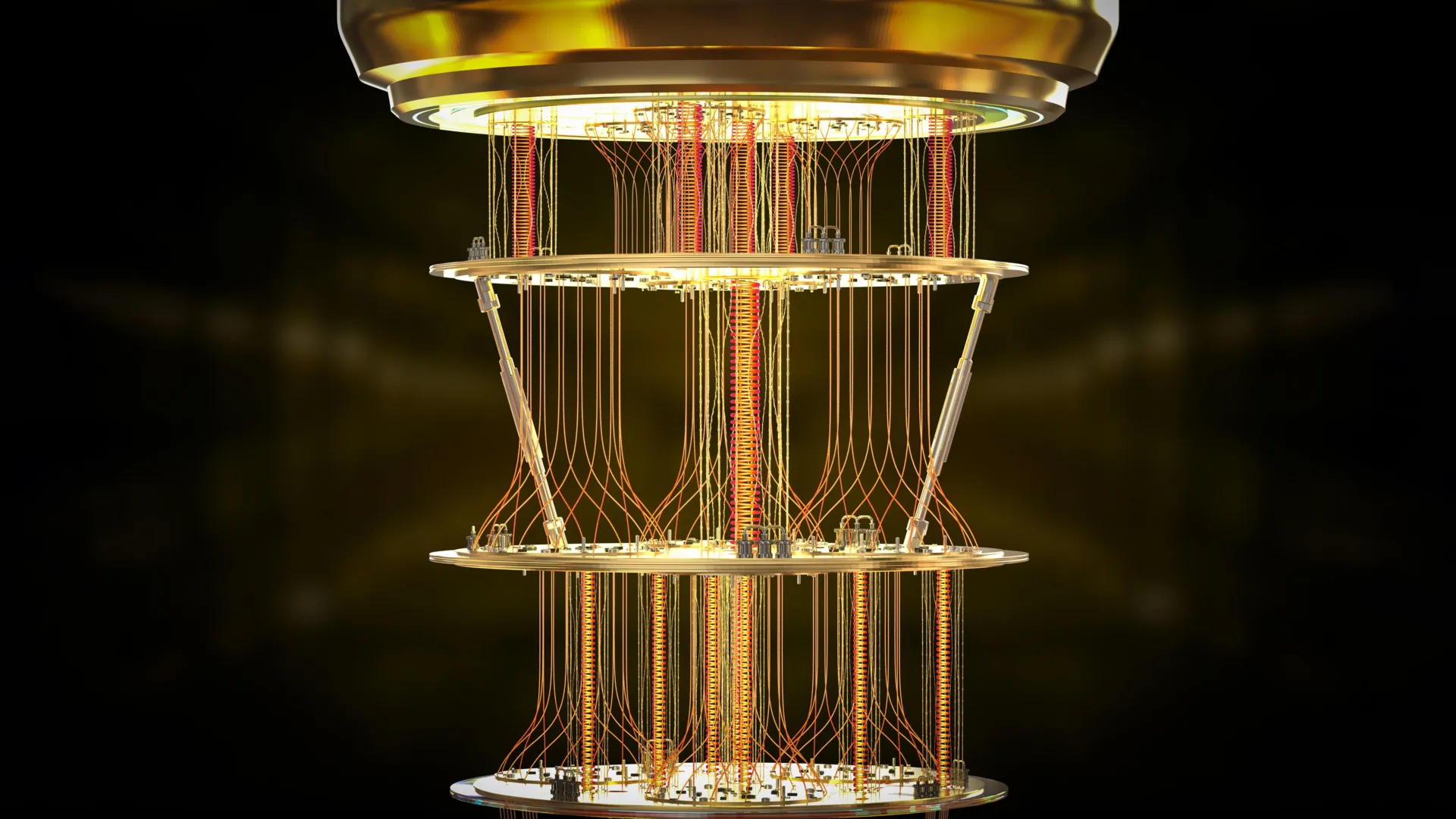
Scientists believe so called triplet superconductors could open the door to the most energy efficient technologies ever developed.
"A triplet superconductor is high on the wish list of many physicists working in the field of solid state physics," said Professor Jacob Linder.
Linder is a physicist at the Norwegian University of Science and Technology's (NTNU' Department of Physics, where he works at QuSpin -- a research centre that brings together some of the university's leading researchers.
"Materials that are triplet superconductors are a kind of 'holy grail' in quantum technology, and more specifically quantum computing," explained Linder.
Researchers around the world are eager to confirm the existence of such materials. Now Linder and his team believe they may be getting close.
"We think we may have observed a triplet superconductor," said Professor Linder.
If verified, the finding would represent a major step forward for quantum science.
Stabilizing Quantum Technology With Spin
Linder's research focuses on quantum materials and their potential use in spintronics and advanced quantum devices. Spintronics relies on spin, a fundamental property of electrons, to carry and process information in ways that differ from today's conventional electronics.
Spin can also play an important role in quantum technology, especially when paired with superconductors. However, one of the biggest obstacles has been instability.
"One of the major challenges in quantum technology today is finding a way to perform computer operations with sufficient accuracy," explained Linder.
Triplet superconductors could help solve that problem.
Working with experimental collaborators in Italy, Linder co authored a study published in Physical Review Letters. The paper was selected as one of the journal's editor's recommendations.
"Triplet superconductors make a number of unusual physical phenomena possible. These phenomena have important applications in quantum technology and spintronics," said Linder.
Conventional vs Triplet Superconductors
Traditional superconductors allow electricity to flow without measurable resistance. In practical terms, this means electrical current can move without losing energy as heat. While extremely useful, conventional superconductors have limitations.
Conventional superconductors are known as 'singlet superconductors'. In simple terms, this means the superconducting particles do not carry spin.
Triplet superconductors are different because their superconducting particles do carry spin.
So why does that matter?
"The fact that triplet superconductors have spin has an important consequence. We can now transport not only electrical currents but also spin currents with absolutely zero resistance," explained Linder.
That ability could make it possible to transmit information using spin without any energy loss. In turn, extremely fast computers could operate using almost no electricity at all.
NbRe Alloy Shows Promising Signs
"In our published article, we demonstrate that the material NbRe exhibits properties consistent with triplet superconductivity," said Linder.
NbRe is a niobium-rhenium alloy, and both elements are rare metals.
"It is still too early to conclude once and for all whether the material is a triplet superconductor. Among other things, the finding must be verified by other experimental groups. It is also necessary to carry out further triplet superconductivity tests," explained Linder.
Even so, the results are encouraging.
"Our experimental research demonstrates that the material behaves completely differently from what we would expect for a conventional singlet superconductor," added Linder.
Superconductivity at 7 Kelvin
"Another advantage of this material is that it superconducts at a relatively high temperature," said Linder, though what counts as high temperature in this field may sound surprising.
Here, 'high temperature' refers to 7 Kelvin (K), just above absolute zero at -273.15 degrees Celsius. In the world of superconductivity, that is comparatively warm. Other potential triplet superconductors require temperatures close to 1K, making 7K far more practical and attainable.
Taken together, the findings from NTNU suggest that the long sought triplet superconductor may finally be within reach.
Story Source:
Materials provided by Norwegian University of Science and Technology. Note: Content may be edited for style and length.
Journal Reference:
- F. Colangelo, M. Modestino, F. Avitabile, A. Galluzzi, Z. Makhdoumi Kakhaki, Abhishek Kumar, J. Linder, M. Polichetti, C. Attanasio, C. Cirillo. Unveiling Intrinsic Triplet Superconductivity in Noncentrosymmetric NbRe through Inverse Spin-Valve Effects. Physical Review Letters, 2025; 135 (22) DOI: 10.1103/q1nb-cvh6
Cite This Page: