
A flash of laser light flips a magnet in major light-control breakthrough
- Date:
- March 3, 2026
- Source:
- University of Basel
- Summary:
- Researchers at the University of Basel and the ETH in Zurich have succeeded in changing the polarity of a special ferromagnet using a laser beam. In the future, this method could be used to create adaptable electronic circuits with light.
- Share:
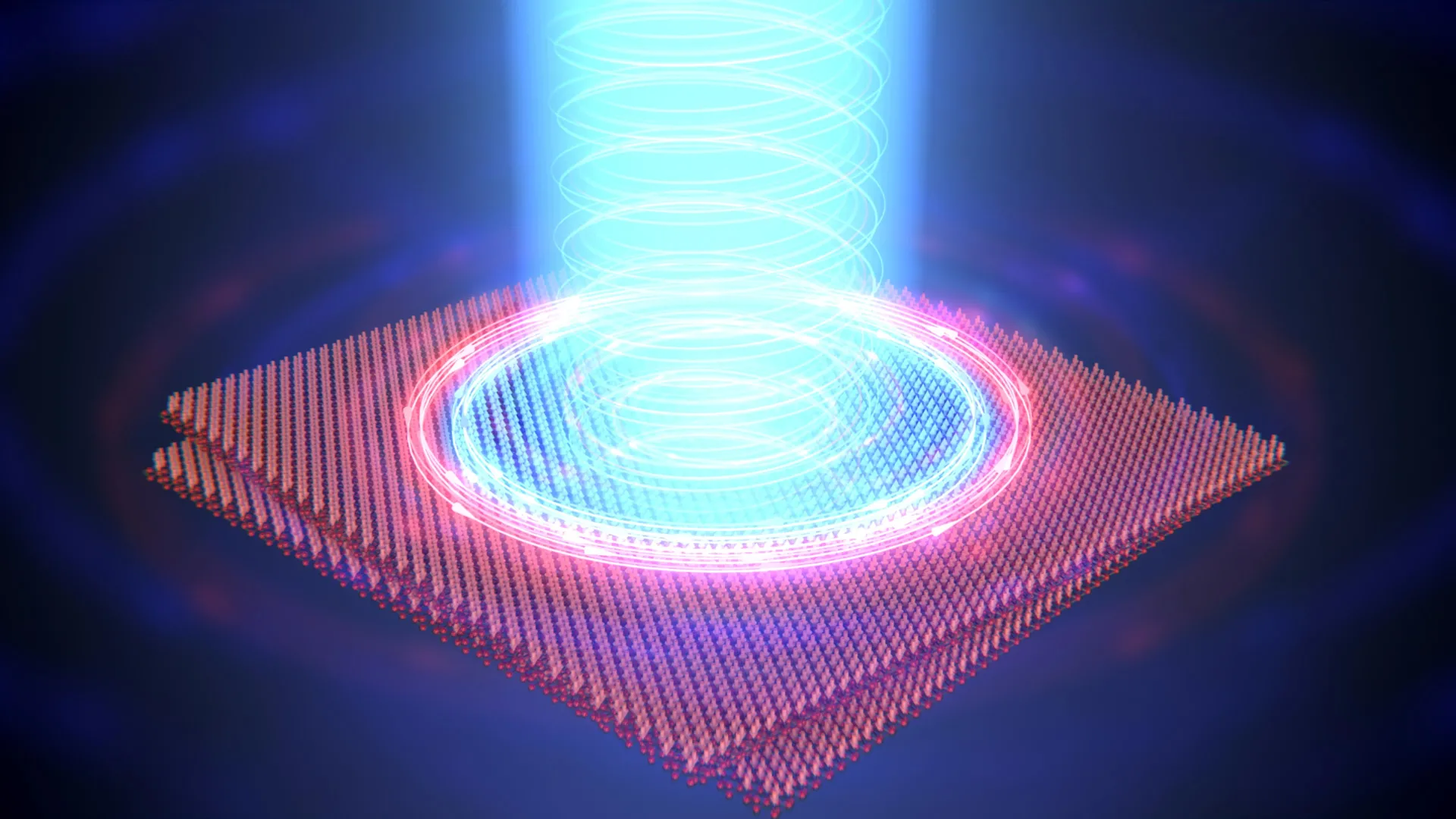
Researchers at the University of Basel and ETH Zurich have demonstrated a way to reverse the polarity of a specialized ferromagnet using a focused laser beam. The advance points toward a future in which light could be used to design and reconfigure electronic circuits directly on a chip.
Ferromagnets function because vast numbers of tiny magnetic moments inside a material move in unison. Each electron has a property called spin that produces a very small magnetic field. When many of these spins align in the same direction, their combined effect creates a strong, stable magnet, like the one in a compass or on a refrigerator door.
This alignment only occurs when interactions between the spins are strong enough to overcome random thermal motion. Below a specific critical temperature, these coordinated interactions dominate, and the material becomes ferromagnetic.
Typically, reversing a magnet's polarity requires heating it above that critical temperature. At higher temperatures, the orderly alignment breaks down, allowing the spins to rearrange. Once the material cools again, the spins settle into a new collective orientation, and the magnet points in a different direction.
Laser Switching Without Heat
The team led by Prof. Dr. Tomasz Smoleński at the University of Basel and Prof. Dr. Ataç Imamoğlu at ETH Zurich achieved this reorientation using only light, without raising the temperature. Their findings were published in the journal Nature.
"What's exciting about our work is that we combine the three big topics in modern condensed matter physics in a single experiment: strong interactions between the electrons, topology and dynamical control," Imamoğlu says.
To accomplish this, the researchers worked with a carefully engineered material made of two atomically thin layers of the organic semiconductor molybdenum ditelluride. The layers are stacked with a slight twist between them, a detail that gives rise to unusual electronic behavior.
Topological States and Twisted Quantum Materials
In this twisted structure, electrons can organize into what are known as topological states. These states can be understood using a simple analogy. A ball has no hole, while a doughnut has one. No matter how much you reshape a ball, you cannot turn it into a doughnut without cutting or tearing it. In the same way, topological states are fundamentally distinct and cannot be smoothly transformed into one another.
In the experiments overseen by Smoleński and Imamoğlu, the researchers were able to tune the electrons between topological states that behave as insulators and those that conduct electricity like metals. In both cases, interactions between electrons caused their spins to align in parallel, producing a ferromagnetic state.
"Our main result is that we can use a laser pulse to change the collective orientation of the spins," says Olivier Huber, a PhD student at ETH who carried out the measurements with Kilian Kuhlbrodt and Tomasz Smoleński. While earlier work had shown that individual electron spins could be manipulated with light, this study demonstrates switching the polarity of an entire ferromagnet at once. "This switching was permanent and, moreover, the topology influences the switching dynamics," says Smoleński.
Dynamical Control of Magnetic States
The laser does more than simply flip the magnet. It can also define new internal boundaries within the microscopic material, creating regions where the topological ferromagnetic state exists. Because this process can be repeated, the researchers can dynamically control both the magnetic and topological properties of the system.
To confirm that the tiny ferromagnet, which measures only a few micrometers across, had truly reversed its polarity, the team shone a second, weaker laser beam onto it. By analyzing the reflected light, they could determine the orientation of the electron spins.
"In the future, we will be able to use our method to optically write arbitrary and adaptable topological circuits on a chip," says Smoleński. Such circuits could include miniature interferometers capable of detecting extremely small electromagnetic fields, opening new possibilities for precision sensing technologies.
Story Source:
Materials provided by University of Basel. Note: Content may be edited for style and length.
Journal Reference:
- O. Huber, K. Kuhlbrodt, E. Anderson, W. Li, K. Watanabe, T. Taniguchi, M. Kroner, X. Xu, A. Imamoğlu, T. Smoleński. Optical control over topological Chern number in moiré materials. Nature, 2026; 649 (8099): 1153 DOI: 10.1038/s41586-025-09851-w
Cite This Page: