
Friction without contact discovered as magnetic forces break a 300-year-old law
- Date:
- March 22, 2026
- Source:
- University of Konstanz
- Summary:
- Researchers have uncovered friction without contact—driven entirely by magnetic interactions. As two magnetic layers slide, their internal forces compete, causing constant rearrangements that dramatically increase resistance at certain distances. This creates a surprising peak in friction instead of a steady rise, breaking a long-standing physics law.
- Share:
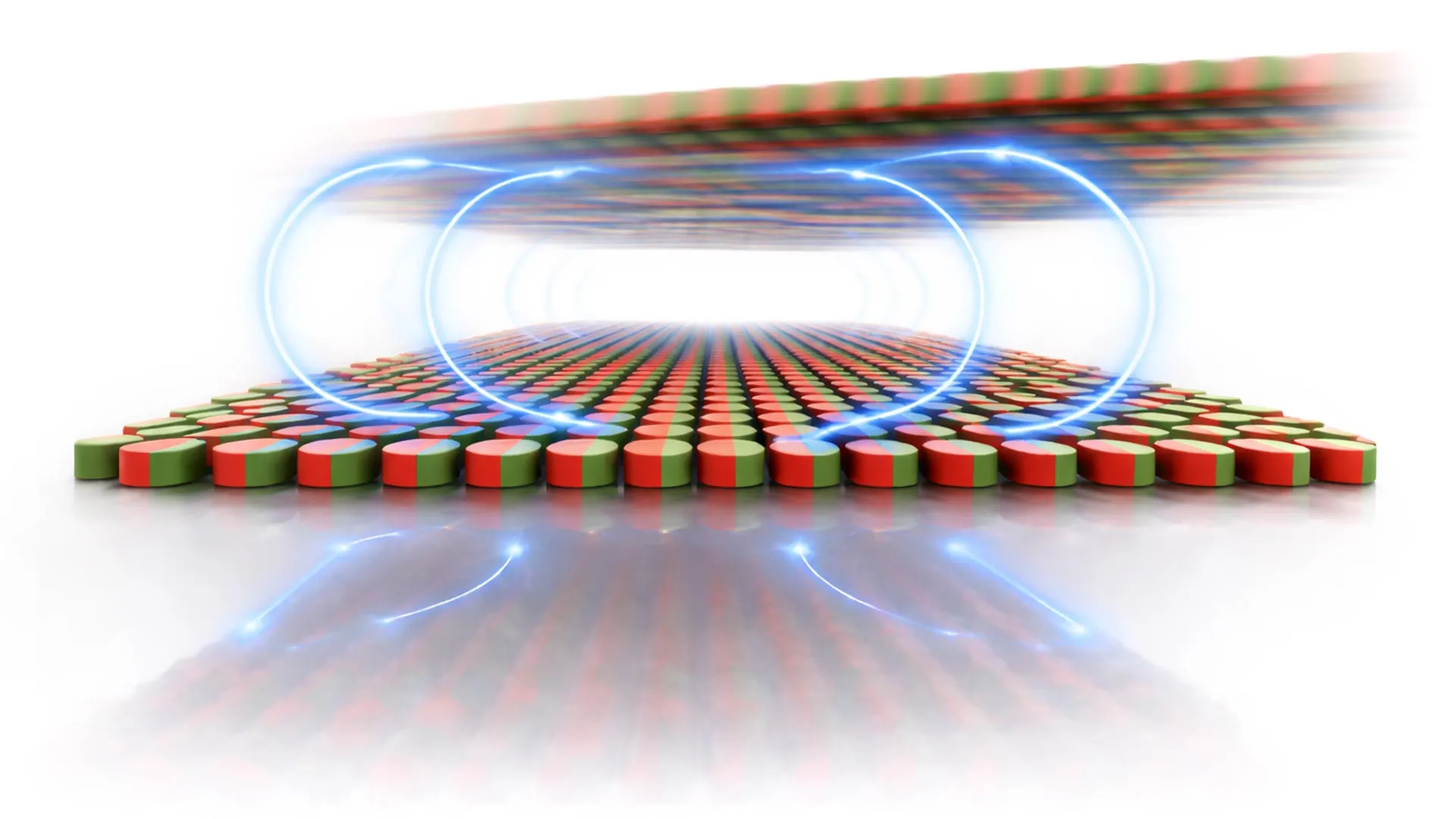
Researchers at the University of Konstanz have identified a completely new type of sliding friction. In this case, resistance to motion occurs without any physical contact, arising instead from the collective behavior of magnetic elements. Their findings show that friction does not always increase steadily with load, as described by Amontons' law -- one of the oldest and most widely accepted empirical laws in physics -- but can reach a clear peak when magnetic ordering inside the system becomes frustrated.
For over 300 years, Amontons' law has linked friction directly to how much force presses two surfaces together. This matches everyday experience, where heavier objects are harder to move than lighter ones. The usual explanation is that surfaces deform slightly under pressure, creating more microscopic contact points that increase resistance.
In most traditional systems, these deformations are minor and do not significantly alter the internal structure of the materials during motion. However, this assumption may not hold in systems where movement triggers major internal changes. Magnetic materials are a key example, since motion can rearrange their internal magnetic order.
A Contactless Magnetic Experiment
To investigate this possibility, the researchers designed a tabletop experiment with a two-dimensional array of freely rotating magnetic elements positioned above a second magnetic layer. Even though the two layers never physically touch, their magnetic interaction still produces a measurable friction force.
By adjusting the distance between the layers, the team was able to control the effective load while directly observing how the magnetic structure changed during motion.
"By changing the distance between the magnetic layers, we could drive the system into a regime of competing interactions where the rotors constantly reorganize as they slide," says Hongri Gu, who carried out the experiments.
Magnetic Conflict Creates a Peak in Friction
The results revealed an unexpected pattern. Friction is lowest when the layers are either very close together or far apart. At intermediate distances, however, friction rises sharply.
This effect occurs because of competing magnetic preferences. The upper layer tends to align its magnetic moments in an antiparallel configuration (parallel, but pointing in opposite directions), while the lower layer prefers a parallel arrangement. These conflicting tendencies force the system into an unstable state.
As the layers move, the magnets repeatedly switch between these incompatible configurations in a hysteretic manner (that means the current state depends on its past history). This constant switching increases energy loss and produces a pronounced peak in friction.
A New Explanation for Friction Without Surfaces
"From a theoretical perspective, this system is remarkable because friction does not originate from a physical surface contact, but from the collective dynamics of magnetic moments," explains Anton Lüders, who developed the theoretical description.
The competing magnetic interactions naturally drive repeated reorientations during motion, leading to a friction force that does not change in a simple linear way with load. Rather than being an exception, the breakdown of Amontons' law in this case follows directly from the behavior of magnetic ordering during sliding.
"What is remarkable is that friction here arises entirely from internal reorganization," adds Clemens Bechinger, who supervised the project. "There is no wear, no surface roughness and no direct contact. Dissipation is generated solely by collective magnetic rearrangements."
Future Applications of Contactless Magnetic Friction
Because the underlying physics does not depend on scale, these findings could apply far beyond the experimental setup. Similar effects may occur in atomically thin magnetic materials, where even small movements can alter magnetic order. This opens new ways to study and control magnetism using friction measurements.
Looking ahead, the research suggests the possibility of friction that can be tuned without physical wear. By using magnetic hysteresis, it may become possible to adjust friction remotely and reversibly. This could lead to technologies such as frictional metamaterials, adaptive damping systems, and contactless control components.
Potential uses include micro and nanoelectromechanical systems, where wear limits device lifespan, as well as magnetic bearings, vibration isolation systems, and ultra-thin magnetic materials where motion and magnetism are closely linked. More broadly, magnetic friction provides a new way to study collective spin behavior through mechanical measurements, connecting the fields of tribology and magnetism in a new way.
Story Source:
Materials provided by University of Konstanz. Note: Content may be edited for style and length.
Journal Reference:
- Hongri Gu, Anton Lüders, Clemens Bechinger. Non-monotonic magnetic friction from collective rotor dynamics. Nature Materials, 2026; DOI: 10.1038/s41563-026-02538-1
Cite This Page: