
Oxford physicists just made Schrödinger’s cat even stranger
- Date:
- June 15, 2026
- Source:
- University of Oxford
- Summary:
- Oxford physicists have created an entirely new type of Schrödinger’s cat-like quantum state using components that are themselves highly quantum in nature. The advance could open new possibilities for more resilient quantum computers and deeper insights into the strange rules that govern the quantum universe.
- Share:
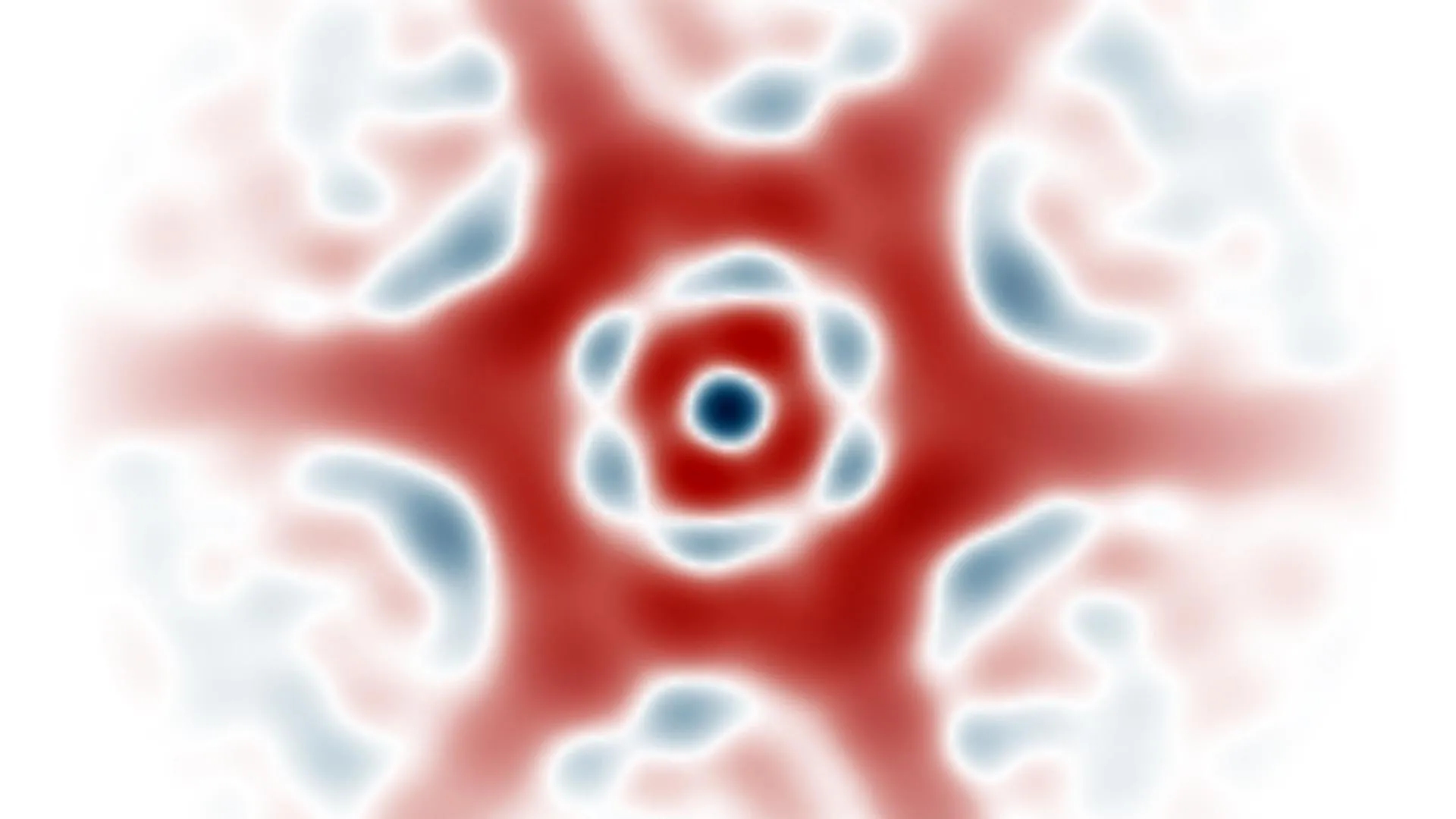
Researchers at the University of Oxford have created a new type of quantum superposition, a phenomenon often associated with the famous Schrödinger's cat thought experiment. Unlike previous versions, these newly demonstrated states are built from highly nonclassical quantum components. The achievement could help advance quantum computing beyond traditional binary systems, improve sensing technologies, and provide new insights into the foundations of quantum physics.
One of the most surprising features of quantum mechanics is that objects can exist in multiple states simultaneously. This concept is commonly illustrated by Schrödinger's cat, a hypothetical cat that is considered both alive and dead until it is observed.
While the thought experiment is fictional, scientists routinely create real quantum superpositions in the laboratory. Atoms, light, and even motion can be placed into multiple quantum states at once. The ability to generate and control these states is critical for technologies such as quantum computers and ultra-precise clocks.
A familiar example is a quantum bit, or qubit, which can exist in a combination of both 0 and 1 at the same time. However, quantum systems are capable of much more than two-state behavior.
Quantum harmonic oscillators, which can occupy many energy levels, offer a far richer set of possibilities. These oscillators describe a wide range of physical systems, including light, vibrations, and the motion of trapped particles. Scientists have used them to create many different kinds of quantum superpositions. One well-known example is the "cat state," where an oscillator exists as a superposition of two wave packets moving in opposite directions. These wave packets, called coherent states, are the closest quantum equivalents to classical motion.
Building Quantum States From Nonclassical Components
The Oxford team has now demonstrated an entirely new family of quantum superpositions.
Rather than constructing cat-like states from coherent-state wave packets, the researchers developed a technique that combines a broad range of quantum components that are already highly nonclassical. In squeezed-state superpositions, for example, quantum uncertainty is distributed differently across each part of the state.
The experiment relied on the motion of a single trapped ion. A trapped ion combines two distinct quantum systems in one platform. Its internal state behaves like a qubit, while its motion acts as a quantum harmonic oscillator that can occupy many different motional states. This combination makes trapped ions especially useful for creating quantum states that extend beyond conventional qubits.
To generate the new states, the researchers first engineered interactions that entangled the ion's internal state with different possible states of motion. They then performed a mid-circuit quantum measurement on the internal state, causing the ion's motion to collapse into the desired superposition of nonclassical components.
"This approach gave us a tool to sculpt the quantum superposition into almost any shape," explains lead author Dr. Sebastian Saner (Department of Physics, University of Oxford).
Programmable Control of Exotic Quantum States
The new method gave the team a high degree of control over the quantum states they produced.
By adjusting experimental parameters, they could modify the relative size, orientation, and separation of the components within the superposition. This flexibility allowed them to create a wide variety of unusual motional quantum states using the same trapped-ion system.
The researchers then reconstructed the quantum states directly. Their measurements revealed interference patterns and regions of Wigner negativity -- clear signs that the states could not be described as ordinary classical mixtures. These observations confirmed that the experiment had successfully produced genuine quantum superpositions composed of truly nonclassical motional states.
The team is now working with theorists to better understand exactly how "quantum" these newly created states are.
"We were really encouraged by our colleagues' reaction when we showed them what we had made. We believe we're still scratching the surface of what's possible, both for practical applications and for understanding these states at a more fundamental level," says Dr. Raghavendra Srinivas (Department of Physics, University of Oxford), who supervised the work.
Potential Impact on Quantum Computing
The research points toward future quantum technologies that rely on quantum oscillators instead of only simple quantum bits.
One particularly promising application is quantum computing. These types of states may be more resistant to errors while also supporting simpler and more effective error-correction strategies. Beyond computing, they provide a new experimental platform for investigating one of physics' biggest questions: where the boundary lies between the classical world we experience and the underlying quantum reality that governs it.
Story Source:
Materials provided by University of Oxford. Note: Content may be edited for style and length.
Journal Reference:
- S. Saner, O. Băzăvan, D. J. Webb, G. Araneda, D. M. Lucas, C. J. Ballance, R. Srinivas. Generating Arbitrary Superpositions of Nonclassical Quantum Harmonic Oscillator States. Physical Review X, 2026; 16 (2) DOI: 10.1103/k1xk-yt42
Cite This Page: