
This newly discovered ballista spider catapults ants into a deadly trap
A newly discovered spider tricks deadly green tree ants into springing a silk catapult that launches them straight into its web.
- Date:
- June 26, 2026
- Source:
- Macquarie University
- Summary:
- Scientists have discovered a “ballista spider” that builds a spring-powered silk trap designed specifically to catch aggressive green tree ants. The ant unknowingly triggers the mechanism itself, launching into the spider’s web in one of nature’s most extraordinary hunting strategies.
- Share:
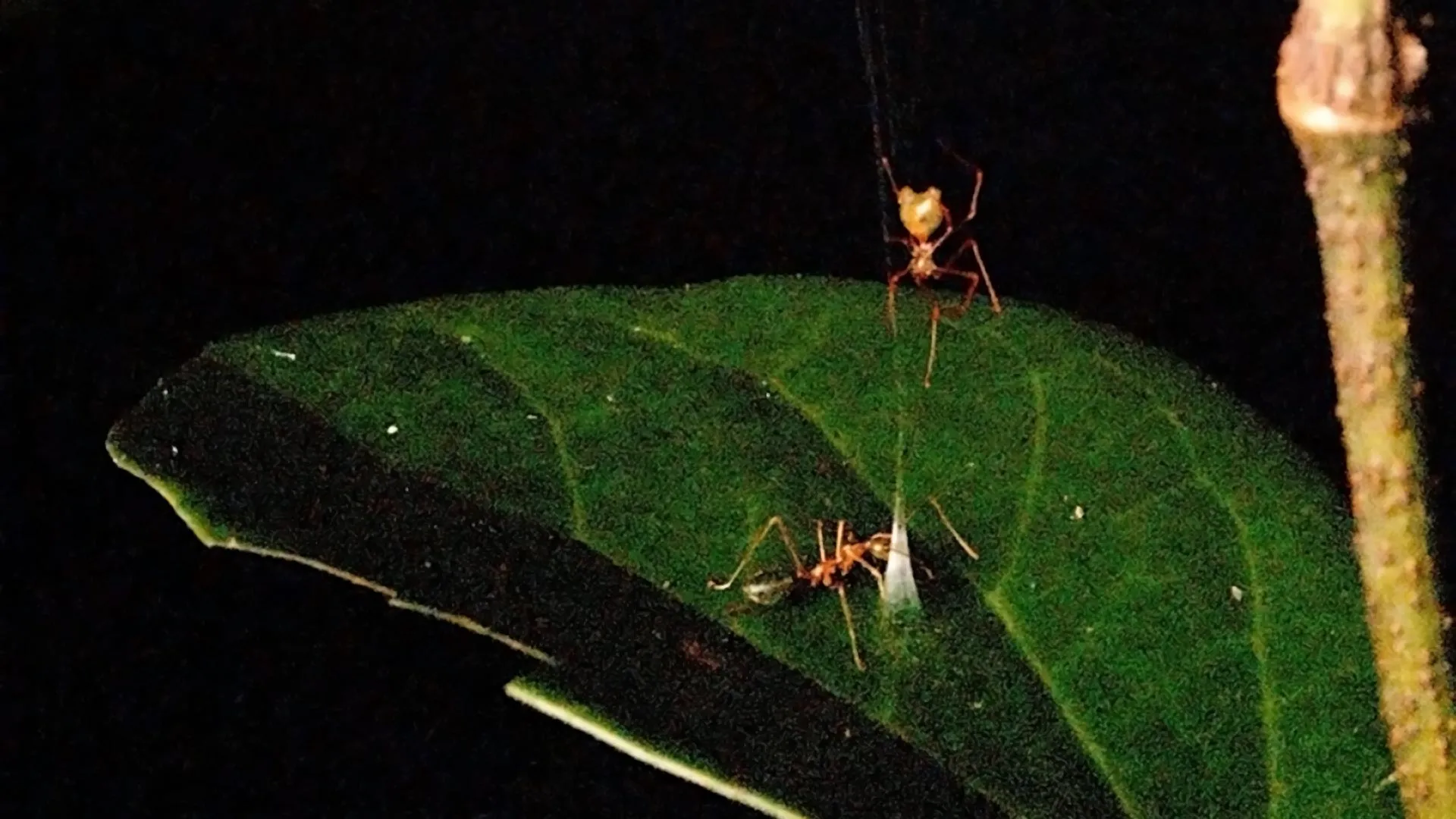
A newly discovered spider in the rainforests of northern Queensland has evolved an extraordinary hunting technique. Researchers say the species uses a powerful spring-loaded silk trap to capture a single type of prey, catching one ant at a time in what they describe as "the ultimate specialization."
The small nocturnal arachnid has been nicknamed the ballista spider after the ancient Roman siege weapon that launched bolts and stones using stored tension. According to scientists, the spider appears to have developed a unique web system designed specifically to capture the aggressive green tree ant, Oecophylla smaragdina.
The discovery and detailed analysis of the spider's hunting behavior were published in the journal Current Biology. Although the species has not yet been formally named, it belongs to the genus Propostira. The spider was first spotted by Professor Greg Anderson, a biomedical researcher who is also a spider taxonomist and photographer.
Researchers from Macquarie University, led by Professor Ajay Narendra and postgraduate student Pranav Joshi, spent 10 days and nights in rainforest near Cooktown in far north Queensland searching for the spiders. Using high speed and infrared cameras, they closely documented the animals and recorded their remarkable behavior.
Spider Specializes in Hunting Dangerous Ants
"It's very unusual for a spider to feed on ants, because they're notoriously dangerous, and even more bizarre to find a spider that eats only one particular ant species," said Professor Narendra.
"Ants have a range of chemical defenses -- including the ability to sting in some species -- and they use alarm signals to rapidly recruit hundreds and even thousands of other ants as backup to overcome potential predators."
During daylight hours, the ballista spider remains hidden beneath a leaf positioned above areas where green tree ants are actively foraging. After dark, it descends more than 50 centimeters and creates an anchor point on a leaf, branch, or the forest floor.
The spider then spends as long as four hours constructing an elaborate vertical trap. The structure consists of 15-60 tensioned silk strands bundled together into a cone-shaped arrangement near the ground.
How the Ballista Spider's Silk Catapult Works
To complete the trap, the spider wraps the cone with a thinner type of silk and quickly retreats upward. Moments later, a green tree ant approaches. The ant reacts aggressively, biting the cone and accidentally detaching it from the anchor point.
That action triggers the trap.
Once released, the spring-loaded snare launches the ant more than 30 centimeters upward into the spider's main web. The ant experiences acceleration exceeding 1300 meters per second squared before becoming tangled in the web. Only after the prey is fully restrained does the spider approach and wrap it in silk.
"We suspect during the final construction stage the spider adds a pheromone that specifically lures worker ants and induces an aggressive attack, triggering the snare," said Professor Narendra.
"This seems to be the only case where a spider's web is designed to catch a single prey species, and where the mechanism is triggered by the prey rather than by the predator."
A Biological Catapult Powered by Silk
Co-senior author Dr. Jonas Wolff, an expert in the biomechanical properties of spider silk, traveled to Australia to observe the species in its natural habitat. He later brought silk samples back to the University of Greifswald in Germany, where they were examined using advanced techniques including scanning electron microscopy.
"The ballista spider's snare is bioengineered to store elastic energy in the silk and rapidly release it, giving it incredible instantaneous power density -- greater than any other specialized silk-based biological catapults," said Professor Narendra.
"The ants it preys on have adhesive pads on their feet, so the contraction of the bundle of tension lines has to overcome a force of many times the ant's body weight to lift it."
Researchers believe the mechanism evolved as a highly specialized solution for safely hunting dangerous prey.
"The snare mechanism seems to have evolved as a highly specialized way of allowing the spider to 'pick off' potentially hazardous prey one at a time and transport them a safe distance away from ant trails and nests."
Story Source:
Materials provided by Macquarie University. Note: Content may be edited for style and length.
Journal Reference:
- Ajay Narendra, Pranav Joshi, Daniele Liprandi, Gregory J. Anderson, Jonas O. Wolff. Ballistic high-powered spider webs overcome dangerous prey defenses. Current Biology, 2026; 36 (12): R691 DOI: 10.1016/j.cub.2026.04.066
Cite This Page: