
Your fingers may hold a secret of human brain evolution
A baby’s finger lengths may reveal how prenatal estrogen helped drive the evolution of the larger human brain.
- Date:
- July 17, 2026
- Source:
- Swansea University
- Summary:
- A study of 225 newborns suggests prenatal estrogen may have played a role in the evolution of larger human brains. Boys with finger-length patterns linked to higher estrogen exposure before birth tended to have larger head circumferences, which are strongly associated with brain size. The same connection was not seen in girls.
- Share:
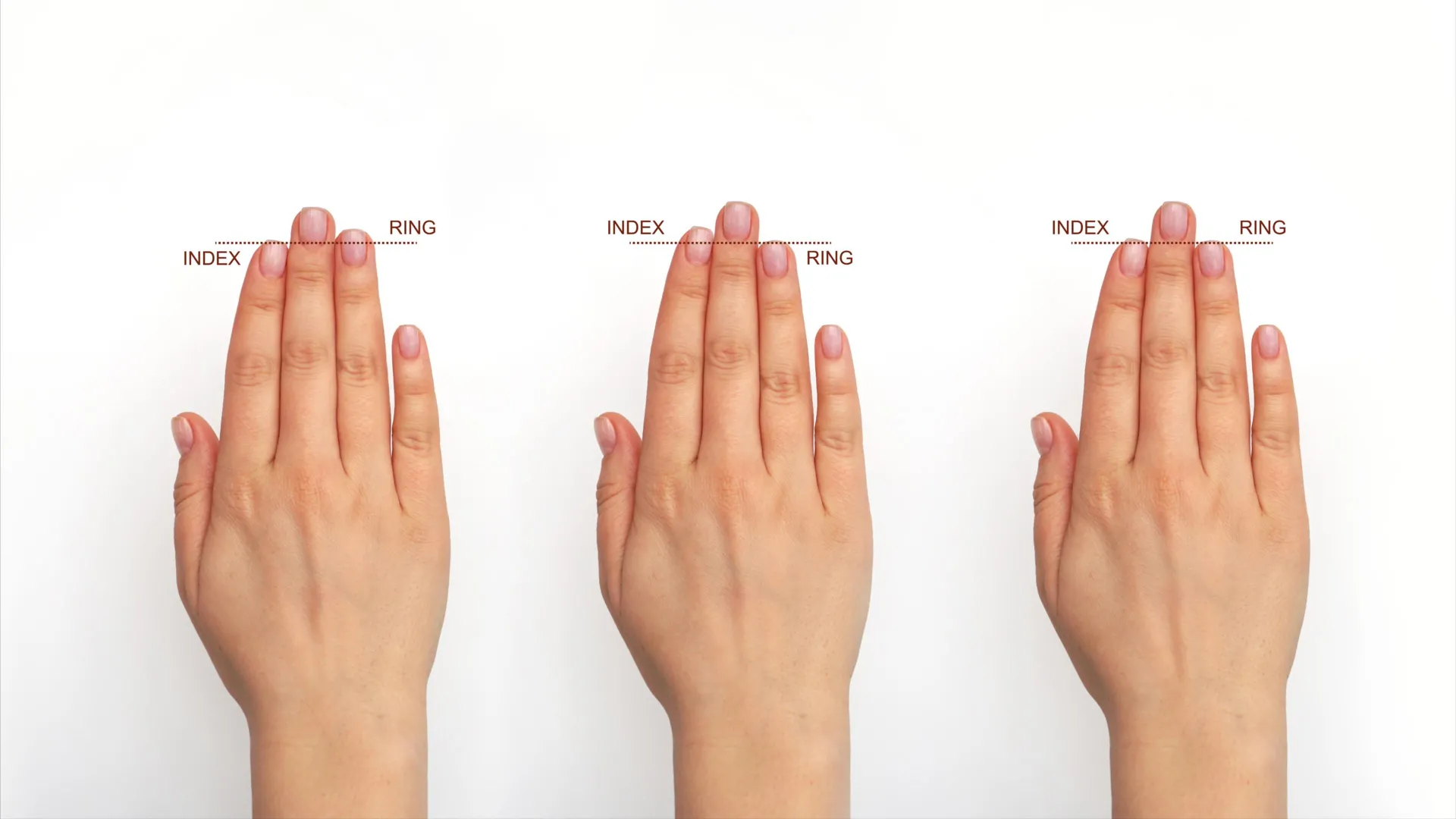
Human evolution is closely associated with the development of a much larger brain. New research suggests that greater exposure to estrogen before birth may have contributed to that expansion, and that a possible trace of this hormonal influence can be seen in the relative lengths of a person's fingers.
Professor John Manning, a member of Swansea University's Applied Sports, Technology, Exercise and Medicine (A-STEM) research team, specializes in the study of digit ratio.
Digit ratio compares the length of the index finger, known as 2D, with the length of the ring finger, known as 4D. This measurement is called the 2D:4D ratio. Researchers use it as an indirect indicator of the balance of estrogen and testosterone a fetus may have been exposed to during the first trimester of pregnancy.
People thought to have had relatively higher exposure to estrogen than testosterone generally have a longer index finger (2D) compared with their ring finger (4D). This results in a higher 2D:4D ratio.
For the latest study, Manning worked with researchers from Istanbul University's Department of Anthropology. Their findings were published in the journal Early Human Development.
Comparing Newborn Fingers and Head Size
The team examined 225 newborns, including 100 boys and 125 girls. They measured each baby's 2D:4D ratio and compared it with head circumference.
Head circumference is commonly used as a general indicator of brain size in newborns. It has also been associated with later measurements of cognitive development and IQ, although many genetic, environmental, and developmental factors influence intelligence.
The researchers found that boys with a higher 2D:4D ratio (indicating high prenatal estrogen) also tended to have a larger head circumference. The same relationship was not observed in girls.
A Possible Clue to Human Brain Evolution
The results may support a theory known as the estrogenized ape hypothesis. This idea proposes that the evolution of larger human brains occurred alongside changes that made the human skeleton less robust and more physically feminine compared with those of earlier ancestors.
Professor Manning said: "This finding is relevant to human evolution because increases in brain size are found alongside feminization of the skeleton, what is known as the estrogenized ape hypothesis. High values of 2D:4D in males have been found to be related to elevated rates of heart problems, poor sperm counts and predisposition to schizophrenia.
"However, increases in brain size may offset these problems. Thus, the evolutionary drive for larger brains in humans may inevitably be linked to reductions in male viability including cardiovascular problems, infertility and rates of schizophrenia."
The researchers suggest that larger brains may have provided major evolutionary advantages, even if the hormonal conditions associated with that development also carried biological costs for males.
Evolution May Have Involved Trade-Offs
According to the team, the findings add to evidence that prenatal estrogen may have played a positive role in the evolution of the human brain.
The study does not show that finger length directly determines brain size. Instead, the researchers view digit ratio as a possible marker of hormonal exposure during early fetal development. The results identify an association that may offer clues about how prenatal hormones influenced human evolution.
Manning's earlier research has explored whether digit ratio can provide information about alcohol consumption, outcomes after contracting COVID-19, and oxygen consumption in footballers.
Story Source:
Materials provided by Swansea University. Note: Content may be edited for style and length.
Journal Reference:
- Barış Özener, John T. Manning, Berna Ertuğrul, Fatih Aydık. Digit ratio (2D:4D) and neonatal head circumference: Evidence for oestrogenization in human brain evolution? Early Human Development, 2026; 214: 106479 DOI: 10.1016/j.earlhumdev.2026.106479
Cite This Page: