
JWST spots a bizarre “black hole star” 100 billion times brighter than a star
Astronomers may have uncovered an entirely new cosmic object: a gigantic “black hole star” that could explain the mysterious red dots filling the early universe.
- Date:
- August 13, 2026
- Source:
- Massachusetts Institute of Technology
- Summary:
- Astronomers using the James Webb Space Telescope have discovered a bizarre object from just a few hundred million years after the Big Bang that looks like an enormous star but shines far too brightly to actually be one. The mysterious red object, dubbed a “black hole star,” may contain a black hole about 100,000 times the mass of the Sun wrapped inside a dense, star-like cocoon of hydrogen roughly the size of our solar system.
- Share:
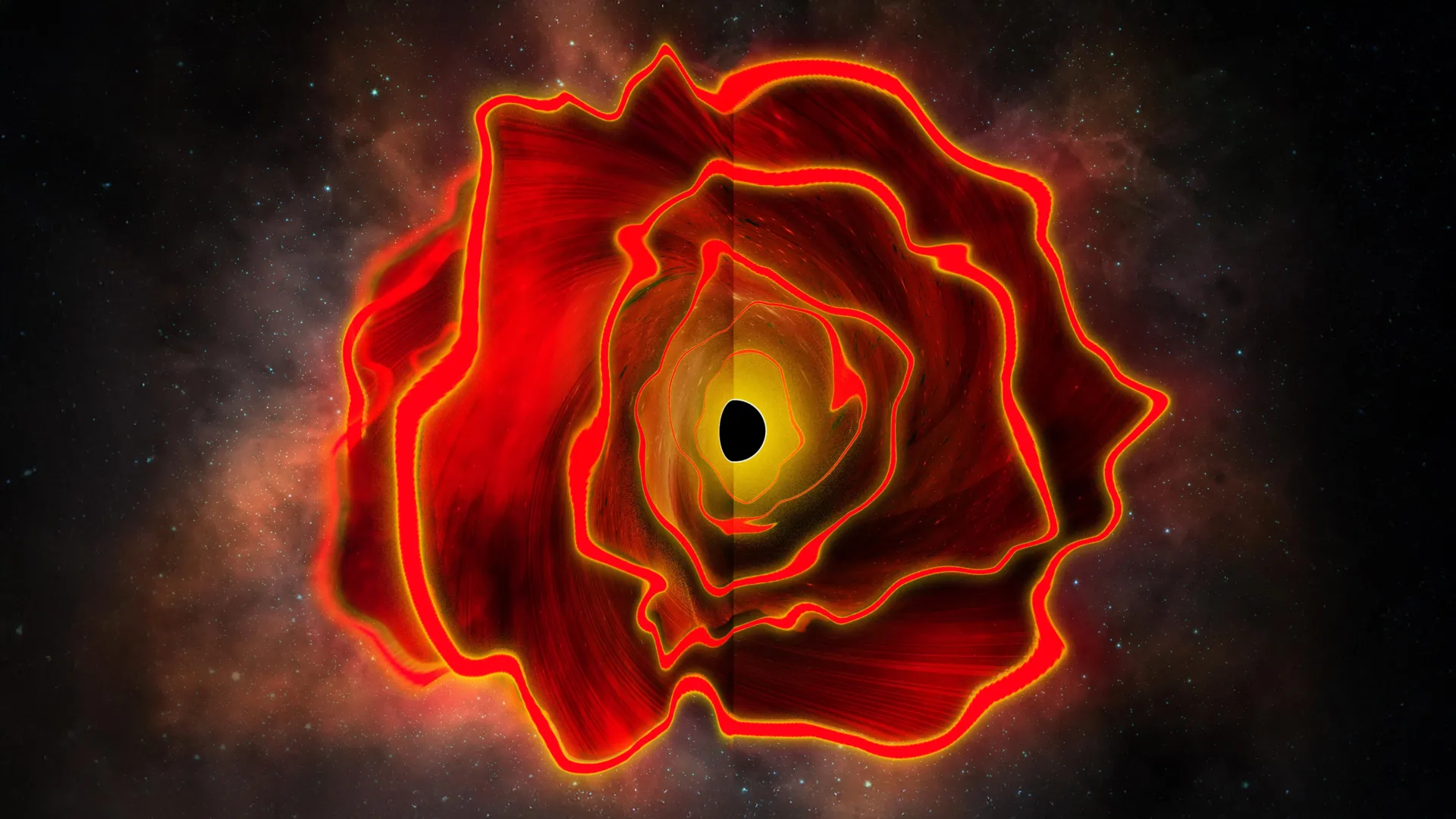
Astronomers from MIT and other institutions have identified an exceptionally bright red object dating back to the early universe. At first glance, it resembles an enormous star with dimensions comparable to our solar system. Its energy output, however, is extraordinary. The object is producing roughly 100 billion times more energy than any known star could physically generate, putting its power much closer to the levels associated with black holes.
That unusual combination has led researchers to propose that the red object represents an entirely new kind of astrophysical source. They are calling it a "black hole star."
A study published on August 12 in Nature describes the object and the team's analysis of observations made with NASA's James Webb Space Telescope (JWST). The telescope detected the bright red dot in the very early universe, only a few hundred million years after the Big Bang.
A Black Hole Hidden Inside a Giant Star Like Cocoon
The researchers say the most likely explanation is a previously unseen combination of a black hole and a star. Instead of being powered by the nuclear fusion that fuels ordinary stars, the object may consist of an extremely dense cloud of gas energized by a black hole at its center.
"Our picture of this object is evolving very rapidly," says lead author Rohan Naidu, a NASA Hubble Fellow and Pappalardo Fellow at MIT's Kavli Institute for Astrophysics and Space Research (MKI). "We think there is a central black hole that is 100,000 times as massive as the Sun. And around this black hole, there would be this very extended envelope of gas that looks like a star the size of the solar system. It's huge."
If the interpretation is correct, the discovery could also help explain the mysterious "little red dots" that have appeared in nearly every deep space image taken by JWST.
"These little red dots seem to be everywhere in the early universe but essentially disappear by the present day," Naidu says. "What exactly these objects are has been one of the most debated topics of the JWST era."
The study's MIT coauthors are MKI Director Robert Simcoe, the Bruno B. Rossi Professor of Experimental Physics; and Wendy Sun '26, along with researchers from several other institutions.
An Unexpected Discovery in the Early Universe
Naidu and his colleagues were not originally searching for a black hole star. Their goal was to identify some of the earliest and most distant galaxies through a survey called "Mirage or Miracle" (MoM). Using JWST, they looked deep into space and therefore far back in time, observing an era when the universe was only a few hundred million years old. They wanted to determine which galaxies had truly formed that early.
"There's been this puzzle of many bright galaxies showing up at extremely early times," Naidu says. "What we found was that what looks like an extremely bright early galaxy, aka a 'miracle,' in some cases actually could be a 'mirage.'"
While searching JWST images for promising targets, the team noticed one source that looked especially unusual. It appeared both intensely red and remarkably bright.
"When we see something very red in the universe, we often assume that it is surrounded by dust, like soot or ash," Simcoe explains. "The same way that the wildfire smoke from Canada recently made the sky in Boston look bright red, astronomical objects can also appear redder than their intrinsic color when you see them through a veil of dust."
But other features in the object's light did not fit what scientists would normally expect from dust. The researchers also found a striking pattern in its spectrum. The source was extremely bright at some wavelengths, yet its light vanished entirely below certain wavelengths.
A Record-Breaking Balmer Break
This sudden drop in light is known as a "Balmer break." The feature is usually linked to dense gas absorbing photons in the atmospheres of stars that are a few hundred million years old. Vega, one of the brightest stars visible in the night sky, displays the same type of pattern.
"The break we observed in this object is the deepest break we have ever observed in any object, ruling out 'ordinary' stars as the source," Naidu says. "But it made us wonder if we were seeing a new kind of 'stellar atmosphere,' but on a spectacular scale."
The object was unusual in another important way. Its light showed almost no evidence of metals or elements other than hydrogen and helium.
"It was truly singular in so many ways," Naidu says.
Testing What Could Create Such a Red Object
To determine what might produce the object's unusual appearance, the researchers simulated several possible astrophysical scenarios and compared them with what JWST had observed.
"We started to ask: Could you make something that red using just hydrogen, without any dust?" Simcoe says. "To our surprise, it turns out you can, if you have an extremely dense screen of hydrogen, so dense that it looks more like the surface of an enormous star than a wispy interstellar nebula."
The simulations suggested that the red source could contain an extremely powerful energy source hidden inside a very dense cocoon of hydrogen. Such a structure could account for the strong Balmer break and for the fact that researchers detected little besides hydrogen and helium.
One major mystery remained, however. The explanation still had to account for the object's extraordinary brightness.
"You have something that looks a bit like a star but is 100 billion times brighter," Naidu says. "That means you can't be powering this by nuclear fusion, which is the energy source that sits at the heart of all the stars we have."
A Massive Black Hole Provides the Missing Power
Black holes can generate energy at the enormous levels detected by the researchers. The team therefore added an active, accreting black hole to its simulations of the dense hydrogen cocoon. They adjusted the black hole's mass and other properties, then compared the simulated brightness with JWST's measurements of the red dot.
The best match pointed to a black hole star as the most likely explanation.
According to the team's model, the object contains a central black hole with a mass roughly 100,000 times that of the Sun. Surrounding it is an extremely dense, star-like envelope of hydrogen that extends across approximately the size of the solar system.
The researchers named the object MoM-BH*-1 after the survey in which it was found. They also gave it the moniker "black hole star - one," suggesting it may be the first example of a broader population.
Could Black Hole Stars Explain JWST's Little Red Dots?
The researchers suspect that black hole stars could account for many of the other little red dots seen in JWST images. Those sources are not as bright as MoM-BH*-1, but they may share the same basic structure.
"Every little red dot is consistent with being a black hole star, embedded in a generic early galaxy," Naidu says. "But what is special about MoM-BH*-1 is, the black hole star is essentially completely outshining its surrounding host galaxy, such that we're seeing pure black hole star light."
If that interpretation holds, MoM-BH*-1 could provide an important clue to one of the most debated mysteries to emerge from the JWST era, while also revealing a type of cosmic object that astronomers had never directly observed before.
This research was supported, in part, by the MIT Department of Physics, NASA, and the Space Telescope Science Institute.
Story Source:
Materials provided by Massachusetts Institute of Technology. Original written by Jennifer Chu. Note: Content may be edited for style and length.
Journal Reference:
- Rohan P. Naidu, Jorryt Matthee, Harley Katz, Anna de Graaff, Pascal A. Oesch, Aaron Smith, Jenny E. Greene, Gabriel Brammer, Andrea Weibel, Raphael Hviding, John Chisholm, Ivo Labbé, Robert A. Simcoe, Callum Witten, Wendy Q. Sun, Hakim Atek, Josephine F. W. Baggen, Sirio Belli, Rachel Bezanson, Leindert A. Boogaard, Sownak Bose, Rychard J. Bouwens, Alba Covelo-Paz, Pratika Dayal, Yoshinobu Fudamoto, Lukas J. Furtak, Emma Giovinazzo, Andy Goulding, Max Gronke, Kasper E. Heintz, Michaela Hirschmann, Garth Illingworth, Akio K. Inoue, Benjamin D. Johnson, Joel Leja, Ecaterina Leonova, Ian McConachie, Michael V. Maseda, Priyamvada Natarajan, Erica Nelson, David J. Setton, Irene Shivaei, David Sobral, Mauro Stefanon, Sandro Tacchella, Sune Toft, Alberto Torralba, Pieter van Dokkum, Arjen van der Wel, Marta Volonteri, Fabian Walter, Bingjie Wang, Darach Watson, Katherine Whitaker. A gas-enshrouded and gas-reddened black hole at cosmic dawn. Nature, 2026; 656 (8127): 329 DOI: 10.1038/s41586-026-10846-4
Cite This Page: