
Scientists may have finally caught “empty” space changing light
- Date:
- August 26, 2026
- Source:
- Universe Today
- Summary:
- A magnetar with an astonishingly powerful magnetic field may have revealed a quantum effect predicted by Werner Heisenberg nearly 90 years ago. Its light shows signs that supposedly empty space is altering how the light travels, potentially providing the first evidence of vacuum birefringence.
- Share:
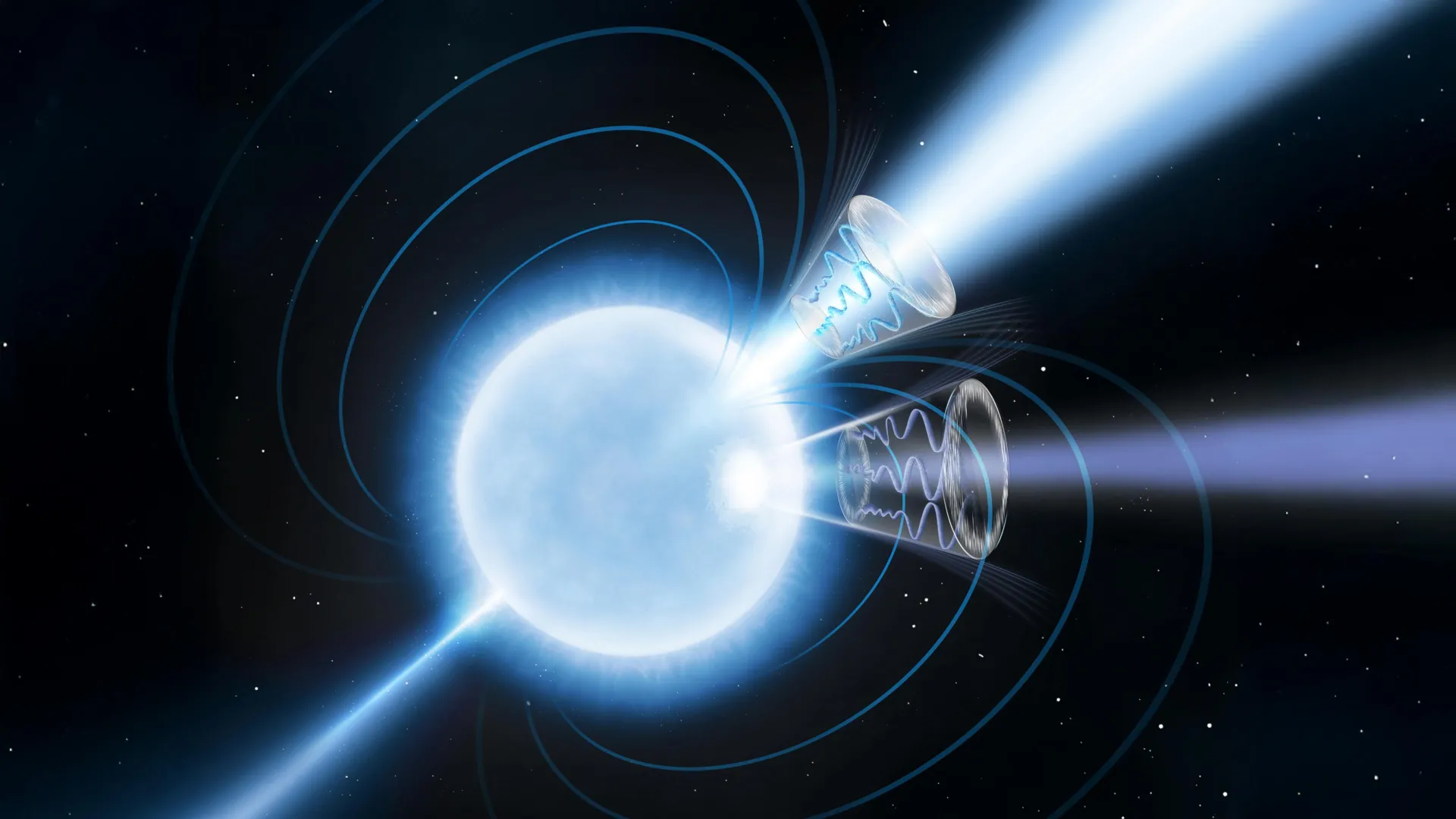
Nearly 90 years ago, Werner Heisenberg predicted a strange quantum effect known as vacuum birefringence, in which seemingly empty space can change the way light behaves. According to the idea, even a perfect vacuum is not truly empty. Instead, it should contain "virtual particles" that briefly appear and disappear.
Despite major advances in nuclear physics since the 1930s and decades of work with particle accelerators, scientists have not been able to conclusively confirm the effect. Now, observations of one of the most extreme objects in the Universe may provide the evidence researchers have been seeking.
A team of scientists studied a magnetar, a rare kind of neutron star with some of the strongest magnetic fields known in the Universe. Their results may represent the first evidence of vacuum birefringence and could open new ways to investigate quantum physics under conditions that cannot be reproduced on Earth.
A Cosmic Test of Quantum Physics
The research involved scientists from the Center for Space Sciences and Technology, the South African Radio Astronomy Observatory (SARAO), the Los Alamos National Laboratory, NASA's Marshall Space Flight Center, the Center for Research and Exploration in Space Science & Technology (CRESST) and the Astrophysics Science Division at NASA's Goddard Space Flight Center, along with universities around the world. Rachael E. Stewart, a Graduate Student of Physics at George Washington University, led the study, which was recently published in Nature.
Theory predicts that when a vacuum is exposed to an extraordinarily strong magnetic field, Heisenberg's virtual particles can affect how light travels, producing vacuum birefringence, or VB. The challenge is that magnetic fields strong enough to make the effect detectable are far beyond anything scientists can generate in laboratories on Earth.
Magnetars provide a natural solution. Dr. Marcus Lower, an Australian Research Council DECRA Fellow at the Center for Astrophysics and Supercomputing (CAS) at the Swinburne University of Technology, helped lead the observations used in the study.
"Detecting vacuum birefringence requires a magnetic field that is over 100 million times stronger than any we've ever made on Earth," said Lower. "Thankfully, nature has provided us with magnetars, which are the perfect cosmic laboratories to go looking for this effect."
Watching an Extreme Magnetar
Lower led observations of the magnetar 1E 1547.0-5408 (1E1547) using CSIRO's Murriyang (aka. Parkes) radio telescope. The resulting data were then analyzed with Swinburne University's Ngarrgu Tindebeek supercomputer.
The researchers combined those observations with measurements from NASA's Imaging X-ray Polarimetry Explorer (IXPE) and the NICER X-ray telescope aboard the International Space Station. As they monitored 1E1547's radio emissions, they tracked the orientation of the waves' oscillations (their "polarization state") as the magnetar rotated.
The measurements showed that the magnetar's magnetic axis and rotational axis are almost aligned. They also revealed that observers see the object from a nearly pole-on perspective. Together, those features make 1E 1547 especially well suited for searching for vacuum birefringence.
X-Rays Reveal a Possible Quantum Signature
The X-rays coming from the magnetar (and detected by IXPE) showed extremely high polarization. Researchers also found that the direction of that polarization remained aligned with 1E 1547's magnetic field, just as its radio waves did.
Both observations are considered signs that vacuum birefringence may be occurring around the magnetar.
Lower explained:
"Because of the magnetic field's strength, Heisenberg's virtual particles become aligned with the direction the field is pointing. By carefully tracking the direction the radio waves and X-rays oscillate as the magnetar rotates, the team found that the alignment of 1E1547's magnetic and rotational poles was ideal for detecting vacuum birefringence. With these future data on hand and our updated simulations, we may finally be able to complete the quest started by Heisenberg nearly 90 years ago."
More Evidence Is Still Needed
Additional observations and more advanced computer simulations could help researchers determine whether the signals really come from vacuum birefringence or whether other physical processes could produce similar effects.
If the result is confirmed, it would give scientists a powerful new way to test quantum physics in one of the most extreme environments in the Universe and could help reveal how fundamental physical theories behave under magnetic fields far beyond anything achievable on Earth.
Story Source:
Materials provided by Universe Today. Original written by Matthew Williams. Note: Content may be edited for style and length.
Journal Reference:
- Rachael E. Stewart, Hoa Dinh Thi, George Younes, Marcus E. Lower, Matthew G. Baring, Michela Negro, Fernando Camilo, Joel B. Coley, Teruaki Enoto, Alice K. Harding, Wynn C. G. Ho, Chin-Ping Hu, Philip Kaaret, Paul Scholz, Alex Van Kooten, Zorawar Wadiasingh. Vacuum birefringence and the polarized X-ray emission from a radio magnetar. Nature, 2026; 656 (8128): 590 DOI: 10.1038/s41586-026-10859-z
Cite This Page: