
A 1950s material just set a modern record for lightning-fast chips
Record-breaking germanium-on-silicon tech promises faster, cooler, next-gen electronics and quantum devices.
- Date:
- December 5, 2025
- Source:
- University of Warwick
- Summary:
- Researchers engineered a strained germanium layer on silicon that allows charge to move faster than in any silicon-compatible material to date. This record mobility could lead to chips that run cooler, faster, and with dramatically lower energy consumption. The discovery also enhances the prospects for silicon-based quantum devices.
- Share:
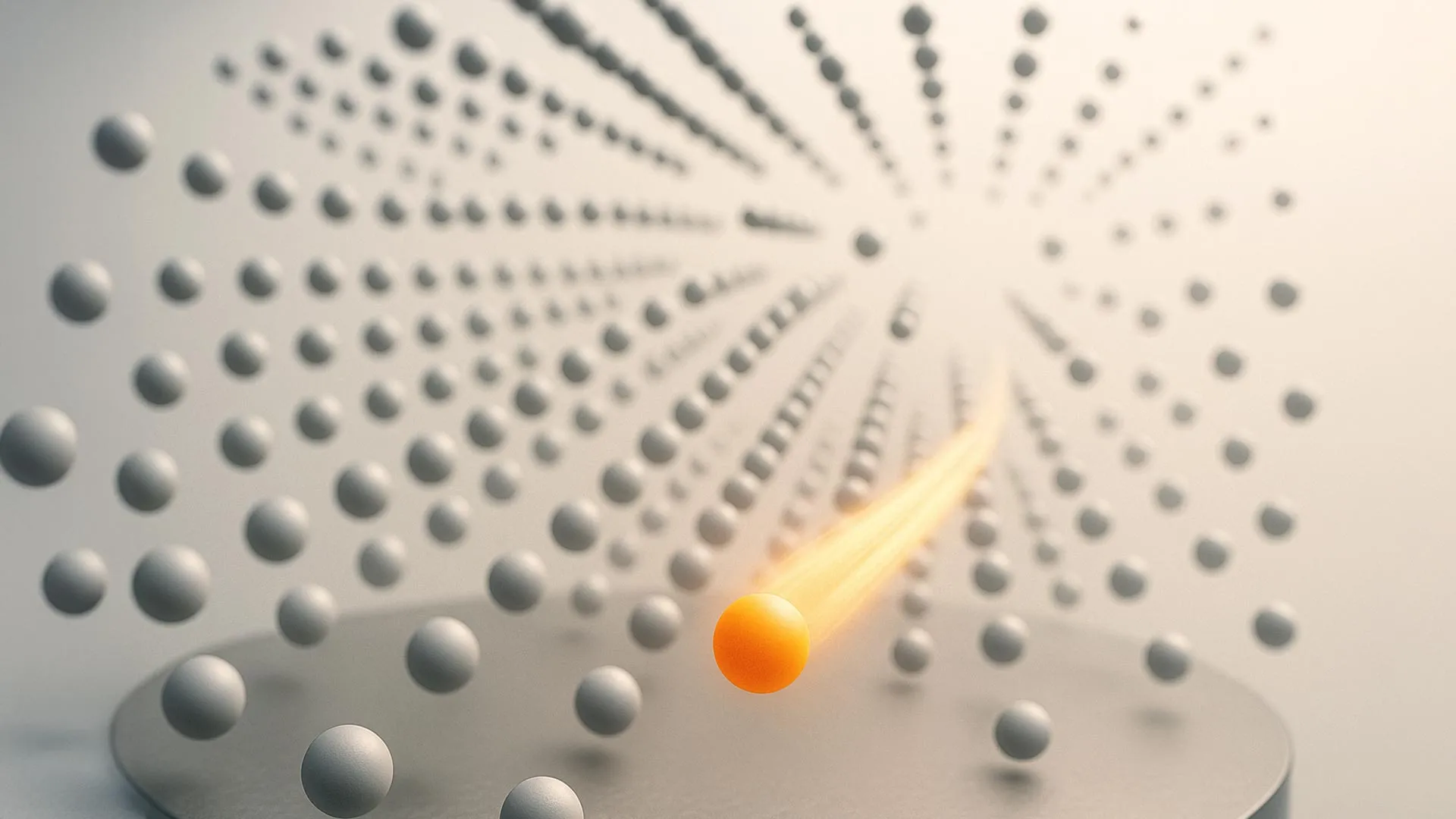
Scientists from the University of Warwick and the National Research Council of Canada have reported the highest "hole mobility" ever measured in a material that works within today's silicon-based semiconductor manufacturing.
Silicon (Si) forms the foundation of most modern semiconductor devices, but as components shrink and are packed closer together, they generate more heat and approach fundamental performance limits. Germanium (Ge), which appeared in some of the earliest transistors of the 1950s, is drawing renewed interest because researchers are finding ways to take advantage of its superior electrical characteristics while retaining the benefits of established silicon production methods.
New Material Breakthrough Using Strained Germanium on Silicon
In a study published in Materials Today, a team led by Dr. Maksym Myronov at the University of Warwick demonstrated a major advancement for next-generation electronics. The researchers created a nanometer-thin germanium epilayer on silicon that is placed under compressive strain. This engineered structure enables electric charge to move faster than in any previously known silicon-compatible material.
Dr. Maksym Myronov, Associate Professor and leader of the Semiconductors Research Group, Department of Physics, University of Warwick, explains, "Traditional high-mobility semiconductors such as gallium arsenide (GaAs) are very expensive and impossible to integrate with mainstream silicon manufacturing. Our new compressively strained germanium-on-silicon (cs-GoS) quantum material combines world-leading mobility with industrial scalability -- a key step toward practical quantum and classical large-scale integrated circuits."
How the Team Achieved Ultra-High Mobility
The researchers created the breakthrough material by growing a thin germanium layer on a silicon wafer and then applying a precise amount of compressive strain. This produced an exceptionally pure and orderly crystal structure that allows electrical charge to pass with minimal resistance.
When tested, the material reached a hole mobility of 7.15 million cm2 per volt-second (compared to ~450 cm2 in industrial silicon), an unprecedented result that indicates electrons and holes can travel through it far more easily than through conventional silicon. This improvement could lead to electronic devices that operate more quickly and consume less power.
Implications for Future Electronics and Quantum Technologies
Dr. Sergei Studenikin, Principal Research Officer at the National Research Council of Canada, states, "This sets a new benchmark for charge transport in group-IV semiconductors -- the materials at the heart of the global electronics industry. It opens the door to faster, more energy-efficient electronics and quantum devices that are fully compatible with existing silicon technology."
The findings establish a promising new route for ultra-fast, low-power semiconductor components. Potential uses include quantum information systems, spin qubits, cryogenic controllers for quantum processors, AI accelerators, and energy-efficient servers designed to reduce cooling demands in data centers.
This achievement also represents a significant accomplishment for Warwick's Semiconductors Research Group and highlights the UK's growing influence in advanced semiconductor materials research.
Story Source:
Materials provided by University of Warwick. Note: Content may be edited for style and length.
Journal Reference:
- Maksym Myronov, Alex Bogan, Sergei Studenikin. Hole mobility in compressively strained germanium on silicon exceeds 7 × 106 cm2V-1s−1. Materials Today, 2025; 90: 314 DOI: 10.1016/j.mattod.2025.10.004
Cite This Page: