
Scientists finally uncovered why the Indus Valley Civilization collapsed
- Date:
- December 14, 2025
- Source:
- Springer Nature
- Summary:
- A series of century-scale droughts may have quietly reshaped one of the world’s earliest urban civilizations. New climate reconstructions show that the Indus Valley Civilization endured repeated long dry periods that gradually pushed its people toward the Indus River as rainfall diminished. These environmental stresses coincided with shrinking cities, shifting settlements, and eventually widespread deurbanization. Rather than a dramatic collapse, the civilization appears to have faded slowly under relentless climate pressure.
- Share:
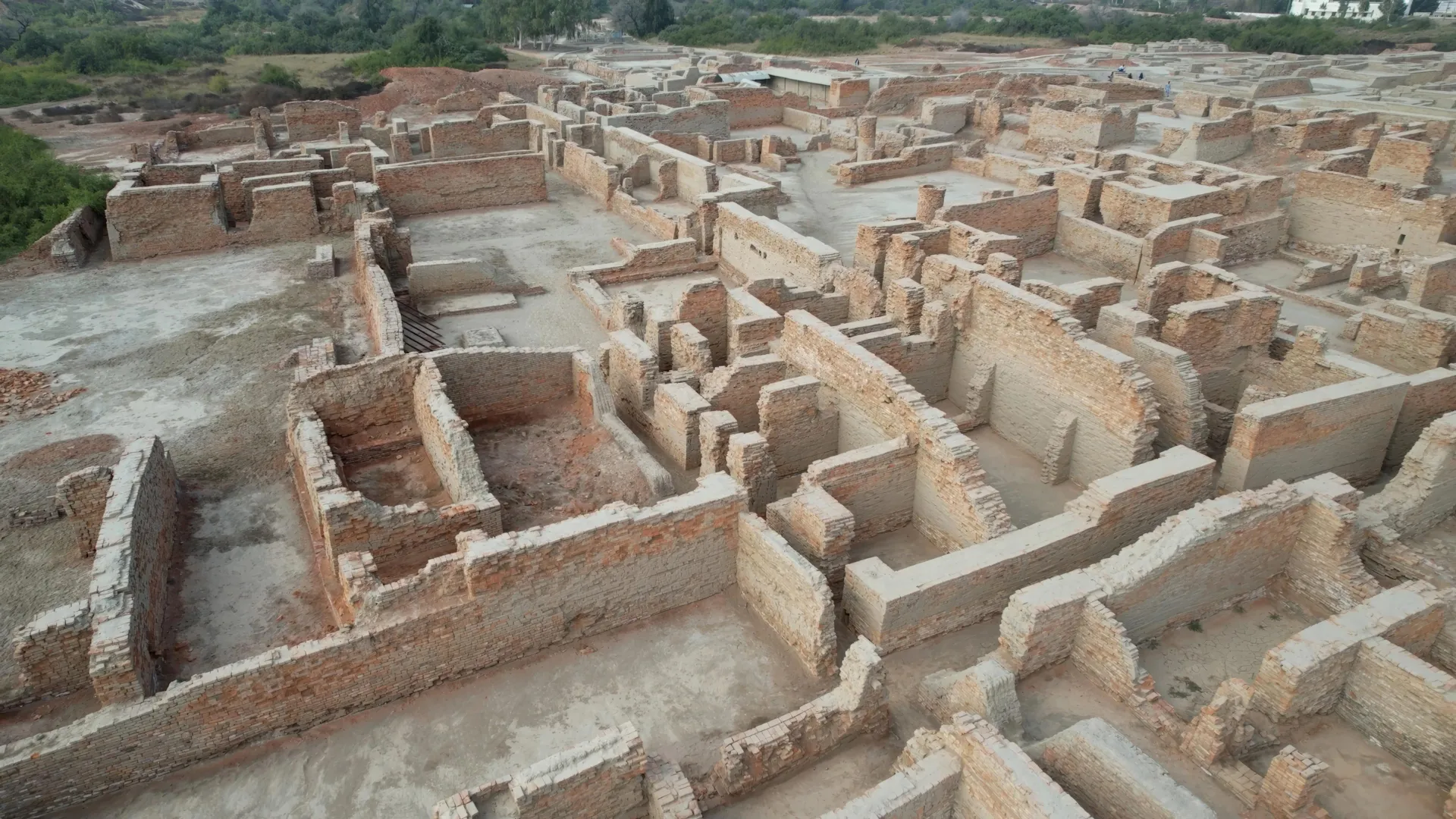
A new study in Communications Earth & Environment reports that a series of major droughts, each extending beyond 85 years, likely played a central role in the eventual decline of the Indus Valley Civilization. This interpretation offers fresh insight into why this influential ancient society, a contemporary of ancient Egypt located near the present-day India-Pakistan border, experienced a slow reduction in its urban and cultural complexity. The research also underscores how long-lasting environmental pressures can shape the development and stability of early civilizations.
The Indus Valley Civilization (IVC) was among the earliest known urban cultures, thriving between 5,000 and 3,500 years ago along the Indus River and its tributaries in what is now Pakistan and northwest India. At its height from 4,500 to 3,900 years ago, the society was known for its planned cities, extensive infrastructure, and innovative water management systems. Despite this high level of development, the reasons behind its long, gradual downturn have remained difficult for researchers to fully explain.
Climate Simulations Reveal Temperature Rise and Reduced Rainfall
To investigate past conditions, Vimal Mishra and colleagues reconstructed climate patterns across the region spanning 5,000 to 3,000 years ago. Their analysis combined climate modeling with several indirect indicators of ancient environmental change. These included the chemical signatures preserved in stalactites and stalagmites from two Indian caves and water level histories recorded in five lakes across northwest India. Together, the data point to a temperature increase of about 0.5 degrees Celsius during this interval, along with a 10 to 20 percent reduction in annual rainfall.
The team also identified four extended drought periods occurring between 4,450 and 3,400 years ago. Each drought lasted more than 85 years and affected between 65 percent and 91 percent of the area associated with the IVC, indicating widespread and long-lasting impacts on water availability.
Shifts in Settlement Patterns During Prolonged Dry Periods
According to the authors, these droughts likely influenced where people chose to establish settlements. Between 5,000 and 4,500 years ago, most communities were situated in regions that received higher rainfall. After 4,500 years ago, settlement patterns changed, with populations moving closer to the Indus River. This shift may reflect increasing dependence on a more reliable water source as drought conditions intensified.
One particularly long drought lasting 113 years, identified between 3,531 and 3,418 years ago, aligns with archaeological evidence of widespread deurbanization in the region. Based on these findings, the researchers conclude that the Indus Valley Civilization did not collapse abruptly from a single climate event. Instead, the society likely experienced a prolonged and uneven decline in which repeated droughts became a significant contributing factor.
Story Source:
Materials provided by Springer Nature. Note: Content may be edited for style and length.
Journal Reference:
- Hiren Solanki, Vikrant Jain, Kaustubh Thirumalai, Balaji Rajagopalan, Vimal Mishra. River drought forcing of the Harappan metamorphosis. Communications Earth, 2025; 6 (1) DOI: 10.1038/s43247-025-02901-1
Cite This Page: