
Global warming could trigger the next ice age
Earth’s climate control system may cool so hard after warming that it freezes the planet over.
- Date:
- December 21, 2025
- Source:
- University of California - Riverside
- Summary:
- Scientists have uncovered a missing feedback in Earth’s carbon cycle that could cause global warming to overshoot into an ice age. As the planet warms, nutrient-rich runoff fuels plankton blooms that bury huge amounts of carbon in the ocean. In low-oxygen conditions, this process can spiral out of control, cooling Earth far beyond its original state. While this won’t save us from modern climate change, it may explain Earth’s most extreme ancient ice ages.
- Share:
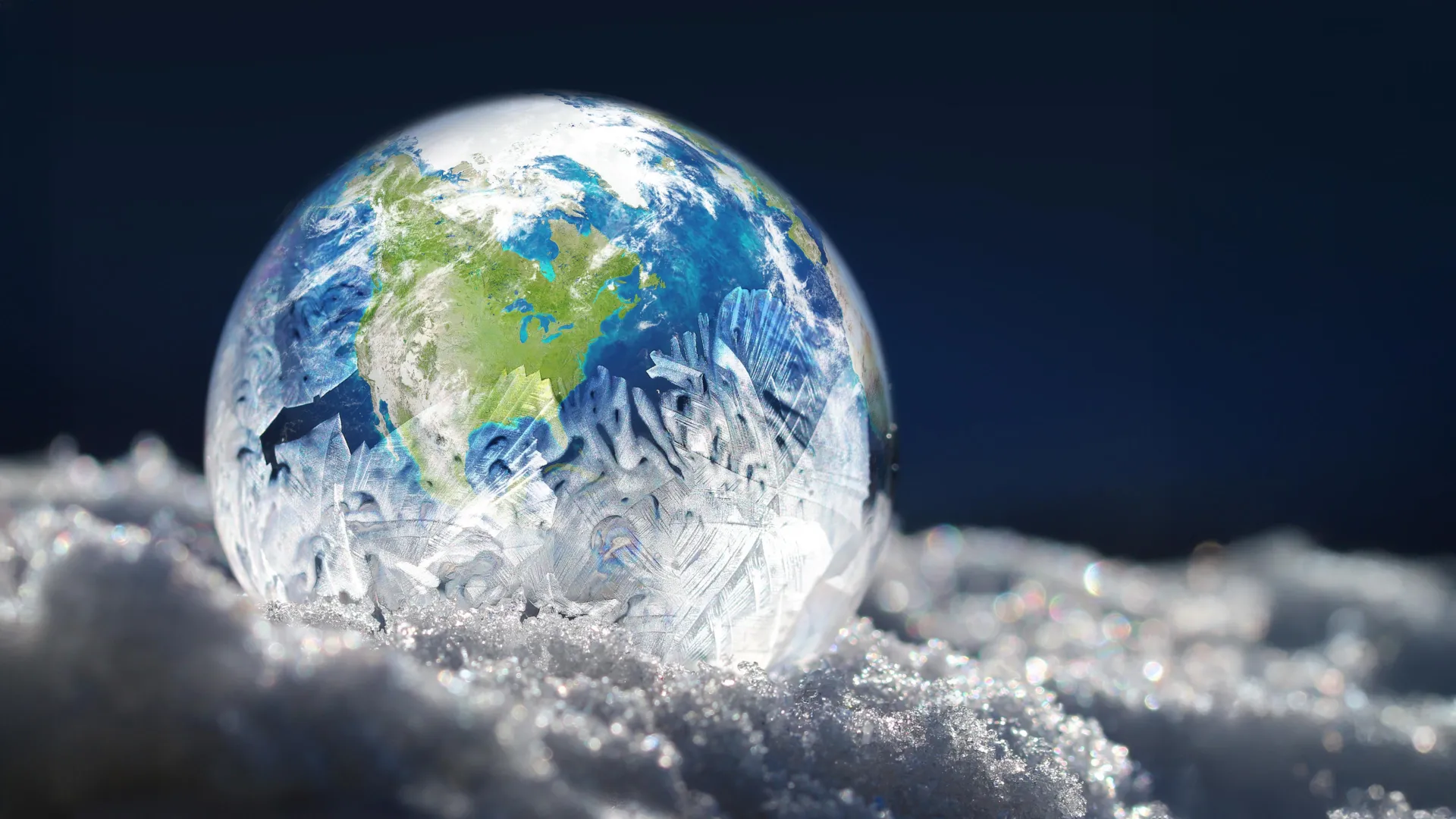
Researchers at UC Riverside say they have identified a critical gap in how scientists have long understood Earth's carbon recycling system. By filling in this missing piece, they now believe that periods of global warming can swing too far in the opposite direction, potentially setting the stage for an ice age.
For decades, scientists have thought Earth's climate was regulated by a slow but dependable natural process driven by rock weathering. This mechanism was seen as a stabilizing force that kept temperatures from drifting too far in either direction.
How Rock Weathering Helps Regulate Climate
In this process, rain absorbs carbon dioxide from the atmosphere and then falls onto exposed land surfaces. As the water interacts with rocks, especially silicate rocks such as granite, it gradually breaks them down. The dissolved material, along with the captured CO2, is carried into the oceans.
Once there, the carbon combines with calcium released from the rocks to form shells and limestone reefs. These materials settle on the ocean floor, locking carbon away for hundreds of millions of years and slowly reducing the amount of carbon dioxide in the atmosphere.
"As the planet gets hotter, rocks weather faster and take up more CO2, cooling the planet back down again," said Andy Ridgwell, a UC Riverside geologist and co-author of the study published in Science.
Why Ancient Ice Ages Were So Extreme
Geological records, however, tell a more dramatic story. Evidence shows that some of Earth's earliest ice ages were so severe that ice and snow covered nearly the entire planet. According to the researchers, this level of freezing cannot be explained by a climate system that simply fine tunes itself.
That realization led the team to look for an additional process that could push the climate beyond gentle balance and into extremes.
The Role of Oceans, Nutrients, and Plankton
The newly identified factor involves how carbon is buried in the ocean. As atmospheric CO2 rises and temperatures increase, rainfall carries larger amounts of nutrients such as phosphorus into the sea. These nutrients stimulate the growth of plankton, microscopic organisms that absorb carbon dioxide through photosynthesis.
When plankton die, they sink to the ocean floor, taking the carbon they captured with them. This process removes carbon from the atmosphere and stores it in ocean sediments.
In warmer conditions, however, this system changes. Increased plankton growth can reduce oxygen levels in the ocean. With less oxygen available, phosphorus is more likely to be released back into the water instead of being permanently buried. This recycled phosphorus fuels even more plankton growth, whose decay further depletes oxygen and keeps nutrients circulating.
As this loop continues, enormous amounts of carbon are buried, and global temperatures begin to fall.
A Climate System That Can Overshoot
Rather than gently stabilizing Earth's temperature, this feedback can drive cooling well past its original starting point. In the team's computer simulations, the effect was strong enough to trigger an ice age.
Ridgwell likens the process to a household cooling system working too hard.
"In summer, you set your thermostat around 78°F. As the air temperature climbs outside during the day, the air conditioning removes the excess heat inside until the room temperature comes down to 78° and then it stops," Ridgwell said.
Using this analogy, he explains that Earth's climate control is not broken. Instead, it may respond unevenly, as if the thermostat were not positioned close to the air conditioner.
Why the Future May Be Different
According to the study, lower levels of oxygen in Earth's ancient atmosphere made this climate control far less stable, which helps explain the severity of early ice ages. Today, atmospheric oxygen levels are much higher.
As human activity continues to add CO2 to the atmosphere, the planet is expected to keep warming in the near term. The researchers' model suggests that a cooling rebound will eventually follow. However, this future cooling is likely to be less extreme because higher oxygen levels reduce the strength of the nutrient feedback in the oceans.
"Like placing the thermostat closer to the AC unit," Ridgwell added. Even so, the effect could be enough to bring forward the beginning of the next ice age.
Why Climate Action Still Matters Now
"At the end of the day, does it matter much if the start of the next ice age is 50, 100, or 200 thousand years into the future?" Ridgwell wondered. "We need to focus now on limiting ongoing warming. That the Earth will eventually cool back down, in however wobbly a way, is not going to happen fast enough to help us out in this lifetime."
Story Source:
Materials provided by University of California - Riverside. Original written by Jules Bernstein. Note: Content may be edited for style and length.
Journal Reference:
- Dominik Hülse, Andy Ridgwell. Instability in the geological regulation of Earth’s climate. Science, 2025; 389 (6767) DOI: 10.1126/science.adh7730
Cite This Page: