
Hidden heat beneath Greenland could change sea level forecasts
- Date:
- December 27, 2025
- Source:
- University of Ottawa
- Summary:
- Scientists have built the most detailed 3D models yet of temperatures deep beneath Greenland. The results reveal uneven heat hidden below the ice, shaped by Greenland’s ancient path over a volcanic hotspot. This underground warmth affects how the ice sheet moves and melts today. Understanding it could sharpen predictions of future sea level rise.
- Share:
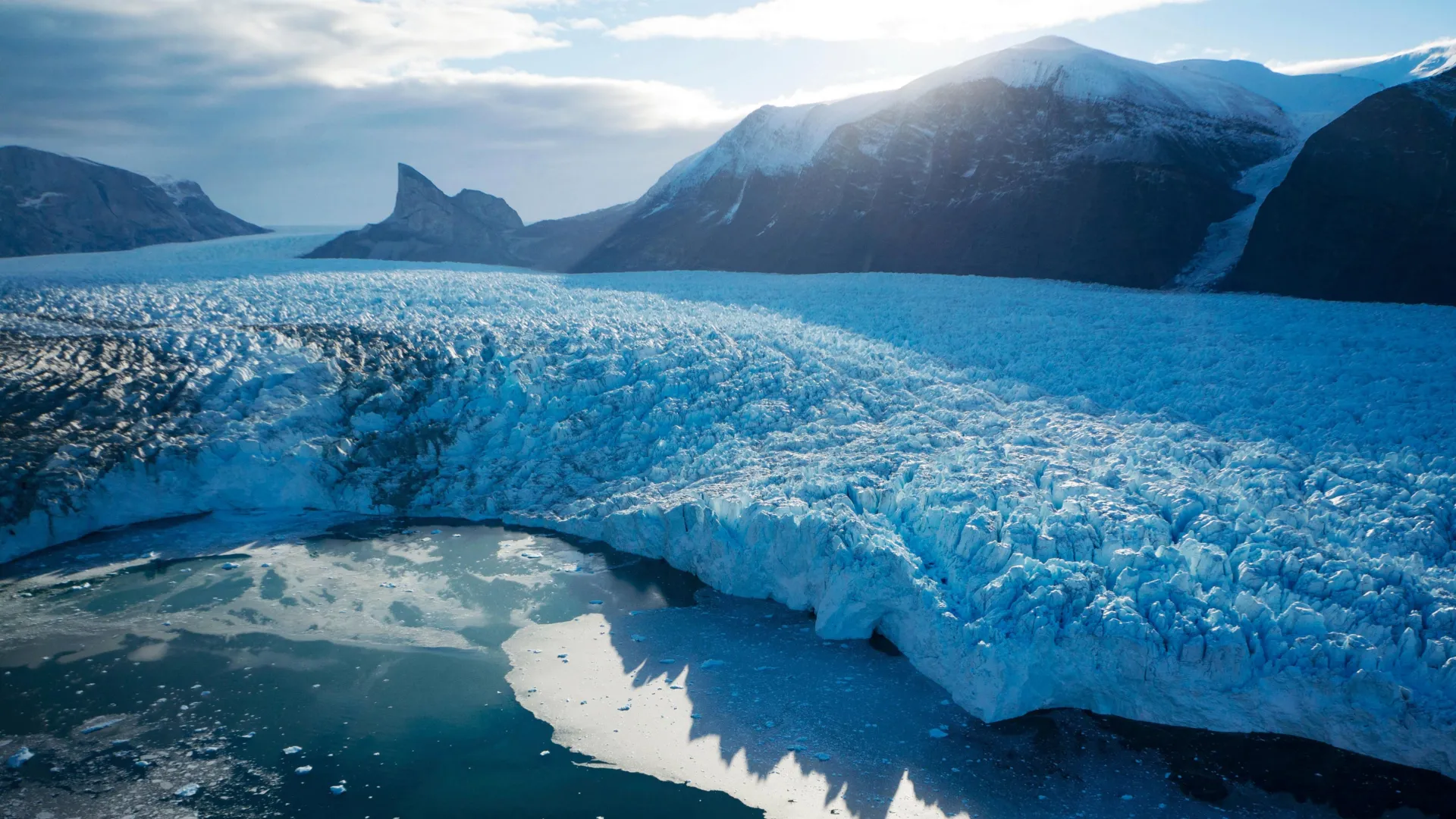
A research team led by scientists at the University of Ottawa has produced a new set of detailed 3D models that map temperatures deep beneath Greenland and northeastern Canada. These models shed light on how the region formed over millions of years and help explain how Greenland's massive ice sheet has responded, and may continue to respond, to climate change.
Mapping Hidden Heat Beneath Greenland
The project was carried out at the University of Ottawa in partnership with researchers from the University of Twente in the Netherlands and the Geological Survey of Denmark and Greenland (GEUS). To build their models, the team combined satellite observations with data collected on the ground. They then ran hundreds of thousands of computer simulations using high-performance systems, including resources from the Digital Research Alliance of Canada.
The results reveal that heat deep inside the Earth is not evenly distributed beneath Greenland. According to the study's lead author, these variations are closely tied to Greenland's geological journey across a powerful volcanic region in the past.
"Our new regional temperature models reveal significant lateral variations in the Earth's thermal structure beneath Greenland, which provide important information on the island's passage over the Iceland hotspot," explains uOttawa's PhD graduate Parviz Ajourlou, the study's first author. "These variations help us better interpret Greenland's tectonic history and the influence of this history on the geophysical properties of the underlying rocks."
Why Underground Heat Matters for Ice and Land
The temperature of the rocks beneath the ice plays a major role in how the ice sheet behaves today. Warmer conditions at the base can affect how ice slides, how the ground beneath it moves, and how scientists interpret satellite measurements of Earth's surface.
Glenn Milne, Chair and Full Professor within the Department of Earth and Environmental Sciences at uOttawa and the study's principal investigator, highlighted the broader importance of these findings.
"This research advances our understanding of the Earth's internal structure beneath Greenland. Temperature variations directly influence the interaction between the ice sheet and the bedrock, which must be quantified to interpret observations of land motion and gravity changes. These observations tell us how the ice sheet is responding to recent climate warming."
Improving Predictions of Future Sea Level Rise
To create their 3D temperature model, the researchers analyzed a wide range of geophysical data, including seismic velocities, gravity anomalies, and heat flow. This comprehensive approach not only provides new insight into Greenland's geological past but also strengthens scientists' ability to model how the ice sheet may change in the future.
By better accounting for how heat inside the Earth interacts with ice above it, researchers can improve simulations of ice loss and refine estimates of Greenland's contribution to global sea level rise.
"This work is a good illustration of how our knowledge of the solid Earth enhances our ability to understand the climate system," says Ajourlou. "By improving how we model ice-earth interactions, we can better forecast future sea level rise and plan accordingly."
Story Source:
Materials provided by University of Ottawa. Note: Content may be edited for style and length.
Journal Reference:
- Parviz Ajourlou, Glenn A. Milne, Ryan Love, Juan C. Afonso, Farshad Salajegheh, Konstantin Latychev, Kristian K. Kjeldsen, Alexis Lepipas, Yasmina M. Martos, Sarah A. Woodroffe. Upper mantle temperatures illuminate the Iceland hotspot track and understanding of ice–Earth interactions in Greenland. Proceedings of the National Academy of Sciences, 2025; 122 (50) DOI: 10.1073/pnas.2504752122
Cite This Page: