
Scientists discover “migrions,” a viral shortcut that supercharges infection
- Date:
- January 5, 2026
- Source:
- Science China Press
- Summary:
- Scientists have uncovered a surprising viral shortcut that turns moving cells into delivery vehicles for infection. Instead of spreading one virus at a time, infected cells bundle viral material into large structures called Migrions and pass them directly to new cells. This collective delivery jump-starts viral replication and boosts disease severity. The finding reveals a migration-based route of viral spread that defies classic models of infection.
- Share:
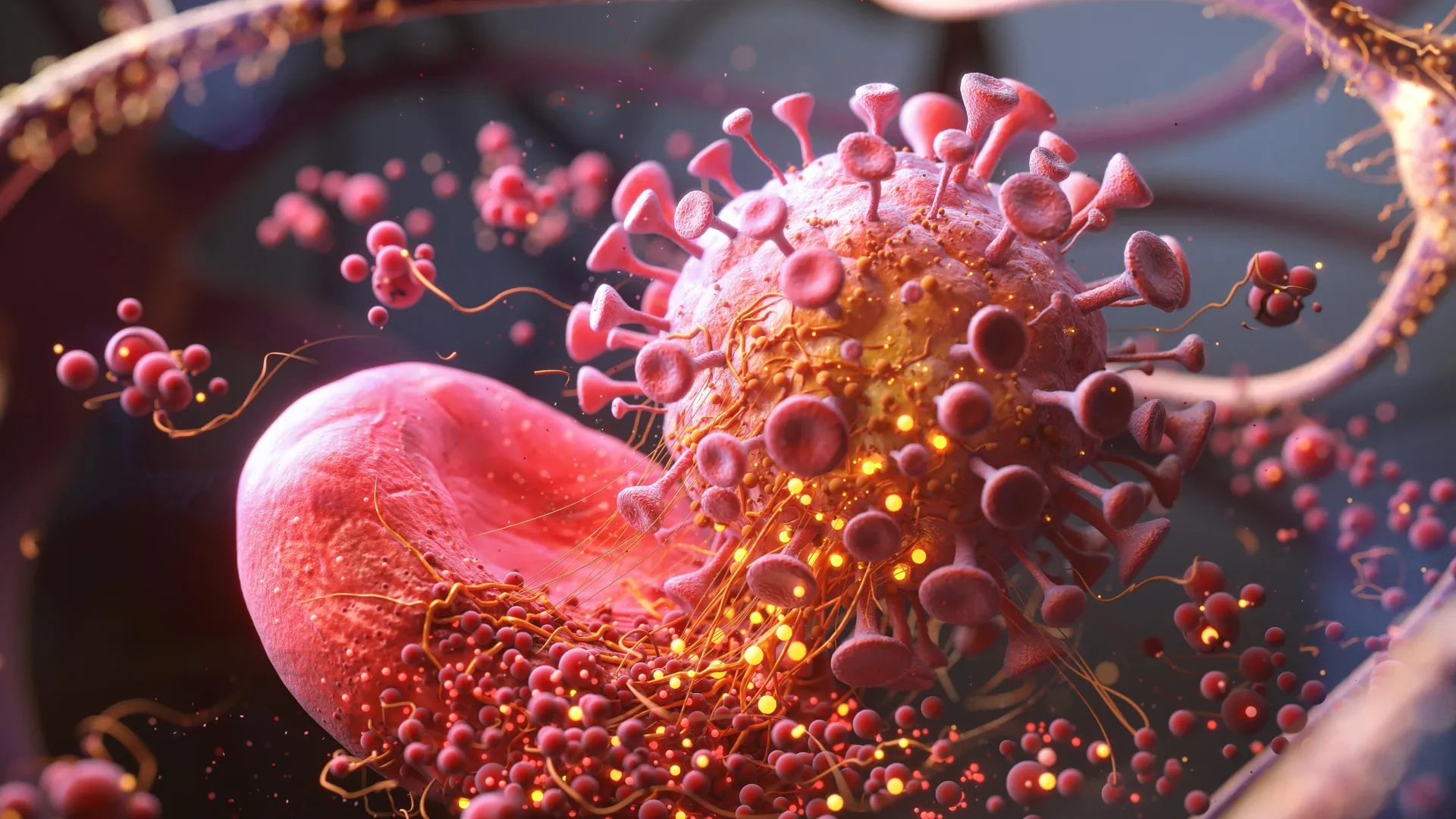
How efficiently viruses move between cells plays a major role in how dangerous an infection becomes. In a study published in Science Bulletin, scientists from Peking University Health Science Center and the Harbin Veterinary Research Institute uncovered a previously unknown route that helps viruses spread faster and more aggressively.
The team found that in cells infected with vesicular stomatitis virus (VSV), viral genetic material and proteins are actively packed into migrasomes. Migrasomes are recently identified cellular structures that form specifically when cells are moving. This means viral components are not just released randomly but are deliberately loaded into structures tied to cell migration.
Migrions Form Virus-Like Packages Inside Moving Cells
Some migrasomes contained viral nucleic acids inside while displaying the VSV surface protein VSV-G on their outer membrane. The researchers named these large virus-like structures "Migrions." Unlike free-floating VSV particles, Migrions represent a distinct form of viral transport created from both viral and cellular components.
When viruses spread through Migrions rather than as individual particles, they replicate more quickly inside newly infected cells. This faster growth happens because Migrions deliver multiple copies of the viral genome at the same time, allowing replication to begin immediately and in parallel.
A Faster and More Flexible Transmission Pathway
The study also revealed that Migrions can carry more than one type of virus at once. This ability to co-transmit different viruses sets Migrions apart from traditional extracellular vesicle (EV)-based viral spread, which follows a different mechanism.
Once Migrions reach a new cell, they enter through endocytosis without relying on specific cell surface receptors. Inside the cell, acidic conditions activate VSV-G on the Migrion surface, triggering fusion with endosomes. This fusion releases the viral contents, a critical step that allows replication to begin.
Animal Models Show More Severe Disease
Experiments in mice showed that Migrions are far more infectious than free virus particles. Animals exposed to Migrion-mediated infection developed much more severe disease, including serious lung and brain infections. These infections were marked by encephalitis and frequently resulted in death, highlighting the increased pathogenic potential of this transmission route.
Rethinking How Viruses Move Through the Body
The researcher proposed that "Migrion," described as a chimeric structure formed between virus and migrasome, represents an entirely new model of viral transmission between cells. By directly linking viral spread to cell movement, this mechanism challenges long-standing assumptions about how infections propagate.
Rather than spreading only through passive release into surrounding tissue, viruses can exploit the body's own migratory machinery to move efficiently and systemically. This migration-dependent strategy offers a new perspective on viral dissemination and may help explain how certain infections escalate so rapidly.
Story Source:
Materials provided by Science China Press. Note: Content may be edited for style and length.
Journal Reference:
- Yuxing Huang, Xiaojie Yan, Xing Liu, Congcong Ji, Wenmin Tian, Haohao Tang, Yong Li, Yiling Wen, Peiyao Fan, Hongli Wang, Cankun Xi, Zhongtian Li, Tian Lu, Fuping You, Xin Yin, Yang Chen. Migrion, a Migrasome-mediated unit for intercellular viral transmission. Science Bulletin, 2025; DOI: 10.1016/j.scib.2025.08.039
Cite This Page: