
The worst coral bleaching event ever recorded damaged over 50% of reefs
Half the world’s coral reefs were devastated by extreme ocean heat—and an even worse wave is happening right now.
- Date:
- February 12, 2026
- Source:
- Smithsonian
- Summary:
- Coral reefs, worth an estimated $9.8 trillion a year to humanity, are in far worse shape than previously realized. A massive international study found that during the 2014–2017 global marine heatwave, more than half of the world’s reefs suffered significant bleaching, and many experienced large-scale coral death.
- Share:
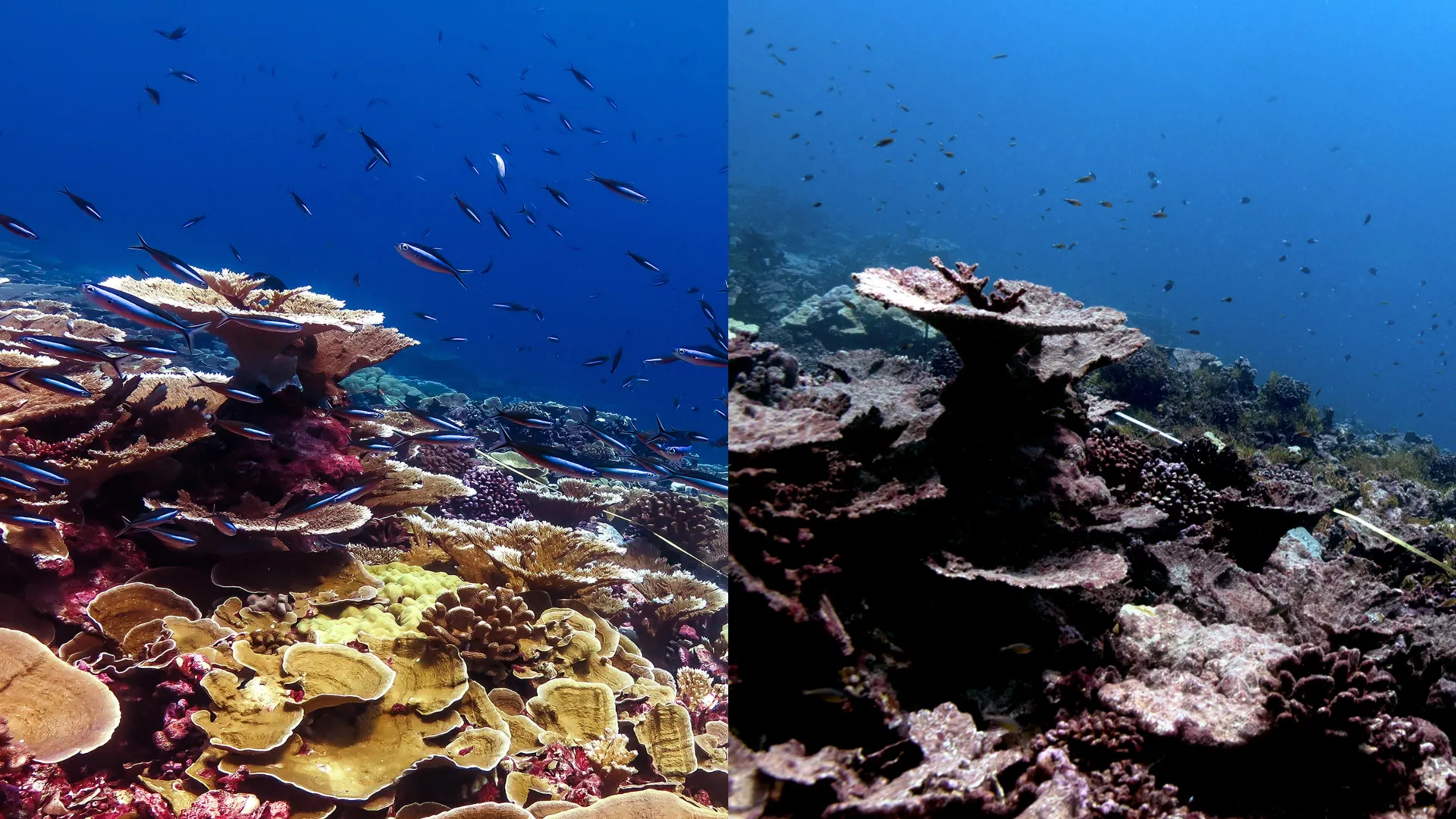
Coral reefs provide enormous value to people around the world. They support fisheries, power tourism industries, protect coastlines from storms, and even help scientists discover new medicines. Altogether, these benefits are estimated to be worth about $9.8 trillion each year.
Now, researchers report that a global marine heatwave caused widespread coral bleaching, damaging roughly half of the world's reefs. The findings, led by scientists at the Smithsonian, mark the first time the global extent of bleaching during such an event has been carefully calculated. A new heatwave that began in 2023 is still unfolding. The study appears in Nature Communications.
What Causes Coral Bleaching
Coral is built on a close partnership between two living organisms. One is a tiny animal related to jellyfish that creates the hard reef structure. The other is microscopic algae that live inside the coral's tissues and use sunlight to produce energy, which feeds the coral.
When ocean temperatures rise too high, this partnership breaks down. The coral expels the algae that supply its energy and turns white, a condition known as bleaching. Without its algae, coral grows more slowly, reproduces less, and can die if the heat stress is intense or lasts too long.
Mapping the Third Global Coral Bleaching Event (2014-2017)
To measure the scale of damage during the "Third Global Coral Bleaching Event" (2014-2017), scientists from dozens of countries worked together. The project was led by researchers at the Smithsonian Tropical Research Institute (STRI), James Cook University in Australia, and the former director of Coral Reef Watch at the U.S. National Oceanic and Atmospheric Administration (NOAA).
The team combined satellite measurements of ocean surface temperatures from the Coral Reef Watch system with on site reef surveys and aerial observations collected worldwide. This approach allowed them to link heat exposure from space with real world reef conditions.
"This is the most geographically extensive analysis of coral bleaching surveys ever done," said Sean Connolly, a senior scientist at the Smithsonian. "Nearly 200 co-authors from 143 institutions in 41 countries and territories contributed data."
Widespread Coral Damage and Mortality
The researchers analyzed more than 15,000 reef surveys. They found that 80 percent of reefs experienced moderate or worse bleaching, and 35 percent showed moderate or higher levels of coral death.
After establishing how heat stress corresponded to reef damage at surveyed sites, the team applied satellite based heat data to estimate impacts on reefs that were not directly studied. Their results suggest that more than 50% of coral reefs globally suffered significant bleaching, and 15% experienced significant mortality.
As reefs decline, the services they provide also suffer, including tourism revenue and seafood supplies that millions of people rely on.
"Levels of heat stress were so extreme during this event that Coral Reef Watch had to create new, higher bleaching alert levels that were not needed during prior events," said first author C. Mark Eakin, former director of Coral Reef Watch and chief scientific advisor for the Netflix film Chasing Coral.
"Around half of reef locations affected by bleaching-level heat stress were exposed twice or more during the three-year event -- often with devastating consequences," said Scott Heron, professor of physics at James Cook University. "That included back-to-back events on Australia's Great Barrier Reef. Three more bleaching events have happened there since. We are seeing that reefs don't have time to recover properly before the next bleaching event occurs."
Ocean Warming and the Fourth Global Bleaching Event
Over the past three decades, the planet has lost about 50% of its coral. The oceans absorb most of the excess heat generated by burning fossil fuels. Without that heat absorption, global air temperatures would reach around 50 degrees Celsius (122 degrees Fahrenheit).
Data collected worldwide now show that Earth is in the midst of a Fourth Global Coral Bleaching Event.
"Our results show that the Third Global Coral Bleaching Event was by far the most severe and widespread coral bleaching event on record," Connolly said. "And yet, reefs are currently experiencing an even more severe Fourth Event, which started in early 2023."
Why Global Coral Reef Monitoring Matters
"Local, regional and global economies rely heavily on the health of natural systems, such as coral reefs, but we often take them for granted," said Joshua Tewksbury, the director of STRI. "It is vital that science communities come together, like this global team has done, to track how these critical systems are changing. Doing this well, and at scale, requires connecting geographies and combining technologies -- from Earth observation satellites to in-the-water surveys that calibrate observations from space and show us the extent of the damage."
Story Source:
Materials provided by Smithsonian. Note: Content may be edited for style and length.
Journal Reference:
- C. Mark Eakin, Scott F. Heron, Sean R. Connolly, Denise A. Devotta, Gang Liu, Erick F. Geiger, Jacqueline L. De La Cour, Andrea M. Gomez, William J. Skirving, Andrew H. Baird, Neal E. Cantin, Courtney S. Couch, Simon D. Donner, James Gilmour, Manuel Gonzalez-Rivero, Mishal Gudka, Hugo B. Harrison, Gregor Hodgson, Ove Hoegh-Guldberg, Andrew S. Hoey, Mia O. Hoogenboom, Terry P. Hughes, Meaghan E. Johnson, James T. Kerry, Tadashi Kimura, Jennifer Mihaly, Aarón Israel Muñiz-Castillo, David O. Obura, Morgan S. Pratchett, Andrea Rivera-Sosa, Claire L. Ross, Jennifer Stein, Angus Thompson, Gergely Torda, T. Shay Viehman, Cory S. Walter, Shaun Wilson, Benjamin L. Marsh, Blake L. Spady, Noel Dyer, Thomas C. Adam, Pedro Alcolado, Mahsa Alidoostsalimi, Parisa Alidoostsalimi, Lorenzo Alvarez-Filip, Mariana Álvarez-Noriega, Jesús Ernesto Arias-González, Keisha D. Bahr, Peter Barnes, José Enrique Barraza Sandoval, Julia K. Baum, Andrew G. Bauman, Maria Beger, Kathryn Berry, Pia Bessell-Browne, Lionel Bigot, Victor Bonito, Ole B. Brodnicke, David Burdick, Deron E. Burkepile, April J. Burt, John A. Burt, Ian R. Butler, Jamie M. Caldwell, Yannick Chancerelle, Chaolun Allen Chen, Kah-Leng Cherh, Michael J. Childress, Darren J. Coker, Bryan Costa, Georgia Coward, M. James C. Crabbe, Thomas Dallison, Steven Dalton, Thomas M. DeCarlo, Crawford Drury, Ian Drysdale, Clinton B. Edwards, Linda Eggertsen, Eylem Elma, Rosmin S. Ennis, Richard D. Evans, Gal Eyal, Douglas Fenner, Baruch Figueroa-Zavala, Jay Fisch, Michael D. Fox, Elena Gadoutsis, Antoine Gilbert, Andrew R. Halford, Tom Heintz, James Hewlett, Jean-Paul A. Hobbs, Whitney C. Hoot, Peter Houk, Lyza Johnston, Michelle A. Johnston, Hajime Kayanne, Emma V. Kennedy, Ruy Kenji Papa de Kikuchi, Ulrike Kloiber, Haruko Koike, K. Lindsey Kramer, Chao-Yang Kuo, Judith Lang, Alice Lawrence, Abigail Leadbeater, Zelinda M. A. N. Leão, Jen Nie Lee, Cynthia Lewis, Diego Lirman, Guilherme Ortigara Longo, Chancey MacDonald, Jennie Mallela, Sangeeta Mangubhai, Isabel Marques da Silva, Christophe Mason-Parker, Vanessa McDonough, Melanie McField, Thayná Mello, Celine Miternique-Agathe, Mouchtadi Madi, Stephan Moldzio, Alison A. Monroe, Monica Montefalcone, Kevin S. Moses, Pargol G. Mostafavi, Rodrigo Leão de Moura, Chathurika S. Munasinghe, Jelvas Mwaura, Takashi Nakamura, Jean-Benoit Nicet, Marissa F. Nuttall, Marilia D. M. Oliveira, Hazel A. Oxenford, John M. Pandolfi, Vardhan Patankar, Denise Perez, Nishan Perera, Derta Prabuning, William Precht, K. Diraviya Raj, James D. Reimer, Laura E. Richardson, Randi Rotjan, Nicole Ryan, Rod Salm, Stuart A. Sandin, Stephanie Schopmeyer, George Shedrawi, Mohammad Reza Shokri, Jennifer E. Smith, Kylie Smith, Struan R. Smith, Tyler B. Smith, Brigitte Sommer, Melina Soto, Richard Suckoo, Helen Sykes, Kelley Anderson Tagarino, Marianne Teoh, Minh Quang Thai, Tai Chong Toh, Alex Tredinnick, Alex Tso, Harriet Tyley, Ali M. Ussi, Bernardo Vargas-Angel, Christian Vaterlaus, Mark J. A. Vermeij, Si Tuan Vo, Christian R. Voolstra, Hin Boo Wee, Bradley A. Weiler, Dana E. Williams, Saleh A. S. Yahya, Thamasak Yeemin, Maren Ziegler, Derek P. Manzello. Severe and widespread coral reef damage during the 2014-2017 Global Coral Bleaching Event. Nature Communications, 2026; 17 (1) DOI: 10.1038/s41467-025-67506-w
Cite This Page: