
Textbooks challenged by new discovery about how cells divide
- Date:
- February 28, 2026
- Source:
- Technische Universität Dresden
- Summary:
- Scientists have uncovered a surprising new way that giant embryonic cells divide—without relying on the classic “purse-string” ring long thought essential for splitting a cell in two. Studying zebrafish embryos, researchers found that instead of forming a fully closed contractile ring, cells use a clever “mechanical ratchet” system.
- Share:
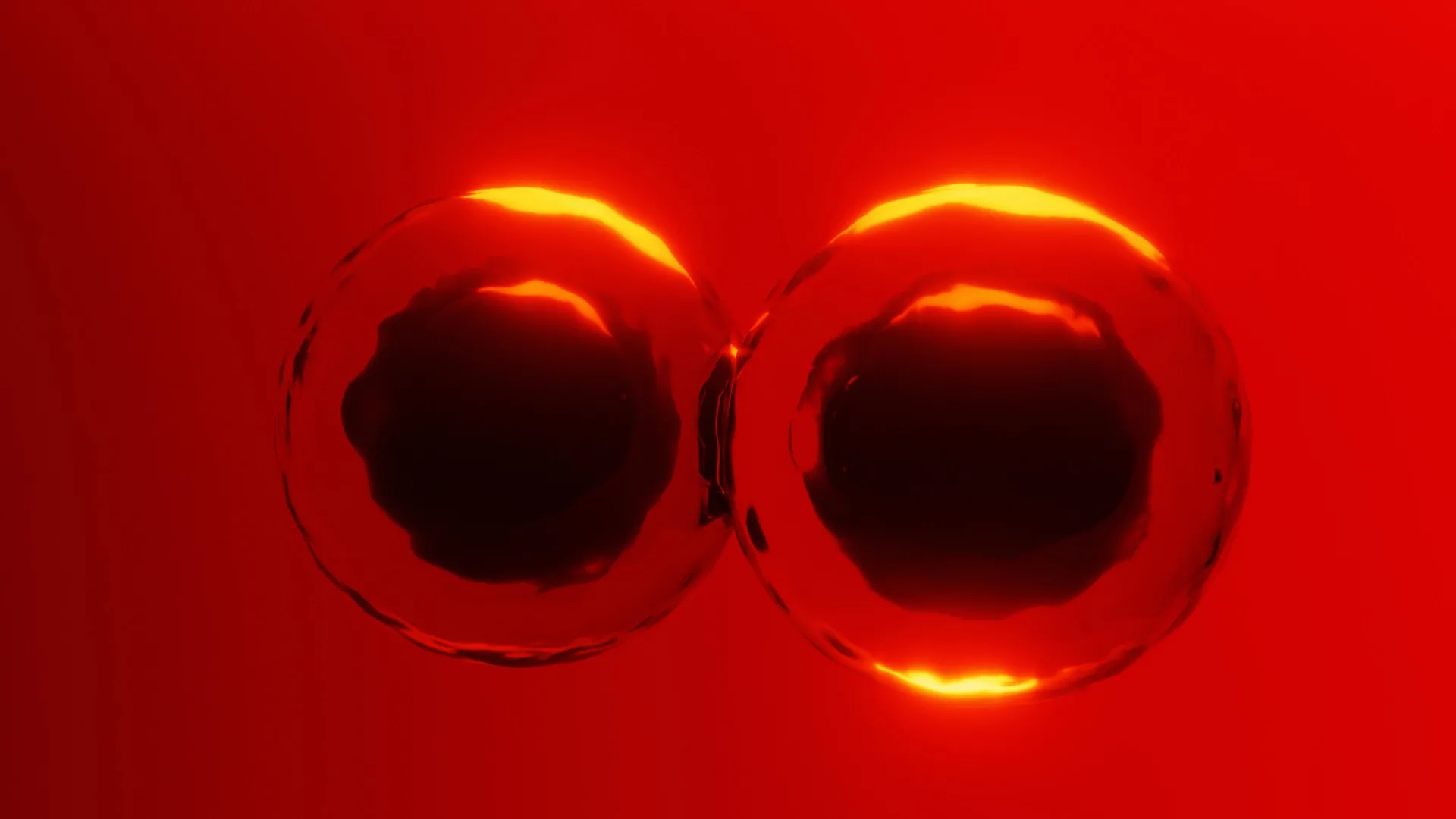
Cell division is fundamental to life, yet scientists have struggled to fully explain how it works in the earliest stages of embryonic development, especially in egg laying animals. Researchers from the Brugués group at the Cluster of Excellence Physics of Life (PoL) at TUD Dresden University of Technology have now identified a previously unknown mechanism that allows large embryonic cells to divide without forming a complete contractile ring, long considered essential for this process. Their findings, published in Nature, challenge traditional textbook models by showing how components of the cytoskeleton and the physical properties of the cell interior (or cytoplasm) work together through a 'ratchet' mechanism to drive division.
In many organisms, cells divide by building a ring made of the protein actin at the cell's midpoint. This structure tightens like a drawstring, squeezing the cell into two daughter cells. While this purse string model applies broadly, it does not explain division in species with especially large embryonic cells, including sharks, platypus, birds and reptiles. In these cases, the sheer size of the cell and the presence of a large yolk sac prevent the actin ring from fully closing. For years, researchers have wondered how these oversized cells manage to split.
"With such a large yolk in the embryonic cell, there is a geometric constraint. How does a contractile band, with loose ends, remain stable and generate enough force to divide these huge cells?" asked Alison Kickuth, a recently graduated PhD student from the Brugués group at the Cluster of Excellence Physics of Life (PoL) and lead author of the study. The team's experiments, reported in Nature, provide an answer.
Zebrafish Reveal a Stabilizing Role for Microtubules
To investigate, the researchers turned to zebrafish embryos, which develop quickly and also contain large, yolk rich cells during early stages. Using a laser to precisely cut the actin band, Alison found that the band continued to move inward even after being severed. This suggested that it was supported along its length rather than anchored only at its ends.
The team also observed that microtubules, another key part of the cytoskeleton, bent and spread out when the actin band was cut. These fibers appeared to help stabilize the band as it tightened. To test their importance, the researchers disrupted microtubules in two ways. They chemically induced depolymerization (effectively stopping new microtubules from forming), and they physically interfered with them by inserting a tiny oil droplet as an obstacle. In both cases, the actin band collapsed without microtubules, demonstrating that these structures provide crucial mechanical support and signaling during band formation and contraction.
Cytoplasmic Stiffness Changes During the Cell Cycle
The cytoskeleton naturally reorganizes as cells progress through the cell cycle. This cycle includes a mitotic phase (M-phase), when DNA is separated, and interphase, when the cell grows and duplicates its DNA. After DNA separation, large microtubule structures called asters expand throughout the cytoplasm. During interphase, these asters help determine where the actin band will form, marking the future division site.
Because microtubules can influence how stiff the cytoplasm is, the researchers asked whether asters might help anchor the actin band by stiffening the cell interior. To measure this, they placed magnetic beads inside cells and tracked how the beads moved under magnetic force. This allowed them to assess changes in cytoplasmic stiffness across different stages of the cell cycle.
They discovered that the cytoplasm becomes stiffer during interphase, creating a supportive scaffold that stabilizes the actin band. During M-phase, however, the cytoplasm becomes more fluid, allowing the band to move inward between the two emerging cells. These shifts between stiffness and fluidity play a central role in enabling division.
A Mechanical Ratchet Drives Division Over Time
One puzzle remained. If the cytoplasm becomes more fluid during M-phase, how does the actin band avoid collapsing? By tracking the ends of the band over time, the team saw that it does become unstable while contracting during M-phase, but it does not fail completely. Instead, its partial retraction is "rescued" by the rapid pace of early embryonic cell cycles.
When the cell enters the next interphase and the asters reform, the cytoplasm stiffens again and stabilizes the band. The band then continues moving inward during the next fluid phase. This pattern of temporary instability followed by renewed stabilization repeats across several cell cycles until the cell fully divides. The process functions like a 'mechanical ratchet', gradually advancing division without requiring a fully closed contractile ring. Rather than completing division in a single cycle, the cell achieves it step by step through alternating physical states of the cytoplasm.
"The temporal ratchet mechanism fundamentally alters our view of how cytokinesis works," emphasized Jan Brugués, corresponding author of the study. The researchers propose that this mechanism provides an effective solution for very large embryonic cells that divide rapidly and cannot rely on the conventional model.
"Zebrafish are a fascinating case, as cytoplasmic division in their embryonic cells is inherently unstable. To overcome this instability, their cells divide rapidly, allowing ingression of the band over several cell cycles by alternating between stability and fluidization until division is complete" highlighted Alison regarding this finding.
This work introduces a new framework for understanding cell division in large, yolk rich embryos and could apply to many egg laying species. It also underscores the importance of precisely timed changes in the material properties of the cytoplasm in controlling cellular processes. Insights like these may reshape how scientists study early development across different organisms.
Funding: This study was supported by the Deutsche Forschungsgemeinschaft (DFG, German Research Foundation) under Germany's Excellence Strategy -- EXC-2068-390729961- Cluster of Excellence Physics of Life of TU Dresden. Researchers were also supported by Volkswagen 'Life' grant number 96827.
Story Source:
Materials provided by Technische Universität Dresden. Note: Content may be edited for style and length.
Journal Reference:
- Alison Kickuth, Urša Uršič, Michael F. Staddon, Jan Brugués. A mechanical ratchet drives unilateral cytokinesis. Nature, 2026; 650 (8102): 759 DOI: 10.1038/s41586-025-09915-x
Cite This Page: