
Astronomers discover nearby galaxy was shattered by cosmic crash
- Date:
- March 20, 2026
- Source:
- University of Arizona
- Summary:
- A nearby galaxy is behaving strangely—and now scientists know why. The Small Magellanic Cloud’s stars move in chaotic patterns because it slammed into its larger neighbor millions of years ago. That collision disrupted its structure and even created the illusion that its gas was rotating. The discovery means this once “textbook” galaxy may not be as typical as astronomers believed.
- Share:
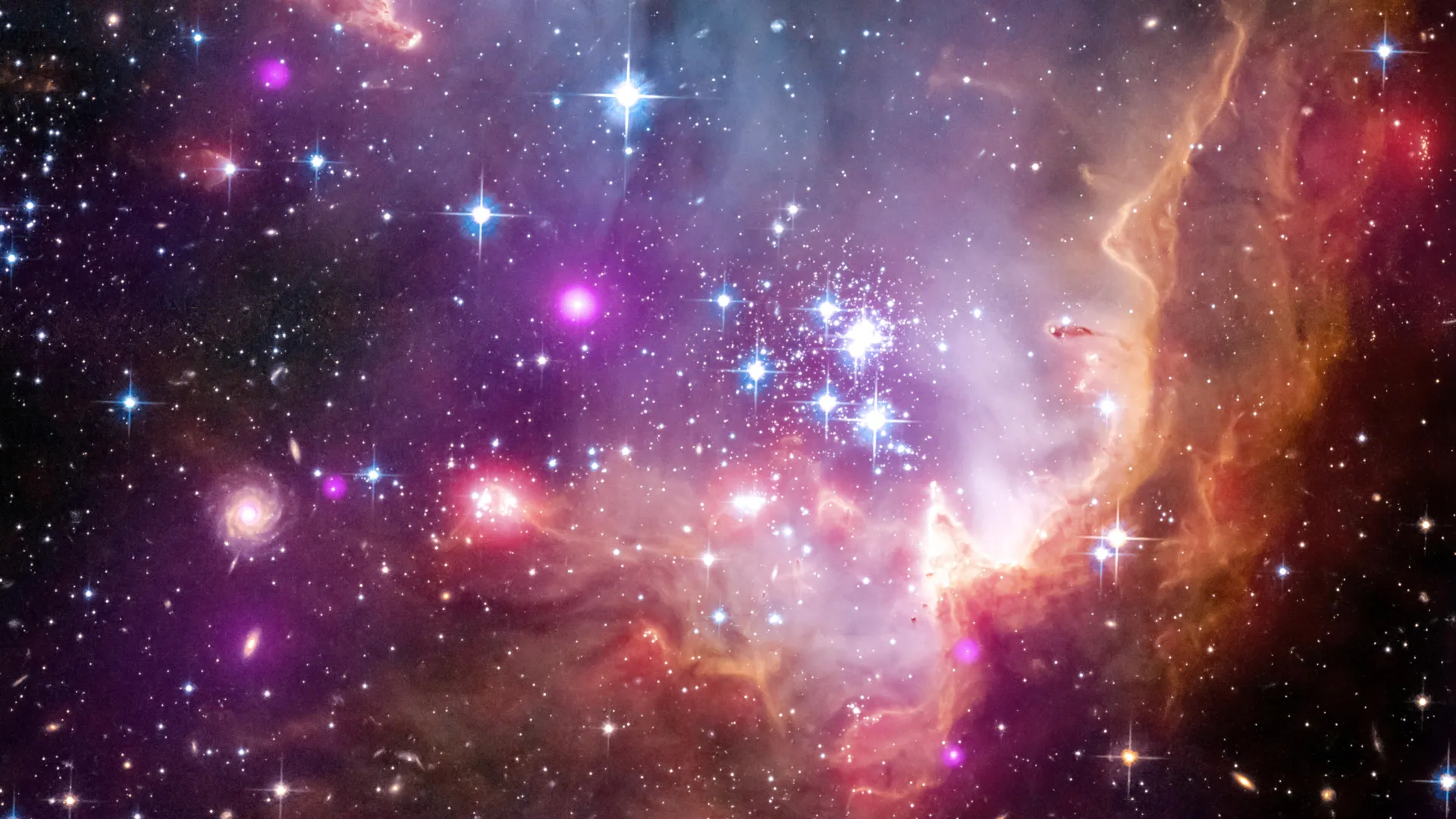
The Small Magellanic Cloud (SMC) is one of the Milky Way's closest galactic neighbors, a compact, gas-rich galaxy that can be seen with the naked eye from the southern hemisphere. It orbits our galaxy along with its larger companion, the Large Magellanic Cloud (LMC), and all three have been interacting for hundreds of millions of years. Because of its proximity, the SMC has been studied in detail for decades, with astronomers mapping its stars, tracking its gas, and measuring its motion.
Even so, one fundamental puzzle remained unresolved. Unlike most galaxies, the stars in the SMC do not move in orderly orbits around the center, leaving scientists searching for an explanation.
Collision Explains Missing Stellar Rotation
New research published in The Astrophysical Journal points to a dramatic answer. A team from the University of Arizona found that the SMC's unusual behavior is the result of a direct collision with the Large Magellanic Cloud. This finding also raises concerns about using the SMC as a standard example for understanding how galaxies formed and evolved over cosmic time.
"We are seeing a galaxy transforming in live action," said Himansh Rathore, a graduate student at Steward Observatory and the lead author of the paper. "The SMC gives us a unique, front-row view of something very transformative of a process that is critical to how galaxies evolve."
Gas, Gravity, and Disrupted Motion
The SMC contains more mass in gas than in stars. Under normal conditions, gas cools and settles into a rotating disk under gravity, much like the process that formed the flat, spinning plane of our solar system. However, earlier measurements using the Hubble Space Telescope and the European Space Agency's Gaia satellite showed that the SMC's stars were not following this expected pattern.
According to Rathore, the likely cause is a collision that occurred a few hundred million years ago. During this event, the SMC passed directly through the disk of the LMC. The gravitational forces involved disrupted the SMC's structure and scattered its stars into disorganized motion. At the same time, the dense gas in the LMC exerted strong pressure on the SMC's gas, effectively stripping away its rotation.
"Imagine sprinkling water droplets on your hand and moving it through the air -- as the air rushes past, the droplets get blown off because of the pressure it exerts. Something similar happened to the SMC's gas as it punched through the LMC," Rathore said.
Solving a Decades-Old Illusion
The study also resolves a long-standing contradiction about the SMC's gas. For years, observations suggested that the gas inside the galaxy was rotating. Since stars form from gas and typically inherit its motion, astronomers expected the stars to rotate as well. But that was not what they observed.
The new analysis shows that this apparent rotation was misleading. The collision stretched the SMC, and gas moving toward and away from Earth along this stretched shape can appear to rotate when viewed from certain angles.
Rethinking a Cosmic Benchmark
For decades, the SMC has served as an important reference point for studying how galaxies form stars and evolve. These new findings challenge that role.
"The SMC went through a catastrophic crash that injected a lot of energy into the system. It is not a 'normal' galaxy by any means," Besla said.
To reach these conclusions, the researchers used detailed computer simulations that matched the known properties of both galaxies, including their gas content, stellar mass, and positions relative to the Milky Way. They combined these models with theoretical calculations to understand how the SMC's gas behaved as it moved through the LMC's dense environment. The team also developed new techniques to interpret the scrambled motions of stars in a galaxy that has experienced a collision.
This matters because the SMC's small size, high gas content, and low abundance of heavy elements made it a key comparison for galaxies in the early universe. If it is still recovering from a major collision, it may no longer serve as a reliable model.
Clues About Dark Matter From a Galactic Impact
The collision may also provide new insight into dark matter. In a separate study published in 2025, the same team found that the impact left a visible mark on the Large Magellanic Cloud. Its central bar-shaped structure is tilted out of the galaxy's plane, a feature linked to the collision.
Rathore explained that the degree of this tilt depends on how much dark matter the SMC contains. This relationship offers a new way to estimate dark matter, which cannot be observed directly and is only detected through its gravitational influence.
"We are used to thinking of astronomy as a snapshot in time," Rathore said. "But these two galaxies have come very close together, gone right through one another, and transformed into something different."
Story Source:
Materials provided by University of Arizona. Note: Content may be edited for style and length.
Journal Reference:
- Himansh Rathore, Gurtina Besla, Roeland P. van der Marel, Nitya Kallivayalil. A Galactic Transformation—Understanding the SMC’s Structural and Kinematic Disequilibrium. The Astrophysical Journal, 2026; 1000 (1): 50 DOI: 10.3847/1538-4357/ae4507
Cite This Page: