
Scientists stretched a liquid and it snapped like a solid
Under extreme stress, even ordinary liquids can snap like solids—rewriting the rules of fluid physics.
- Date:
- March 30, 2026
- Source:
- Drexel University
- Summary:
- Scientists have discovered something that seems almost impossible: under the right conditions, ordinary liquids can snap apart like solid objects. In experiments, researchers found that when certain liquids are stretched with enough force, they don’t just thin and flow—they suddenly fracture with a sharp break, much like metal under stress. This surprising behavior appears to be tied to viscosity, not elasticity, challenging long-held assumptions about how liquids behave.
- Share:
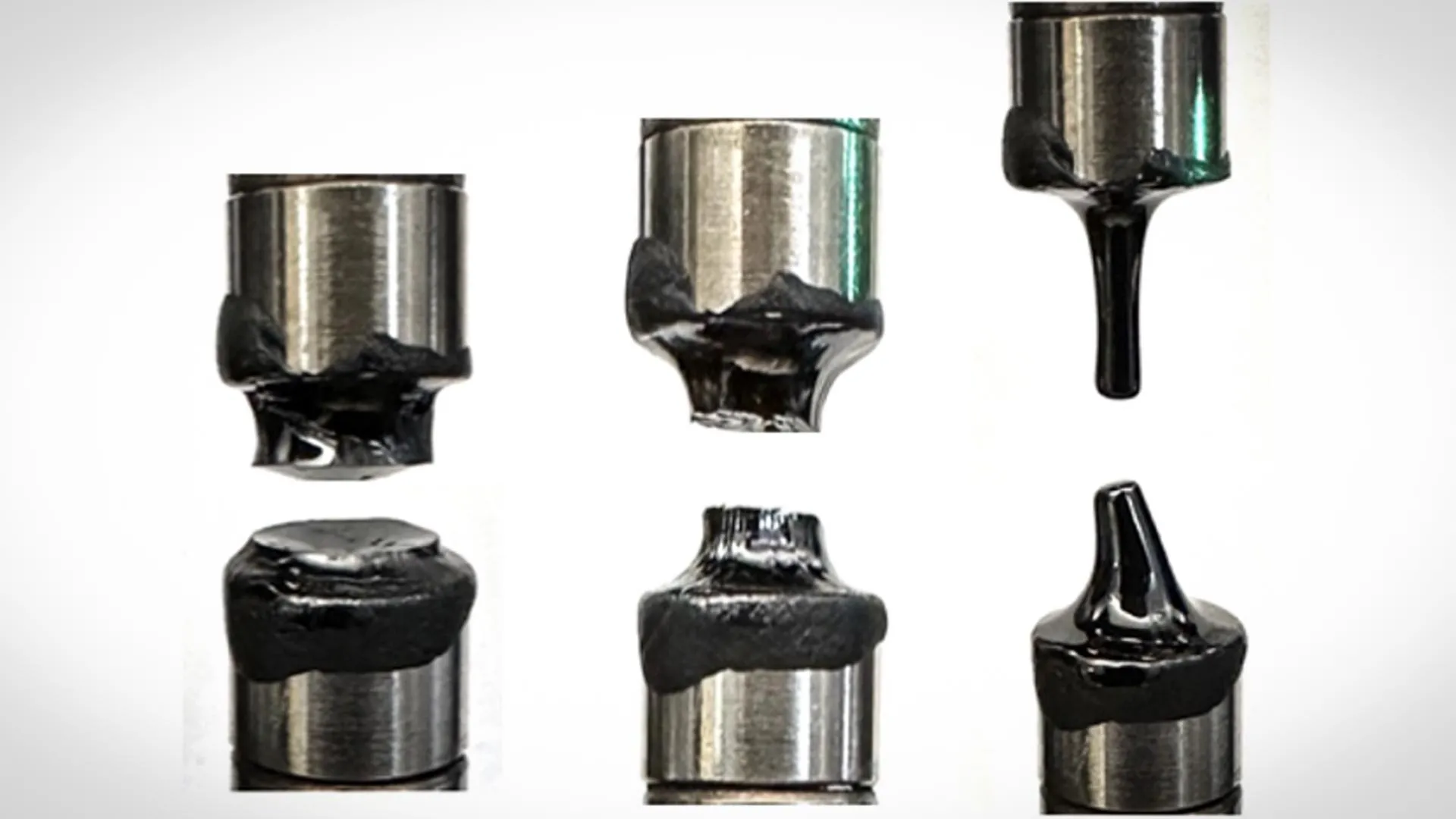
In a surprising discovery that could reshape fluid mechanics, researchers at Drexel University have shown that under certain conditions, a simple liquid can behave like a solid and fracture. The study, published in Physical Review Letters, demonstrates that viscous liquids can abruptly snap when stretched with enough force.
This finding suggests that viscosity, or a liquid's resistance to flow, plays a much larger role in its mechanical behavior than scientists previously believed. It also opens the door to new ways of controlling liquids in applications ranging from hydraulics and 3D printing to blood flow in the body.
"Our findings show that if pulled apart with enough force per area, a simple liquid -- a liquid that flows -- will reach what we call a point of 'critical stress,' when it will actually fracture like a solid. And this is likely true for all simple liquids, including common examples, such as water and oil," said Thamires Lima, PhD, an assistant research professor in Drexel's College of Engineering, who helped to lead the research. "This fundamentally changes our understanding of fluid dynamics."
A Surprising Snap During Testing
The discovery came unexpectedly while Lima and her team were studying two simple liquids in collaboration with ExxonMobil Technology & Engineering Company. During an extensional rheology test -- which measures how much force is needed to make a liquid flow -- the researchers observed something unusual. Instead of stretching and thinning like honey, the tar-like liquids suddenly snapped apart.
"What we observed was so unexpected that we needed to repeat the experiments a few more times to make sure it was real," said Nicolas Alvarez, PhD, a professor in the College of Engineering whose lab led the research. "Once we confirmed the phenomenon, the research became an entirely different scientific endeavor."
Using a high-speed camera, the team captured behavior typically seen in solid materials. When stretched, solids elongate until they reach a critical stress point, then break suddenly in a process known as brittle fracture. According to the researchers, this type of fracture had never before been observed in a simple liquid.
"This was an incredibly surprising thing to behold," Lima said. "The fracture caused a very loud snapping noise that actually startled me. I thought at first the machine had broken, but soon realized that the noise came from the stretching fluid."
Viscosity and the Critical Breaking Point
The first liquids to exhibit this behavior were tar-like hydrocarbon blends, which fractured at a critical stress of 2 megaPascals -- roughly the force you might feel if a laundry bag filled with 10 bricks snagged on your fingernail while falling.
To explore further, the researchers tested another simple liquid, styrene oligomer, with the same viscosity. It fractured under the same stretching conditions, indicating that viscosity is a key factor in this solid-like breaking behavior and suggesting that many simple liquids may share a similar breaking point.
The team then adjusted temperature to change viscosity. At each level, they found a specific stretching rate that triggered fracture, always tied to the same 2 megaPascal critical stress. At lower viscosities, the liquids could not be broken because the testing equipment could not stretch them fast enough.
Challenging Long-Held Assumptions
Until now, fracture has been considered a property of elasticity, which is a material's ability to store and withstand stress. Simple liquids, however, do not typically store stress in this way. Instead, they flow when force is applied, rather than bending or breaking.
In most cases, elasticity only becomes relevant when a liquid is cooled below its "glass transition," the point where it begins to behave more like a solid. Observing fracture in liquids that are still fully in their liquid state shows that breaking is not limited to elastic materials.
"Although viscoelastic and polymer liquids -- things like Oobleck or homemade slime -- have demonstrated solid-like fracture behavior, simple liquids have always been thought to exhibit continuous deformation at temperatures above their glass transition and therefore would not fracture," Lima said. "Showing that viscous effects are enough to promote solid-like fracture behavior opens a world of new questions to explore in this area of scientific inquiry."
A Broad and Unexpected Phenomenon
The researchers also compared a simple liquid, oligomer styrene, with a related polymer liquid. Both broke at the same critical stress point, suggesting that elasticity is not responsible for the fracture behavior in simple liquids.
"This suggests that many other elastic liquids might also break at a relatively similar critical stress point," Lima said. "This points to a phenomenon that is relatively chemistry independent and possibly generalizable to a wide range of liquids."
What Causes Liquids to Fracture
The team plans to continue investigating why this happens and how widespread the effect may be. Early evidence points to cavitation -- a process where tiny vapor bubbles form and collapse rapidly, generating shockwaves within the liquid -- as a possible explanation.
"Now that we have reported this unanticipated behavior, the work of fully understanding why it happens and how the behavior manifests in other liquids is an important next step," Lima said. "It will also be interesting to see how this finding may be applied to assist fiber spinning and other applications that use viscous liquids."
Story Source:
Materials provided by Drexel University. Note: Content may be edited for style and length.
Journal Reference:
- Thamires A. Lima, Nicolas J. Alvarez, Stuart E. Smith, Kazem V. Edmond, Manesh Gopinadhan, Emmanuel Ulysse. Unexpected Solidlike Fracture in Simple Liquids. Physical Review Letters, 2026; 136 (12) DOI: 10.1103/t2vy-32wr
Cite This Page: