
Ancient bees found nesting inside fossil bones in rare cave discovery
Ancient bees pulled off a bizarre survival trick—turning fossilized bones in a cave into their own ready-made homes.
- Date:
- April 3, 2026
- Source:
- Florida Museum of Natural History
- Summary:
- Thousands of years ago in a cave on Hispaniola, an unusual chain of events left behind a rare scientific treasure: bees nesting inside fossilized bones. After giant barn owls repeatedly brought prey like hutias into the cave, their remains accumulated in silt-rich chambers—creating a strange underground environment. Later, burrowing bees took advantage of the soft sediment and even reused tiny cavities in fossilized jaws and bones as ready-made nests, coating them with a smooth, waterproof lining.
- Share:
A giant barn owl, a type of rodent called a hutia, and a burrowing bee entered a cave. Only two of them left. Which one stayed behind? The answer is the one that cannot fly.
This unusual chain of events likely unfolded thousands of years ago on the Caribbean island of Hispaniola. The owl carried the hutia back to its cave to feed its young. The meal ended quickly, and the remains of the unlucky rodent were left scattered across the cave floor. Much later, a bee arrived, searching for a place to build its nest among the debris left behind.
How Bees Turned Fossil Remains Into Nests
The bee began digging into the fine clay-rich silt that had built up in the darker parts of the cave. Before reaching the depth it needed, it encountered the remains of the hutia.
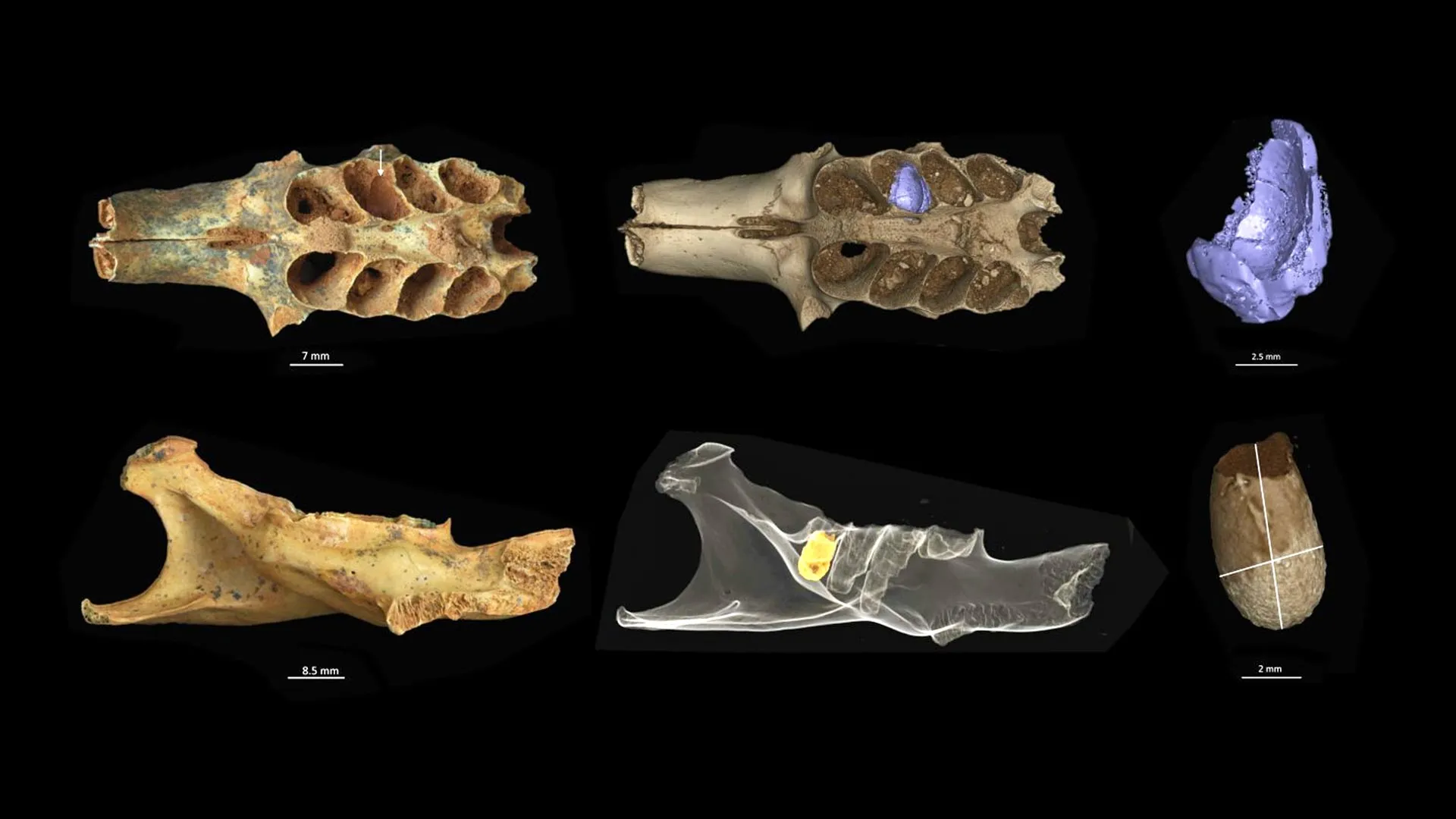
This turned out to be useful. The hutia's teeth had once been held in small sockets in the jaw, known as alveoli. Although the teeth themselves were gone, these hollow spaces remained intact and empty. Their size closely matched what the bee needed for a nest.
Over time, more bees followed, using these natural cavities inside fossilized bones as ready-made nesting sites. Long after the owl, hutia, and possibly even the bees had disappeared, paleontologists uncovered this unusual record preserved in stone.
A Careful Observation Leads to a Discovery
The discovery might have been missed if not for careful attention during excavation.
"Usually, when collecting fossils, you get all the sediment out of the alveoli while cleaning the specimen," said Lazaro Viñola Lopez, who excavated the fossils while working as a doctoral student at the Florida Museum of Natural History.
Viñola Lopez was particularly interested in this species of hutia, which was rarely found elsewhere on the island. In the Cueva de Mono in the southern Dominican Republic, he uncovered thousands of fossils from what appeared to be the same species. The cave had likely served as a long-term feeding site for giant barn owls, which repeatedly brought prey back to the same location over many generations.
Rather than immediately cleaning the fossils, he inspected them closely. One cavity stood out because its inner surface was smooth instead of rough like bone.
Mistaken Identity: Wasps or Bees?
"I'd seen something similar in Montana when I was collecting dinosaur fossils in 2014," he said. At the time, he and his colleagues found wasp cocoons mixed in with fossil material. He initially assumed the same explanation applied here. He recalls thinking, "it would be nice to write a short paper reporting the occurrence of these wasp nests in the mandibles."
He shared the idea with his colleague Mitchell Riegler, another doctoral student at the museum. Riegler was not immediately convinced. "I was like, Lazaro, that's a niche project, and I have a lot of other things to do."
The idea sat on hold until Riegler took on a challenge from a former advisor to write a scientific paper within a week.
"He and I played this game back and forth in which we tried to write a paper in a week."
At first, the team believed they were documenting wasp nests. But after reviewing research on ichnofossils, which are traces of past activity such as footprints, droppings, or nests, they realized something did not match.
Wasp nests typically have rough walls made from chewed plant material and saliva. The structures in the fossils were smooth. Bees, however, often coat their nests with a waxy secretion that creates a waterproof, polished interior. This detail revealed the true identity of the nest builders.
They had been studying bees, not wasps.
A Rare and Unprecedented Behavior
This correction made the discovery far more significant. There is only one other known case of burrowing bees nesting inside a cave, and none where bees used pre-existing fossil structures without altering them. A previous report described bees drilling into human bones, but not simply occupying natural cavities like these.
Realizing the importance of their findings, the researchers slowed down and expanded their study. They consulted experts in modern bees and reviewed scientific literature in detail. Viñola Lopez returned to the cave to examine its geological layers.
At one point, the cave faced a potential threat when someone attempted to develop the land and convert the cave into a septic tank. Although the plan was ultimately stopped, the team acted quickly to recover as many fossils as possible.
"We had to go on a rescue mission and get as many fossils out as possible, and we got a lot of them," Viñola Lopez said.
Nests Found in Multiple Fossil Types
The final study provides a detailed look at the cave's history and the unusual nesting behavior of these bees. The nests were not limited to hutia jaws.
In one case, a nest was discovered inside the pulp cavity of a sloth tooth. Tree sloths once lived in the Caribbean but disappeared after humans arrived. Another nest was found inside a hutia vertebra, in the space that once housed the spinal cord.
CT scans revealed that some cavities contained multiple layers of nests. Instead of digging new tunnels, certain bees reused existing ones if they were empty. In one example, six nests were stacked within a single alveolus, arranged one inside another like Russian dolls.
Why Bees Moved Into the Cave
The study also offers an explanation for this unusual behavior. The surrounding landscape is made of karst, a type of sharp limestone terrain that lacks stable soil.
"The area we were collecting in is karst, so it's made of sharp, edgy limestone, and it's lost all of its natural soils," Riegler said. "I actually fell on it at one point, so I can tell you all about it."
Any soil that does accumulate on the surface is often washed into caves, where it settles and creates pockets of suitable material. These deposits may have provided some of the only viable nesting conditions for burrowing bees in the region.
A Cave Full of Stories Still to Tell
The researchers are continuing to study other fossils recovered from the cave, with additional findings expected in future publications.
Their work, published in the Proceedings of the Royal Society B, reveals a remarkable example of how life can adapt in unexpected ways. In this case, a cave filled with the remains of past meals became a shelter for a completely different kind of inhabitant.
Key Points
- Scientists studying a cave on the Caribbean island of Hispaniola have uncovered the first known evidence of ancient bees nesting inside natural cavities within fossilized bones, a behavior never documented before.
- Burrowing bees usually build their nests in open soil, not inside caves. Only one other case of cave nesting has ever been recorded. In this instance, researchers believe the bees adapted because there was little usable soil outside, while fine sediment inside the cave provided a suitable alternative.
- The cave itself was shaped by generations of giant barn owls, which brought prey inside and left behind bones, eggshells, and other remains. These accumulated over time, creating a unique environment that supported both the owls and, later, the nesting bees.
Story Source:
Materials provided by Florida Museum of Natural History. Note: Content may be edited for style and length.
Journal Reference:
- Lázaro W. Viñola-López, Mitchell Riegler, Selby V. Olson, Johanset Orihuela, Julio A. Genaro, América Sánchez-Rosario. Trace fossils within mammal remains reveal novel bee nesting behaviour. Royal Society Open Science, 2025; 12 (12) DOI: 10.1098/rsos.251748
Cite This Page: