
New solid-state material converts sunlight into higher-energy UV light
Scientists have found a way to turn ordinary sunlight into UV light with a novel material, unlocking new possibilities for solar-powered technologies.
- Date:
- June 26, 2026
- Source:
- Kyushu University
- Summary:
- A new sunlight-powered material can convert visible light into higher-energy UV light, overcoming a challenge that has frustrated scientists for years. The breakthrough could enable cleaner air purification, solar-driven chemistry, and advanced manufacturing technologies using nothing more than natural sunlight.
- Share:
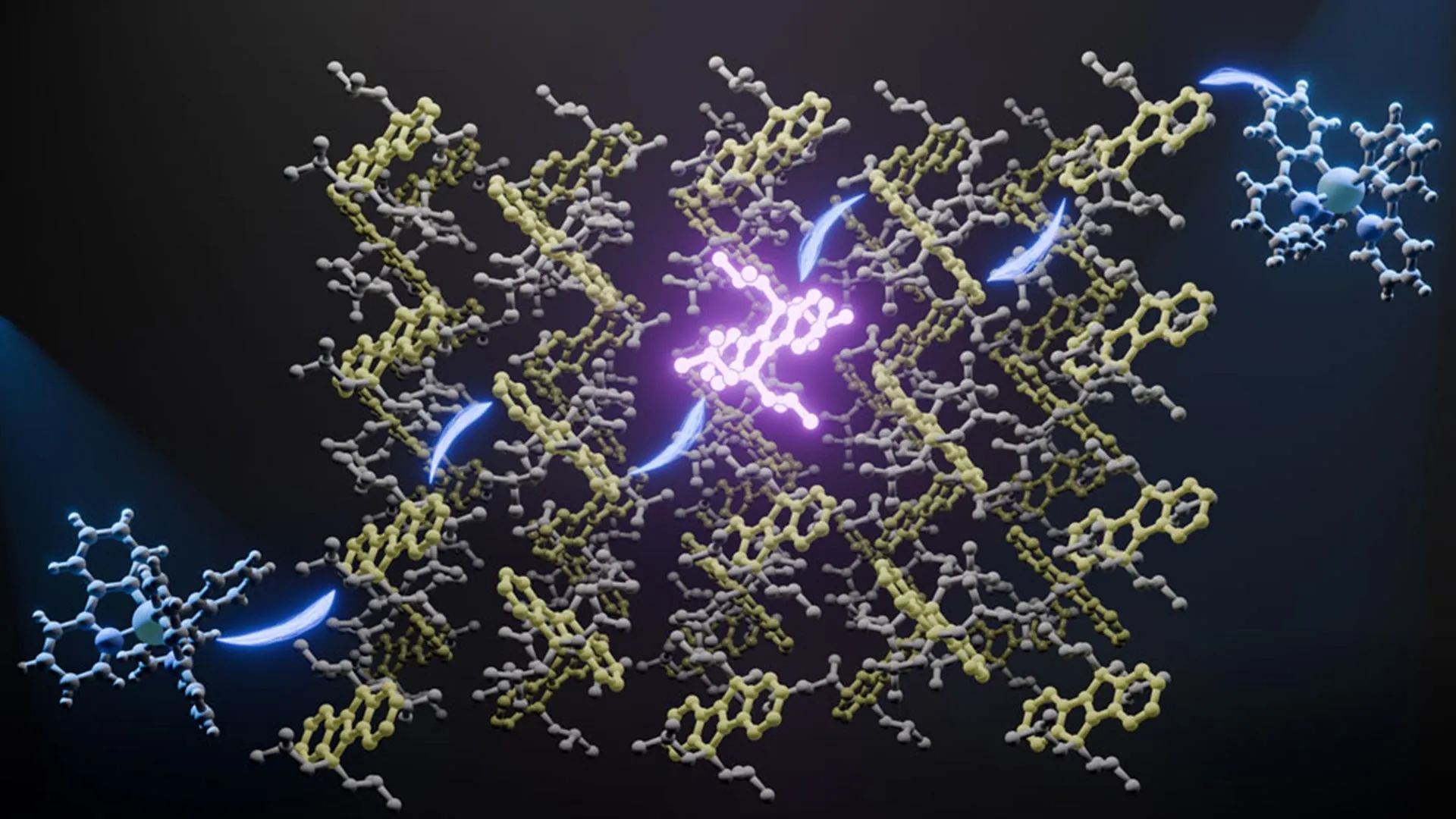
Imagine pouring together two cups of warm water and somehow ending up with a cup of boiling water. That cannot happen in everyday life, but at the quantum level, something similar is possible. Multiple low-energy particles of light can combine their energy to create a single particle with much higher energy.
Researchers at Kyushu University have now created a solid-state molecular material capable of converting visible sunlight into ultraviolet (UV) light under normal outdoor conditions. The new material achieves a photo upconversion efficiency of 1.9%, according to a study published June 23 in Nature Communications.
Why UV Light Matters
Although many people associate UV light with sunburns and skin damage, it plays an important role in numerous technologies. UV light is used for air purification, curing resins in 3D printing, hardening gels in dental fillings, and even applications such as nail treatments.
Despite its usefulness, UV light represents only about 6% of the sunlight that reaches Earth's surface. Even then, only part of that UV radiation is practical for technological applications.
"What we do here is 'add together' the energy from two visible light photons to make one ultraviolet photon. It's a fascinating process called photo upconversion," explains Yoichi Sasaki, Associate Professor at Kyushu University's Faculty of Engineering and the study's corresponding author.
Turning Visible Light Into UV Light
The process relies on a phenomenon known as triplet-triplet annihilation (TTA). In this approach, a molecule known as a donor absorbs visible light and enters a high-energy triplet state. That energy is then transferred to a nearby acceptor molecule.
When two triplet states encounter one another, they combine and release their energy as a single UV photon.
Scientists have long known that TTA works effectively in liquids because molecules can move freely and interact easily. However, liquid systems often require toxic solvents and may evaporate over time, limiting their practicality. As a result, researchers have spent years searching for a reliable solid-state alternative.
"In solids, molecules are packed tightly, and the π electron clouds -- regions of high electron density hovering above and below each molecular plane -- can overlap," says Sasaki. "When that happens, triplets easily fizzle out before they ever meet. Molecules must be close enough for energy to transfer but separated enough to prevent quenching of excitons."
A New Solid-State Solution
The team's breakthrough came from an organic semiconductor called dihydroindenoindenedene (DHI).
The researchers modified DHI by attaching alkyl chains to its sp³ carbon atoms -- which have four bonds pointing in fixed 3D directions. This design created carefully controlled spacing between neighboring molecules. The molecules remained close enough to transfer energy efficiently while avoiding the strong electronic interactions that can suppress performance.
The resulting material exhibited strong luminescence, long-lived excited states, and highly effective energy transfer. It achieved a solid-state fluorescence quantum yield greater than 60%.
When paired with a donor molecule, the system reached an upconversion efficiency of 1.9%.
"This means roughly two UV photons are produced for every hundred visible-light photons absorbed," Sasaki adds. "It may sound low, but it runs on natural sunlight alone. Most solid-state materials cannot realize this even at much higher light intensity."
Potential Applications for Solar-Powered UV Light
The researchers have filed a patent application for the material.
In addition to its performance, the material offers practical advantages. It can be synthesized relatively easily and is made from inexpensive starting materials. The team believes it could eventually be used in solar-powered photocatalysis, indoor air purification systems, and low-intensity 3D printing technologies.
A 14-Year Scientific Journey
For the researchers involved, the achievement represents more than a technical advance.
In 2012, Nobuo Kimizuka, now Professor Emeritus at Kyushu University's Research Center for Negative Emissions Technologies, began exploring photon upconversion through triplet energy migration in self-assembled molecular systems. His goal was to establish a form of molecular systems chemistry in which self-assembly could perform useful functions.
Over the following years, his group made steady progress using solution-based and gel-based systems. Efficient solid-state upconversion, however, remained difficult to achieve.
A major breakthrough finally arrived in May 2024, less than a year before Kimizuka's retirement.
The months that followed became an intense push to bring the project to completion. Graduate students Naoyuki Harada, Hayato Shoyama, and Nutnicha Boonmong worked alongside Sasaki and then-Assistant Professor Kiichi Mizukami of Kyushu University's Faculty of Engineering to consolidate years of research into a final publication.
"We handed the draft to Professor Kimizuka just 11 days before he left the lab, which for us felt like a heartfelt retirement gift," Sasaki notes.
"This discovery is the culmination of over 14 years of our research and marks a major milestone in photon-upconversion and molecular self-assembly research," concludes Kimizuka.
Story Source:
Materials provided by Kyushu University. Note: Content may be edited for style and length.
Journal Reference:
- Naoyuki Harada, Hayato Shoyama, Nutnicha Boonmong, Kiichi Mizukami, Yuya Watanabe, Pei Zhao, Masahiro Ehara, Yoichi Sasaki, Nobuo Kimizuka. Sterically protected π-electron systems for efficient solid-state photon upconversion. Nature Communications, 2026; 17 (1) DOI: 10.1038/s41467-026-73898-0
Cite This Page: