
MIT neuroscientists discover the brain can reason without words
- Date:
- August 11, 2026
- Source:
- Massachusetts Institute of Technology
- Summary:
- MIT neuroscientists have found striking evidence that language and logical reasoning are powered by separate systems in the brain. Even people with severe language impairments caused by stroke were able to solve challenging logic puzzles as well as people without those impairments, while brain scans showed that language-processing regions stayed largely quiet during reasoning tasks.
- Share:
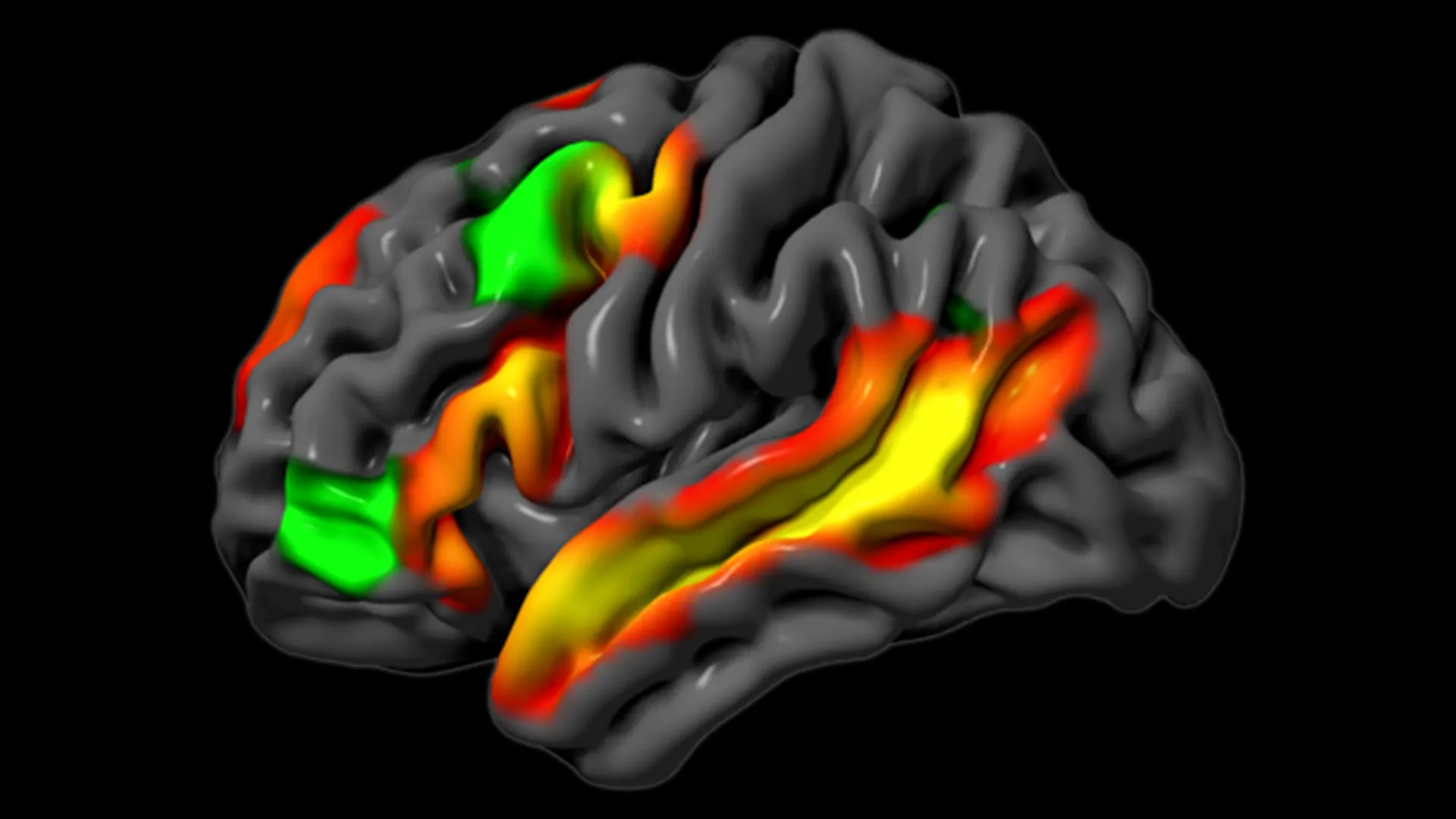
Talking through a difficult problem can help some people organize their thoughts. But according to cognitive neuroscientists at MIT's McGovern Institute for Brain Research, language itself is not required for logical reasoning.
In research published recently in the journal PNAS, a team led by MIT associate professor of brain and cognitive sciences Evelina Fedorenko found that people can successfully solve problems requiring logical reasoning even when their language abilities are severely impaired. Brain imaging also indicated that regions responsible for processing language are not recruited for logical reasoning.
Are Language and Thought Really Connected?
For thousands of years, philosophers, linguists, and cognitive scientists have debated whether language is essential for thought. Many have argued that people rely on language as a tool for thinking.
Hope Kean, a postdoc and former K. Lisa Yang Integrative Computational Neuroscience (ICoN) Center graduate fellow in Fedorenko's lab, says there are understandable reasons to think language and logic might be closely connected.
"Abstract thinking has properties that look a lot like language," Kean says, pointing to structural similarities. "You can decompose a thought into subcomponents, like little atoms of logical propositions, and you can combine them in a hierarchical manner to make more complex structured rules, very akin to language."
Still, Kean and Fedorenko, who is also a McGovern Institute investigator, suspected that the brain might separate the communication of reasoning from reasoning itself. People rely heavily on language when presenting a problem, discussing possible solutions, or explaining how they reached a conclusion. The underlying process of logical thought, however, might depend on a different brain system.
"There are aspects of thinking that seem to go beyond some of the limitations of language," Kean explains. Logical reasoning often requires a level of precision that ordinary language does not provide. Language also unfolds in a linear sequence, one word after another, while reaching a logical conclusion may require considering several pieces of information in ways that are less linear.
Testing Logical Reasoning Without Language
These questions led Kean to investigate how the brain actually performs logical reasoning. Studying the issue is challenging because researchers working with human participants normally rely on language to explain tasks and receive answers.
Fedorenko's group found a way around that obstacle by working with Rosemary Varley, a neuroscientist at University College London who studies acquired language disorders, and her team.
The researchers studied two people who had experienced strokes that damaged language-processing areas of the brain. Both had severe difficulty understanding and producing language.
To test reasoning without depending on language, the researchers developed logic games centered on numbers and visual patterns. In one task, participants saw two lists of numbers and had to determine the hidden rule that transformed one list into the other. A rule might involve reversing the digits or eliminating numbers above a certain value. After identifying the rule, participants had to use it on new examples.
Another task presented participants with a collection of geometric patterns. They then had to choose the pattern that correctly completed the matrix.
As the puzzles became more difficult, the results suggested that language was not necessary for this form of reasoning. The participants with severe language impairments performed as well as a control group. They could even convey the rules they had discovered through gestures or sketches.
"It really upends a theory that says that symbolic rule induction is not possible without linguistic capacities," says Kean.
Brain Scans Reveal a Divide Between Logic and Language
The researchers also examined what happens inside the brains of healthy adults while they solve logical problems.
Participants visited MIT for a series of MRI scans that recorded patterns of brain activity as they completed different tasks. Some tasks involved logic games. Others were designed specifically to identify each participant's language-processing regions. A separate group of tasks mapped the so-called "multiple demand network" -- a distributed brain system that supports complex problem-solving.
The neurotypical participants completed logic puzzles similar to those given to the participants with language impairments. They also worked through problems involving syllogistic reasoning.
These problems used "if-then" statements such as "if the ball is red, then it is big. The ball is red. Is the ball big?"
The researchers adjusted the difficulty of the puzzles to determine which parts of the brain became more active as reasoning demands increased. They also compared brain activity when participants had to discover a hidden rule with activity when they simply applied a rule they had already been given.
The scans revealed a clear distinction between language and logic. The brain's language system was not activated during either inductive reasoning (when participants identified hidden rules) or deductive reasoning (when they assessed the validity of syllogistic conclusions).
The results involving the multiple demand network were more unexpected. Scientists had suspected that this network would play an important role in logical reasoning. It became active during inductive reasoning, but it did not appear to participate in deductive reasoning. Kean is continuing to investigate that finding in her ongoing research.
For Fedorenko and Kean, the results provide strong evidence that language and logic rely on distinct systems in the brain. The findings also build on earlier work from Fedorenko's lab showing that other forms of thought, including object categorization and social reasoning, do not depend on language.
What the Findings Mean for Aphasia
The research could have important implications for how people understand acquired language impairments, or aphasia.
Professionals who work with people with aphasia have long understood that losing language abilities does not mean losing intelligence. Someone with aphasia may still enjoy playing chess, completing sudoku puzzles, or managing a family's finances. Yet other people can mistakenly interpret difficulty communicating as evidence of difficulty thinking.
"This research adds to a growing body of work establishing that even severely aphasic individuals can preserve their ability for abstract logical thought -- a defining feature of our species," Fedorenko says. "We should continue to educate the public that linguistic difficulties -- in aphasia, but also in those with developmental language conditions, such as stuttering, or those who do not speak English natively -- are not indicative of how smart or capable someone is."
A Possible Lesson for Artificial Intelligence
The findings may also have implications for artificial intelligence.
Large language models such as ChatGPT and Claude are trained entirely on text and produce text as their output, yet they can convincingly simulate certain forms of human reasoning.
The human brain appears to work differently. In people, language and abstract logical thought are distinct. Kean says studying the differences between human reasoning and the way large language models operate could provide useful ideas for the development of future AI systems.
Understanding exactly how the human brain performs reasoning remains an open area of research. Kean describes it as a new frontier in the geography of thought -- and one she is eager to explore.
Story Source:
Materials provided by Massachusetts Institute of Technology. Original written by Jennifer Michalowski. Note: Content may be edited for style and length.
Journal Reference:
- Hope Kean, Alexander Fung, Paris Jaggers, Jason Chen, Joshua S. Rule, Yael Benn, Joshua B. Tenenbaum, Steven T. Piantadosi, Rosemary A. Varley, Evelina Fedorenko. Evidence from formal logical reasoning reveals that the language of thought is not natural language. Proceedings of the National Academy of Sciences, 2026; 123 (28) DOI: 10.1073/pnas.2520095123
Cite This Page: