
Why scientists asked 1,000 people to bury their underwear
- Date:
- August 28, 2026
- Source:
- University of Zurich
- Summary:
- More than 1,000 volunteers buried cotton underwear across Switzerland to help scientists measure how active different soils are. The faster the fabric disappeared, the more biological activity was taking place underground. Gardens showed the fastest decomposition, while lawns had the least, revealing how strongly land management can shape soil life.
- Share:
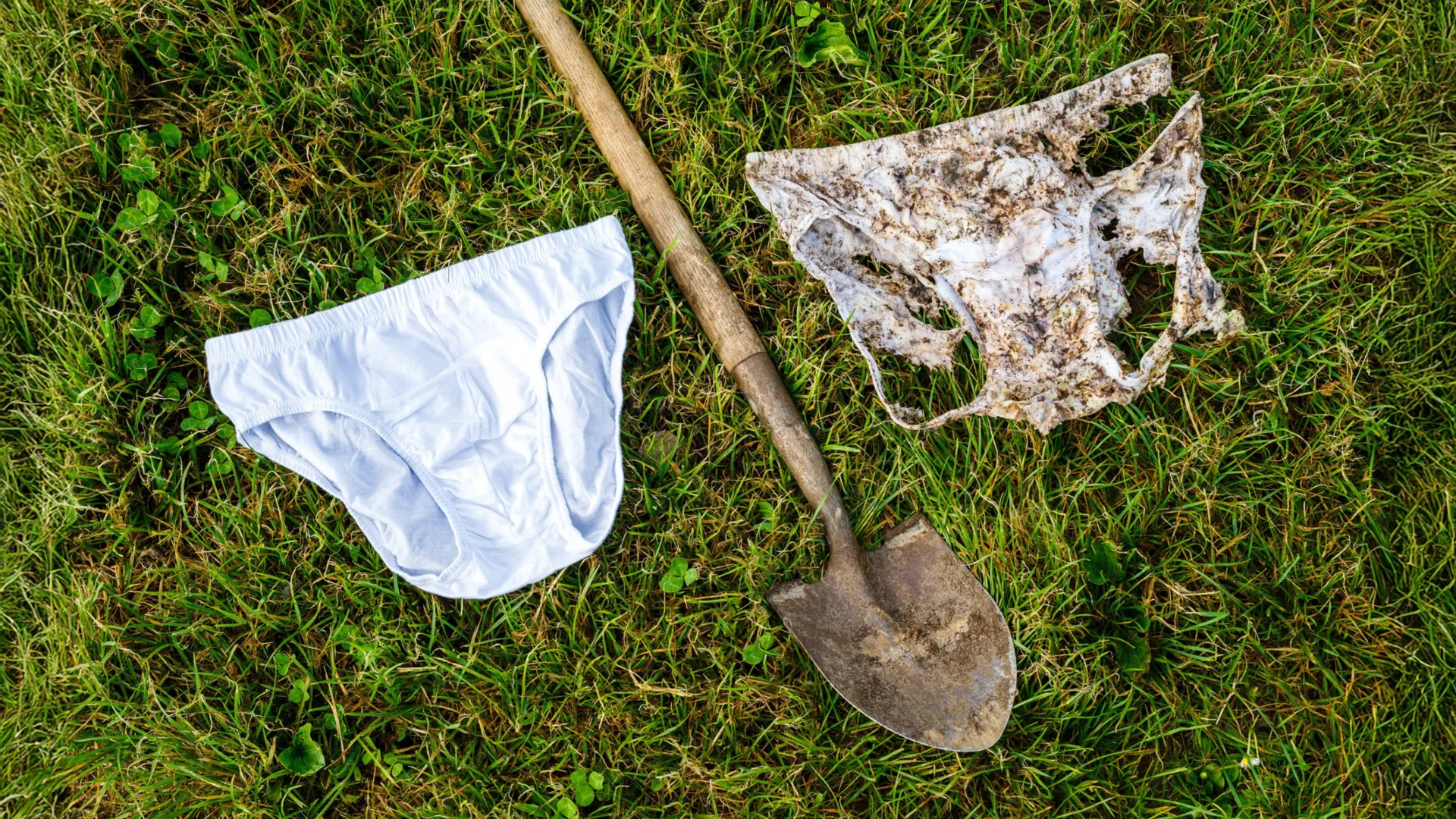
Soil supports the food we eat, stores water, carbon and nutrients, and provides habitat for an enormous share of life on Earth. Scientists estimate that more than half of global biodiversity exists below the surface. But soil biodiversity is declining around the world, threatening agriculture, food security and the ability of ecosystems to function properly.
To investigate this hidden world, researchers from the University of Zurich (UZH) and Agroscope, the Swiss federal center of excellence for agricultural research, launched the citizen science project Proof by Underpants (Beweisstück Unterhose) in 2021. The project was designed both to raise awareness of soil ecosystems and to generate scientific data.
Following the same standardized method, 1,000 volunteers buried more than 2,000 pairs of cotton underwear and 12,000 tea bags at roughly 1,000 sites across Switzerland. After two months, participants dug them up, photographed them, and sent the material to the laboratory along with soil samples for further study.
Decomposing Underwear Reveals Soil Activity
The findings, published in Plants, People, Planet, produced a broad map of biological activity in Swiss soils. Researchers found that the cotton underwear broke down at very different speeds depending on where it was buried.
That decomposition rate served as a simple indicator of how much biological activity was taking place underground. When soil organisms were more active, they broke down the cotton more quickly.
Private gardens showed the fastest decomposition. Researchers also found that these soils contained the highest amounts of organic matter, creating favorable conditions for earthworms, fungi, bacteria, and other organisms that live in soil.
Lawns showed the lowest level of soil organism activity. Agricultural fields and meadows ranked between gardens and lawns.
Land Use Strongly Shapes Soil Health
"Our results show that how soil is managed can significantly affect both soil life and soil quality," says co-study leader Marcel van der Heijden, UZH professor of agroecology. "Healthy, biologically active soil is crucial for fertility, nutrient cycling and many other ecosystem services."
The researchers point to several practices that can encourage soil life. These include keeping soil permanently covered, applying compost, using more diverse crop rotations and reducing the use of mineral fertilizers and pesticides.
Among the factors studied, land use had the strongest influence on how quickly the underwear decomposed. Whether a location was a garden, meadow, cultivated field or lawn explained differences in decomposition better than most of the soil characteristics the researchers measured.
Chemical properties also mattered. Nutrient levels, for example, had a significant effect on how active the soil was.
Faster Decomposition Is Not Always Better
Rapid breakdown of the underwear was often associated with fertile soil and a plentiful supply of nutrients. For agricultural land, those conditions can be beneficial because they support plant production.
"However, maximum decomposition is not desirable in every ecosystem," says co-project leader Franz Bender, head of the agroecological assessments team at Agroscope.
"In near-natural habitats such as forests, very high nutrient levels can indicate disruptions to the natural balance of nutrients. In gardens, too, rapid decomposition of the underwear may point to an oversupply of nutrients," says Bender.
When that happens, gardeners may want to consider whether they are using too much fertilizer. Biological activity in soil is also strongly influenced by temperature and moisture. If the ground becomes too cold or too dry, soil organisms become far less active.
An "Underwear Index" for Soil Health
The experiment shows that burying cotton underwear can offer a simple but useful way to compare biological activity and fertility in different soils.
The researchers suggest creating an "underwear index" that could make soil processes easier for the public to understand while drawing attention to the importance of protecting healthy soils.
Citizen Scientists Build a National Soil Dataset
The "Proof by Underpants" project also highlights the value of citizen science. A study spanning about 1,000 locations across Switzerland would have been difficult to carry out without the participation of so many volunteers.
Because samples came from every region of the country, the project produced one of Switzerland's most comprehensive datasets on soil life.
The scale of public involvement is also reflected in the study's authorship. Around 240 citizen scientists are listed as co-authors of the publication.
In return for their participation, researchers gave volunteers personalized feedback, including soil analysis results, evaluation tools and advice for managing soil more sustainably.
Story Source:
Materials provided by University of Zurich. Note: Content may be edited for style and length.
Journal Reference:
- S. Franz Bender, Diane Bürge, Luca Bragazza, Eva Knop, Sandie Masson, Noemi Peter, Romina Demarmels, Daniel Mueller, Ariane Imhof, Pia Viviani, Atlant Bieri, Frank Liebisch, Stefan Geisen, Yann Hautier, Panos Panagos, Pablo Garcia‐Palacios, Marta Goberna, David Johnson, Simon Jöhr, Alain Valzano‐Held, Claudia Weik, Nadine Gloor, Heidi Aguilar, Marco Agustoni, Barbara Albertoni, Regina Anderson, Alberto Andreani, Bénédicte Arguillère, Osvaldo Arrigo, Barbara Auer, Vanessa Badà, Brigitte Baenteli, Gaëlle Balleys, Dagmar Bay, Daniel Beck, Martina Becker, Alma Bender‐Freisinger, Sarah Benoit, Barbara Bernasconi, Chiara Bernasconi, Marco Bertschinger, Michael Bessard, David Bichsel, David Bichsel, Matteo Binda, Joel Bischof, Ruth Bischof, Bernadette Bisig, Andreas Bitterli, Natacha Bodenhausen, Yann Bonjour, Lucien Bovy, Tanja Boyandin, Eliane Breitenmoser, Christian Brönimann, Nathalie Brückner, Marcel Bucher, Stefan Bucher, Andreas Cadonau, Simone Cairoli, Elodie Calais, Bruno Campana, Catrina Canetta Collenberg, Davide Carrara, Cristian Cattaneo, Ester‐Camilla Cattaneo, Renzo Cattori, Silvana Cavagna, Luciano‐Grazia Cavallini, Elio Cavargna, Laura Cerri, Marlis Chanton, Camilla Chiesa, Elisabeth Clément, Morgane Clivaz‐Duc, Léonie Cocquio, Helio Correia, Cristina Corti, Stefano Corti, Fabien Dauphin, Annette Délétroz, Nicola Della Casa, Francesco Denova, Yannick Ducommun, Jacques Dugon, Monique Duplan, Lisa Ehrler, Bruno Enz, Philipp Fässler, Alain Favre, Urs Fellmann, Nadine Fischer, Serge Fischer, Johann‐Peter Flisch, Franklyn Foresti, Paola Frapolli, Simon Freiburghaus, Edie Freisinger, Peter Gamper, Agnes‐Julia Geissberger, Frères Girardin, Stephan Goppel, Fabiana Greco, Ueli Grossniklaus, Gabriela Grubenmann, Marc‐Henri Guex, Urs Hähni, Martina Haller, Gerhard Hardegger, Kyle Hartman, Anastase Hategekimana, Regula Hegglin, Matteus Heiter, Andreas Hellwig, Sandra‐John Hemsley, Chantal Herzog, Stephan Herzog, Ruedi Hess, Werner Hilber, Sarah‐Lea Hipp, Jolanda Hofmann, Mirjam Hofmann, Thomas Holdener, Mischa Hug, Erol Incesu, Sebastian Ineichen, David Iten, Regula‐Christoph Jakob, Peter Jann, Salomé‐David Jantz Bröckelmann, Markus Jocher, Simon Jöhr, Jasmin Joshi, Andreas Jud, Corinne Jud, Beatrice Jung, Daniel Jutzi, Walter Käch, Franziska‐Oli Kägi, Franziska Kaguembega‐Müller, Antonia Kaiser, Lukas Kammermann, Andreas Katz, Pirmin Kneubühler, Janique Koller, Eva Kollmann, Michèle Kraiem, Markus Künzler, Laura Kuonen, David Küttel, Romeo Ladina, Gabriella Lakatos, Anna Lazzarotto, Jean Lebedeff, Manuela Leonardi, Paola Leonardi, Simone Leoni, Eric Leuenberger, Corinne Lüthi, Sari Manaa, Simonetta Mauri, Harald Menzi, Vincenzo‐Corinne Meroni Held, Stephan Meyer, Stéphan Meylan, Matteo Minotti, Paola Molinari, Fabiola Monigatti, Vinciane Monod, Andrea Moroni‐Stampa, Jürg Moser, Res Moser, Alain Müller, Balz Müller, Laurence Müller, Nathalie Nevo, Stefan Odermatt, Lucia Oertle, Sandra Ott, Sébastien Oulevey, Ania Hans‐Peter Padrutt, Manuela Paltenghi, Nadia Paltenghi, Anna Parathazham, Nicolas Pavillard, Cesare Sonia Pedrazzini Giussani, Barbara Loris Pedroia, Alicia Perego, Paola Paolo Pieracci Cestari, Luisa Poggi, Mirko Ponti, Laurence Pot, Pierre‐Antoine Preti, Brice Prudat, Lina Rasheed, Dominique Raphael Reichenbach, Etienne Reichenbach, Beat Reidy, Ruedi Riniker, Chantal Ritter Cochand, Katharina Ritter, Julien Rondez, Fabien Roth, Adrian Rubi, Nicolas Ruch, Nicla‐Alex‐Mia‐Zoe‐Febe Rusca, Mirjam Rust, Erminia Salvi Knobloch, Alberto Sassella, Anke Schäfer, Beat Schär, Sabine Schärer, Patric Schatzmann, Belinda Schegg, Joël Scheidegger, Klaus Schläppi, Judith Schlegel, Marisa Schnüriger, Toni Schönbächler, Jürg Schönholzer, Coni Schweizer, Eugenio Scozzafava, Caroline Serafini, Tina Siegenthaler, Claudio Signer, Dustin Singer, Iris Solothurnmann, Rolf Sonderegger, Stefanie R. Spycher, Mirjam Stähli, Jean‐Pierre Stefanelli, Katja Stucki, Valentina Tanzi, Christina Thalmann, Sylvia Tiercy, Valentina Togni, Mathias Tönz, Paul Trachsel, Dino Troncatti, Pirmin‐Fredy Umbricht, Claude Valloton, Alexander van der Heijden, Liev van Moorsel, Sofia van Moorsel, Thea van Woerkom, Claude Varin, Manuela Villa‐Petraglio, Christophe Viltard, Florian Vogelsanger, Adrian von Niederhäusern, Barbara Walther, Jocelyn Widmer, Gianna Wullschleger, Thomas Würms, Thomas Wüthrich, Anita Zulliger, Renatus C. Zürcher, Thomas D. Bucheli, Marcel G. A. van der Heijden. Soil health assessment using buried cotton underpants with the help of 1000 citizen scientists. PLANTS, PEOPLE, PLANET, 2026; DOI: 10.1002/ppp3.70259
Cite This Page: