
Quantum computing’s “dark horse” just proved it can go universal
- Date:
- September 25, 2026
- Source:
- University of Chicago
- Summary:
- Researchers have shown that exotic quantum particles called non-Abelian anyons can perform the full range of operations needed for universal quantum computing. Using 54 qubits on Quantinuum’s H2 processor, they combined braiding and fusion to unlock capabilities that braiding alone could not provide.
- Share:
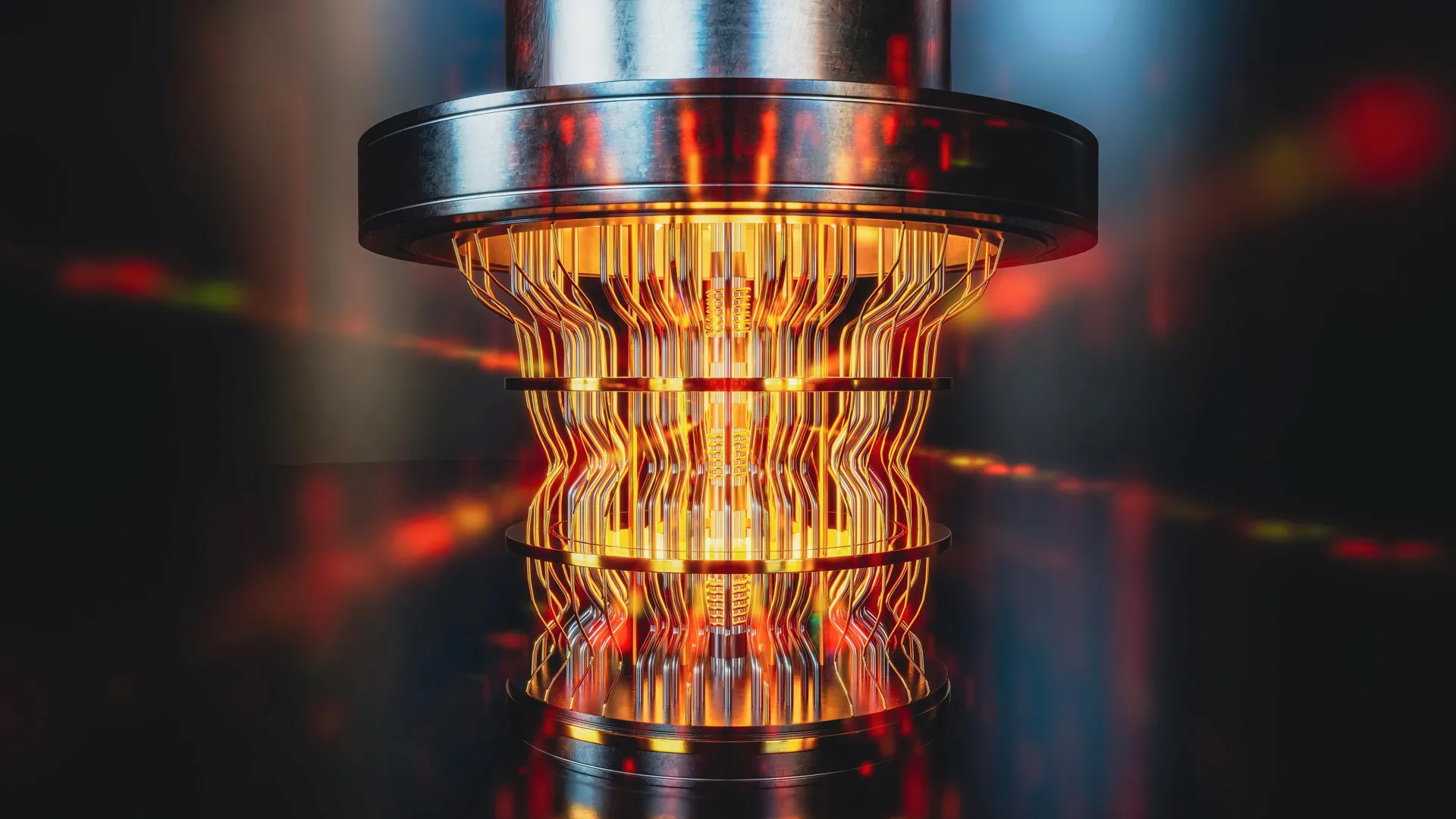
A practical quantum computer must eventually be able to handle any type of quantum algorithm, much like a conventional laptop can run many different kinds of software. Researchers have now demonstrated a new way to reach that level of flexibility using unusual quantum objects known as non-Abelian anyons.
Scientists from the University of Chicago Pritzker School of Molecular Engineering (UChicago PME), Harvard, Stony Brook University, and Quantinuum created and tested a full set of operations based on non-Abelian anyons. Their results provide the first experimental demonstration that this approach can support the broad range of operations required for universal quantum computing.
"We demonstrated a so-called universal gate set -- meaning that if you store information in these emergent versions of quarks, and you move them around, you can do any quantum computation you might want to do," said Ruben Verresen, assistant professor of molecular engineering at UChicago PME and a co-author of the new study published in Nature.
A Possible Shortcut Around Costly Quantum Error Correction
The strategy could do more than help create a general-purpose quantum computer. It may also offer a more efficient route toward reliable quantum machines.
Quantum computers are extremely vulnerable to errors, so researchers typically protect information by distributing it across many physical qubits. These error correction methods can preserve data, but they usually do not provide every operation needed to perform universal quantum computation on that protected information.
To fill the gap, engineers often rely on specially prepared resources called "magic states." Producing them usually requires an intensive purification process known as distillation, which can consume a large fraction of a quantum computer's available qubits. The new results suggest that non-Abelian anyons may offer a way around that expensive step.
"Non-Abelian codes are a dark horse in the race to quantum error correction," said Henrik Dreyer, managing director and scientific lead at Quantinuum's Munich office and a co-author of the study. "In this work we show the first universal gate set in a non-Abelian code, which demonstrates that fault-tolerant computations can in principle be done without resorting to magic state distillation or cultivation, which are the most expensive operations in standard quantum error correction codes."
Why Non-Abelian Anyons Are Different
Ordinary qubits encode information using two basic states, along with quantum combinations of those states. Non-Abelian anyons work in a fundamentally different way.
These anyons do not appear as ordinary standalone particles in nature. Instead, scientists create them inside quantum circuits by entangling many conventional qubits into a collective state that behaves as though it were a new type of particle with its own unusual rules.
"The way I think about these codes is they're creating little universes -- alternative universes, but ones that reflect some of the properties of our own," Verresen said.
Each non-Abelian anyon carries an internal state that changes when one anyon is moved around another in a process known as braiding. The sequence of those braiding operations matters (that's what non-Abelian means), allowing information to be encoded and manipulated in ways that are unavailable to ordinary particles.
Because the information is spread across many entangled qubits rather than stored in a single location, it can also be naturally protected from some of the small disturbances that frequently disrupt conventional qubits. Braiding the anyons can also perform computational operations.
Why Braiding Alone Was Not Enough
In 2024, a research team that included Verresen used a Quantinuum trapped-ion computer to create anyons associated with a symmetry group called D4 -- the rotations and reflections that leave a square unchanged -- demonstrating this form of non-Abelian order on quantum hardware for the first time.
That experiment showed that the unusual particles could be created and manipulated, but braiding them alone was not sufficient to carry out every operation required for universal quantum computing.
"In that work, we didn't demonstrate that those emergent forces were enough to do quantum computation," said Verresen. "That particular universe we created was not powerful enough."
Fusion Unlocks Universal Quantum Operations
For the new study, the researchers switched to another symmetry known as S3 -- the rotations and mirror-image flips that leave an equilateral triangle unchanged -- and created the corresponding anyons on Quantinuum's H2 trapped-ion processor using 54 entangled qubits.
The S3 system had the properties needed for universal quantum computation, but only when braiding was combined with another operation called fusion. During fusion, two anyons are brought together and the resulting state is measured.
The underlying concept was proposed theoretically in 2003 by Carlos Mochon, then a student of John Preskill at Caltech. Turning that theoretical idea into an experiment that could actually run on quantum hardware, however, required extensive additional theoretical and experimental work.
The researchers used pairs of anyons to encode "topological qutrits" which store three possible levels of quantum information instead of the two levels used by ordinary qubits.
By combining different braiding and fusion operations, the team demonstrated three key tools: one entangling gate produced through braiding and two different measurements created through fusion. Together, those operations can in principle produce any quantum operation, including operations that braiding alone could not achieve.
Beyond their possible computing applications, these unusual quantum states could also help researchers investigate fundamental aspects of physics.
"It is gratifying to see ideas we have spent our PhD work thinking about realized in the lab, and it has been made possible by remarkable advances in quantum hardware over the past few years," said Anasuya Lyons and Chiu Fan Bowen Lo, graduate students at Harvard University in the group of Ashvin Vishwanath who helped lead the work.
Toward Fault-Tolerant Quantum Computers
The researchers also demonstrated that non-Abelian anyons could directly produce a magic state using topological operations -- sidestepping the costly distillation process used in most quantum systems.
The experiment did not yet include active error correction. Instead, the researchers focused on testing the individual building blocks of the method and confirming that they could create a magic state consistent with theoretical expectations.
"So far, we've ignored the question of error correction. Here, it's more like a proof of principle," Verresen said.
The next major step will be combining these operations with active error correction. If that can be achieved, non-Abelian anyons could eventually become a practical basis for large-scale, fault-tolerant quantum computers. Verresen is already working with other PME researchers on new techniques for stabilizing non-Abelian quantum memories.
Story Source:
Materials provided by University of Chicago. Original written by Sarah C.P. Williams. Note: Content may be edited for style and length.
Journal Reference:
- Chiu Fan Bowen Lo, Anasuya Lyons, Dan Gresh, Michael Mills, Peter E. Siegfried, Maxwell D. Urmey, Nathanan Tantivasadakarn, Henrik Dreyer, Ashvin Vishwanath, Ruben Verresen, Mohsin Iqbal. Universal gates from braiding and fusing anyons on quantum hardware. Nature, 2026; 655 (8123): 591 DOI: 10.1038/s41586-026-10709-y
Cite This Page: