
Scientists discover a new state of matter at Earth’s center
Earth’s inner core hides a superionic state that softens its structure and helps fuel the planet’s magnetic heartbeat.
- Date:
- December 10, 2025
- Source:
- Science China Press
- Summary:
- New research reveals that Earth’s solid inner core is actually in a superionic state, where carbon atoms flow freely through a solid iron lattice. This unusual behavior makes the core soft, matching seismic observations that have puzzled scientists for decades. The mobility of these light elements may also contribute energy to Earth’s magnetic field. The findings reshape models of Earth’s interior and could apply to other rocky planets.
- Share:
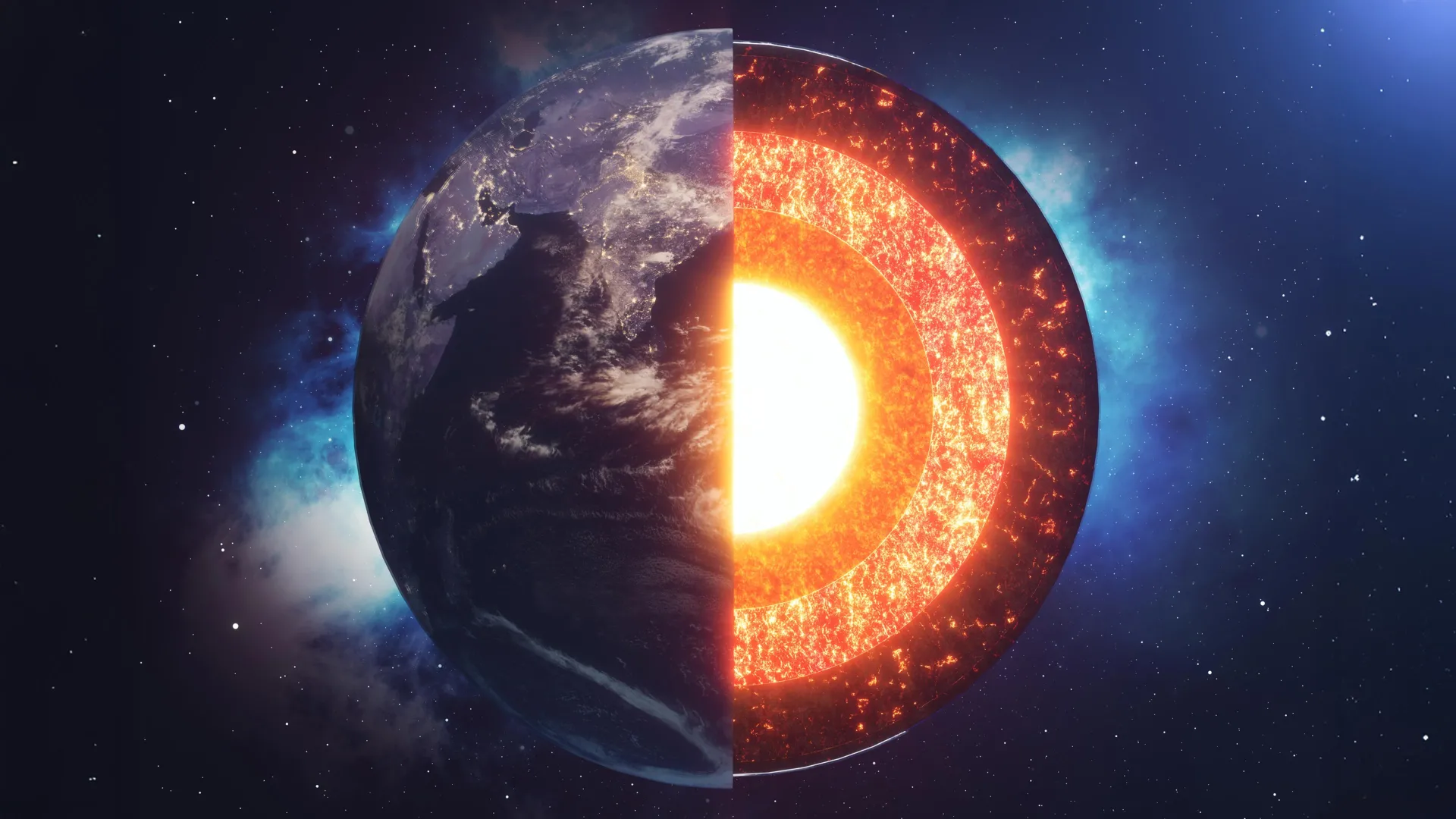
Beneath Earth's molten outer core is a dense central region -- the inner core, a compact sphere made of an iron and light-element alloy squeezed by more than 3.3 million atmospheres and heated to temperatures comparable to the Sun's surface. For many years, researchers have struggled to explain its unusual behavior. Even though the inner core is solid, it behaves like a softened metal, slowing seismic shear waves and displaying a Poisson's ratio more similar to butter than to steel. This paradox raised a fundamental question: how can the planet's solid center appear firm yet strangely pliable?
A major study published in National Science Review offers a strong explanation. The research team reports that Earth's inner core is not behaving like a conventional solid -- instead, it exists in a superionic state in which light elements move through a stable iron framework as if they were liquid. This finding reshapes our picture of the planet's deepest layer.
The investigation, led by Prof. Youjun Zhang and Dr. Yuqian Huang of Sichuan University, together with Prof. Yu He from the Institute of Geochemistry, Chinese Academy of Sciences, demonstrates that iron-carbon alloys shift into a superionic phase under the inner core's extreme conditions. In this environment, carbon atoms zip through the iron lattice at high speeds, greatly reducing the alloy's stiffness.
"For the first time, we've experimentally shown that iron-carbon alloy under inner core conditions exhibits a remarkedly low shear velocity." said Prof. Zhang. "In this state, carbon atoms become highly mobile, diffusing through the crystalline iron framework like children weaving through a square dance, while the iron itself remains solid and ordered. This so-called "superionic phase" dramatically reduces alloy's rigidity."
Experimental Evidence Confirms Previous Predictions
Although computer simulations in 2022 suggested the inner core might take on this exotic form, confirming it in the laboratory had proven difficult -- until now. Using a dynamic shock compression platform, the researchers propelled iron-carbon samples to 7 kilometers per second, achieving pressures of up to 140 gigapascals and temperatures near 2600 kelvin, closely reproducing the environment found in the inner core.
By pairing in-situ sound velocity measurements with advanced molecular dynamics simulations, the team detected a dramatic loss of shear wave speed and a sharp increase in Poisson's ratio. These results align with the unexpectedly soft seismic characteristics recorded within Earth. On an atomic level, the data showed carbon atoms moving freely through iron's orderly structure, weakening it without causing the lattice to collapse.
A Superionic Core That Shapes Earth's Dynamics
The superionic model not only accounts for long-standing seismic anomalies but also expands our understanding of how the inner core contributes to Earth's internal processes. The motion of light elements may explain seismic anisotropy -- directional variations in seismic wave speeds -- and could also play a role in sustaining Earth's magnetic field.
"Atomic diffusion within the inner core represents a previously overlooked energy source for the geodynamo," said Dr. Huang. "In addition to heat and compositional convection, the fluid-like motion of light elements may help power Earth's magnetic engine."
The study also clarifies debates over the behavior of light elements under extreme pressure. Earlier research focused mainly on compounds or substitutional alloys, but this work highlights the key role of interstitial solid solutions (especially those involving carbon) in controlling the core's physical properties.
A Shift in How Scientists View Earth's Center
According to Prof. Zhang, these findings represent a major change in how scientists interpret the inner core. "We're moving away from a static, rigid model of the inner core toward a dynamic one," he explained.
The implications extend beyond Earth. Identifying a superionic phase in the inner core could also improve our understanding of magnetic and thermal evolution in other rocky planets and exoplanets. As Zhang notes, "Understanding this hidden state of matter brings us one step closer to unlocking the secrets of Earth-like planetary interiors."
This research was supported by the National Natural Science Foundation of China, the Sichuan Science and Technology Program, and the CAS Youth Interdisciplinary Team.
Story Source:
Materials provided by Science China Press. Note: Content may be edited for style and length.
Journal Reference:
- Yuqian Huang, Yu He, Youjun Zhang, Jun Li, Long Hao, Bo Gan, Gang Jiang, Qiang Wu, Ho-kwang Mao. Experimental evidence for superionic Fe–C alloy revealed by shear softening in Earth’s inner core. National Science Review, 2025; 12 (11) DOI: 10.1093/nsr/nwaf419
Cite This Page: