
Living cells may generate electricity from motion
- Date:
- December 16, 2025
- Source:
- PNAS Nexus
- Summary:
- Cells may generate their own electrical signals through microscopic membrane motions. Researchers show that active molecular processes can create voltage spikes similar to those used by neurons. These signals could help drive ion transport and explain key biological functions. The work may also guide the design of intelligent, bio-inspired materials.
- Share:
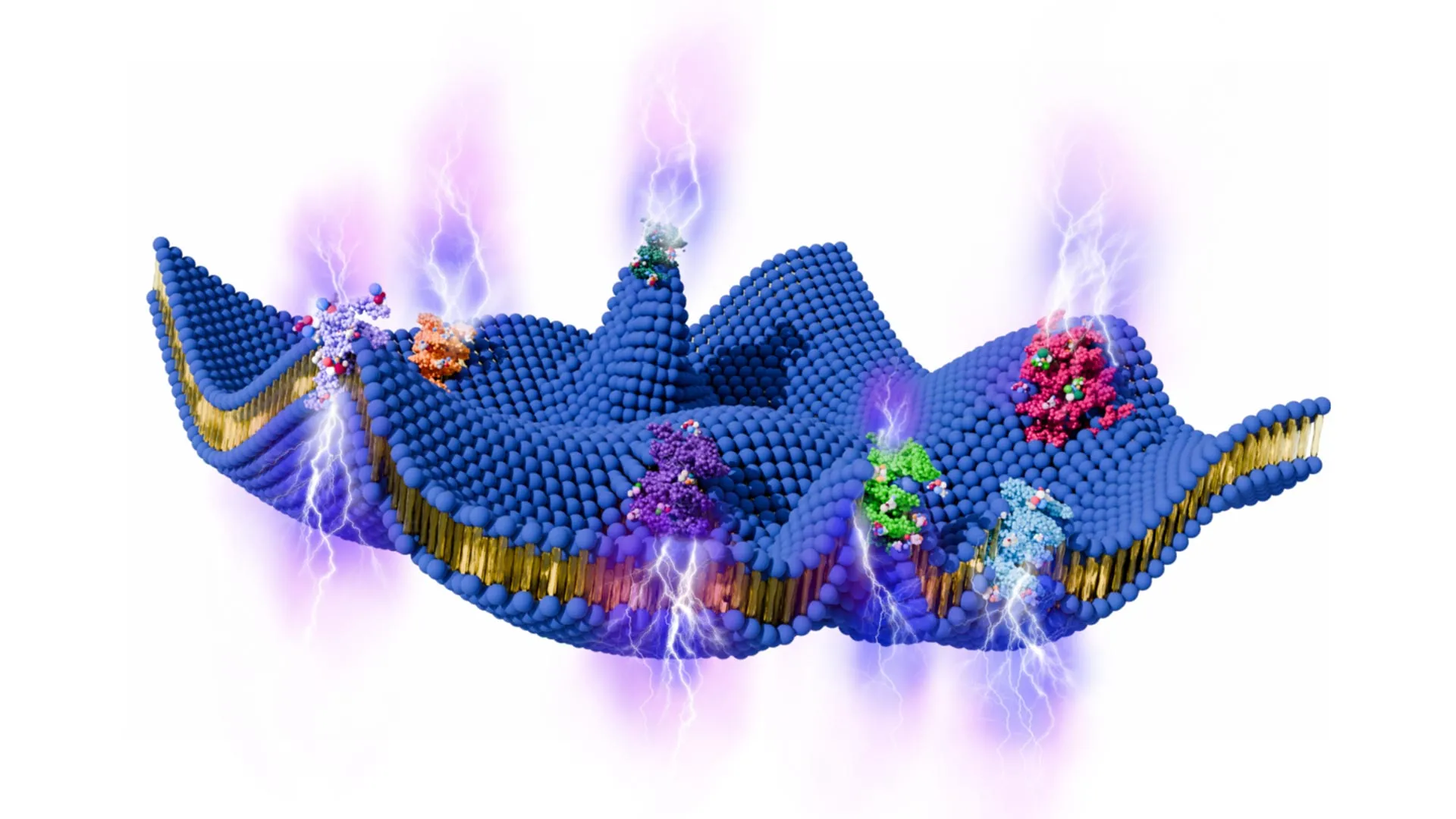
Scientists have developed a new theoretical explanation for how living cells might generate electricity on their own. At the center of the idea is the cell membrane, the thin, flexible layer that surrounds every living cell and controls what enters and leaves it. Rather than being a static barrier, this membrane is constantly moving and reshaping itself at very small scales. The new framework shows that these tiny motions can give rise to real electrical effects.
The research was led by Pradeep Sharma and his colleagues, who built a mathematical model to explore how physical forces inside cells interact with biological activity. Their work focuses on how motion at the molecular level can translate into electrical signals across the membrane.
Molecular Activity That Makes Membranes Move
Inside every cell, proteins are constantly changing shape, interacting with other molecules, and carrying out chemical reactions. One important process is ATP hydrolysis, which is how cells break down adenosine triphosphate to release energy. These active biological processes do not happen quietly. They push and pull on the cell membrane, causing it to bend, ripple, and fluctuate.
The model shows that these ongoing membrane movements can trigger a phenomenon known as flexoelectricity. Flexoelectricity occurs when bending or deformation in a material produces an electrical response. In this case, the bending of the cell membrane can create an electrical difference between the inside and outside of the cell.
Voltage Levels Comparable to Nerve Signals
According to the framework, the electrical voltages created across the membrane can be surprisingly strong. In some cases, they can reach up to 90 millivolts. That level is notable because it is similar to the voltage changes seen in neurons when they fire electrical signals.
The timing also matches what happens in the nervous system. The voltage shifts can occur within milliseconds, which aligns closely with the shape and speed of typical action potential curves for neurons. This suggests that the same physical principles could play a role in how nerve cells communicate.
Driving Ion Movement Against Natural Gradients
The theory goes further by predicting that these membrane driven voltages could actively move ions. Ions are electrically charged atoms that cells use to send signals and maintain balance. Normally, ions flow along electrochemical gradients, meaning they move from areas of high concentration to low concentration.
The new model suggests that active membrane fluctuations could push ions in the opposite direction, working against those gradients. The researchers connect this behavior to specific properties of the membrane, including how stretchy it is and how it responds to electric fields. These properties help determine which direction ions move and what type of charge they carry.
From Single Cells to Tissues and New Materials
Looking ahead, the authors suggest that this framework could be expanded beyond individual cells. By applying the same principles to groups of cells, scientists could explore how coordinated membrane activity leads to larger scale electrical patterns across tissues.
The researchers argue that this mechanism offers a physical foundation for understanding sensory perception, neuronal firing, and even how living cells might harvest energy internally. It may also help bridge neuroscience with the development of bio inspired and physically intelligent materials, offering new ways to design systems that mimic the electrical behavior of living tissue.
Story Source:
Materials provided by PNAS Nexus. Note: Content may be edited for style and length.
Journal Reference:
- Pratik Khandagale, Liping Liu, Pradeep Sharma. Flexoelectricity and the fluctuations of (active) living cells: Implications for energy harvesting, ion transport, and neuronal activity. PNAS Nexus, Volume 4, Issue 12, December 2025 DOI: 10.1093/pnasnexus/pgaf362
Cite This Page: