
A white dwarf’s cosmic feeding frenzy revealed by NASA
- Date:
- January 8, 2026
- Source:
- NASA
- Summary:
- Using NASA’s IXPE, astronomers captured an unprecedented view of a white dwarf star actively feeding on material from a companion. The data revealed giant columns of ultra-hot gas shaped by the star’s magnetic field and glowing in intense X-rays. These features are far too small to image directly, but X-ray polarization allowed scientists to map them with surprising precision. The results open new doors for understanding extreme binary star systems.
- Share:
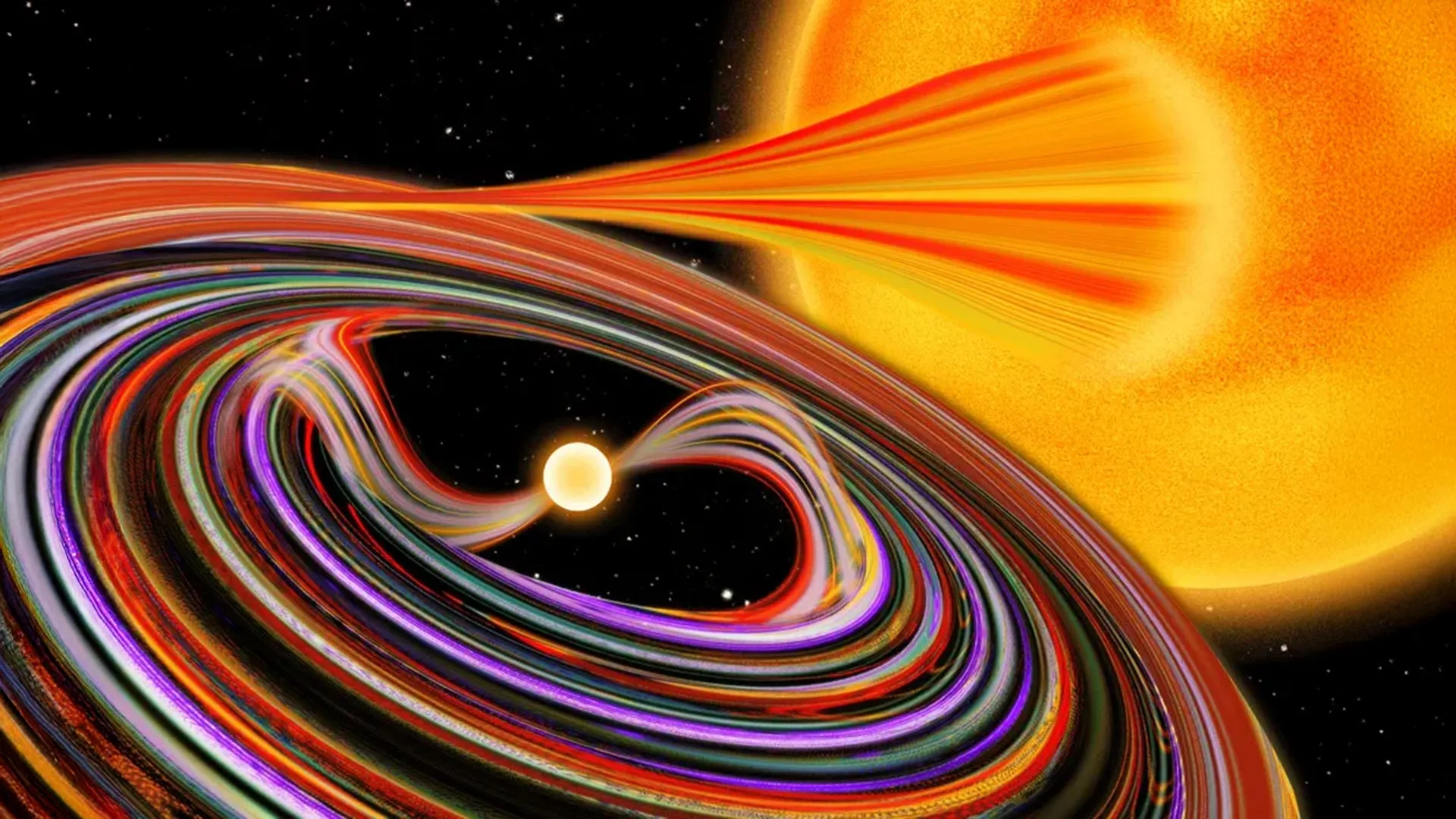
Scientists have, for the first time, used NASA's IXPE (Imaging X-ray Polarization Explorer) to investigate a white dwarf star. The mission's ability to measure the polarization of X-rays allowed astronomers to closely examine EX Hydrae, a type of system known as an intermediate polar. These observations provided new insight into the physical structure and behavior of powerful binary star systems.
During 2024, IXPE spent nearly a full week observing EX Hydrae. This white dwarf system lies about 200 light-years from Earth in the constellation Hydra. The results of the study were published in the Astrophysical Journal. Researchers from the Massachusetts Institute of Technology in Cambridge led the work, with additional contributors from the University of Iowa, East Tennessee State University, the University of Liége, and Embry Riddle Aeronautical University.
What Makes a White Dwarf Unique
A white dwarf forms when a star exhausts the hydrogen fuel needed for nuclear fusion in its core but lacks the mass required to explode as a core-collapse supernova. What remains is an extremely compact object that packs roughly the mass of the Sun into a body about the same size as Earth.
A Binary System Fueled by Accretion
EX Hydrae exists in a binary system alongside a normal main sequence star. Gas from the companion star continuously flows toward the white dwarf. The way this material is gathered, known as accretion, and where it ultimately lands on the white dwarf depend largely on the strength of the white dwarf's magnetic field.
In EX Hydrae, the magnetic field is not strong enough to direct all incoming material onto the star's magnetic poles. Even so, the system rapidly accumulates matter within an accretion disk, placing it in a category called "intermediate polars."
Extreme Temperatures and X-Ray Emissions
In intermediate polar systems, gas forms a rotating accretion disk while also being drawn toward the white dwarf's magnetic poles. As this material accelerates inward, it heats to tens of millions of degrees Fahrenheit. The infalling matter collides with other material bound to the white dwarf, forming tall columns of hot gas that emit intense X-rays, making systems like EX Hydrae ideal targets for IXPE.
"NASA IXPE's one-of-a-kind polarimetry capability allowed us to measure the height of the accreting column from the white dwarf star to be almost 2,000 miles high - without as many assumptions required as past calculations," said Sean Gunderson, MIT scientist and lead author on the paper. "The X-rays we observed likely scattered off the white dwarf's surface itself. These features are far smaller than we could hope to image directly and clearly show the power of polarimetry to 'see' these sources in detail never before possible."
The polarization measurements collected by IXPE from EX Hydrae are expected to help scientists better understand other highly energetic binary star systems across the universe.
More About the IXPE Mission
The IXPE mission continues to deliver unprecedented data that supports major discoveries about extreme objects throughout the cosmos. It is a collaborative effort between NASA and the Italian Space Agency, involving science partners in 12 countries. The mission is led by NASA's Marshall Space Flight Center in Huntsville, Alabama. Spacecraft operations are managed by BAE Systems, Inc., based in Falls Church, Virginia, in partnership with the University of Colorado's Laboratory for Atmospheric and Space Physics in Boulder.
Story Source:
Materials provided by NASA. Original written by Michael Allen. Note: Content may be edited for style and length.
Cite This Page: