
Scientists test a tiny eye implant that could restore sight
A microscopic stem cell patch could help restore vision in people once thought beyond treatment.
- Date:
- January 9, 2026
- Source:
- University of Southern California - Health Sciences
- Summary:
- Scientists at USC are launching a new trial to test a tiny stem cell implant that could restore vision in people with advanced dry macular degeneration. The hair-thin patch replaces damaged retinal cells responsible for sharp, central vision. Earlier studies showed the implant was safe and helped some patients see better. Researchers now hope it can deliver meaningful, lasting improvements in eyesight.
- Share:
Age-related macular degeneration is the most common cause of vision loss and blindness among Americans age 65 and older. The disease worsens over time and primarily damages central vision, making it difficult to see faces, read text or focus on objects directly ahead. As the condition progresses, people may experience blurry areas, dark patches or blind spots in the center of their vision.
Researchers are now launching a new clinical trial that could offer hope to people with advanced dry age-related macular degeneration. This form of the disease is the most widespread and currently has very limited treatment options.
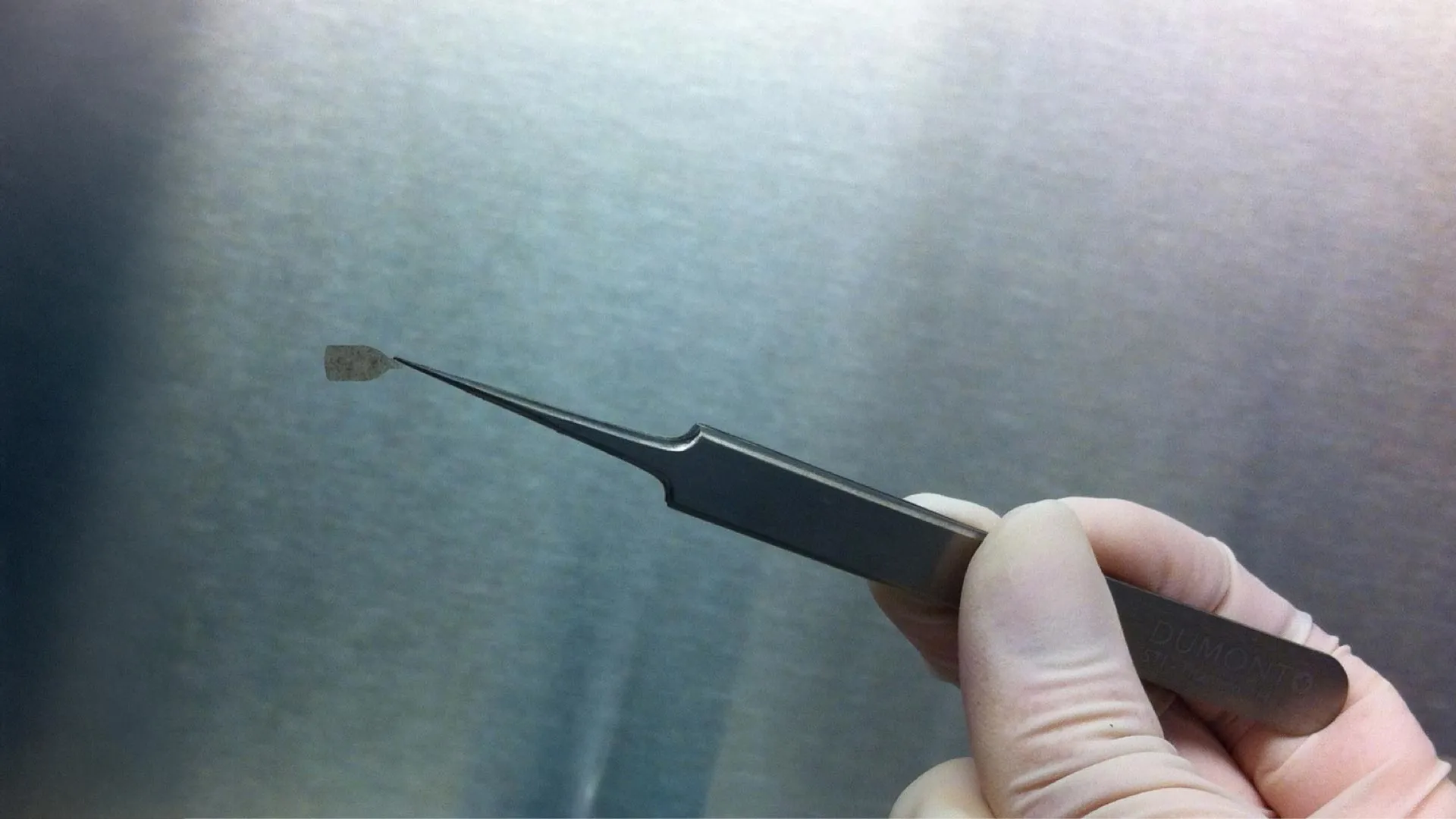
Scientists at the USC Roski Eye Institute, part of Keck Medicine of USC, are beginning a phase 2b clinical trial to test whether stem cells can be used to replace damaged retinal cells and potentially restore vision. The stem cells are attached to an ultra-thin implant, thinner than a strand of hair, designed to hold the cells in place once inserted into the eye.
"We are hoping to determine if the stem-cell based retinal implant can not only stop the progression of dry age-related macular degeneration, but actually improve patients' vision," said Sun Young Lee, MD, PhD, a retinal surgeon with Keck Medicine and principal investigator of the Keck Medicine study site. "The findings could be groundbreaking because while there are a few treatments available that delay the progress of macular degeneration, there are none able to reverse the damage already done."
Encouraging Results From Earlier Research
The new trial builds on earlier research conducted by USC Roski Eye Institute specialists involving a small group of patients. That initial study found the implant was safe, remained securely positioned in the eye and was successfully absorbed into the retinal tissue. Notably, 27% of participants experienced some level of vision improvement.
"The earlier phase of the clinical trial showed the treatment to be safe with the potential to benefit patients' vision; this next phase will investigate whether the therapy can achieve clinically significant improvements in vision," said Lee, who is also an associate professor of ophthalmology and physiology & neuroscience at the Keck School of Medicine of USC.
How the Retinal Implant Is Designed to Work
Roughly 20 million Americans are living with age-related macular degeneration. This figure includes people with wet macular degeneration, which is less common but typically more severe.
The disease affects the macula, a small area at the center of the retina that is essential for sharp, detailed vision. In advanced stages, cells known as retinal pigment epithelium (RPE) cells become damaged or stop functioning. These cells play a critical role in maintaining healthy vision, and their loss leads directly to visual decline.
The implant being tested in the trial is created from embryonic stem cells that are grown in a laboratory and developed into RPE cells. During an outpatient surgical procedure, Keck Medicine eye surgeons will place a thin layer of these lab-grown cells directly into the retina.
"The study will explore if the lab-engineered implant will take over for the damaged cells, function as normal RPE cells would, and improve vision for patients who may currently have no other options for improvement," said Rodrigo Antonio Brant Fernandes, MD, PhD, an ophthalmologist with Keck Medicine and the study surgeon.
Clinical Trial Locations and Patient Eligibility
Keck Medicine is one of five sites nationwide participating in the clinical trial. The study is masked, meaning some participants will receive the actual implant while others will undergo a simulated procedure.
To qualify, patients must be between the ages of 55-90 and have advanced dry age-related macular degeneration along with geographic atrophy, a condition in which RPE cells are damaged or no longer function properly.
Participants will be followed for at least one year so researchers can evaluate how well the implant is tolerated and track any changes in vision. The study aims to enroll 24 patients in total.
Those interested in learning more about the trial can contact Mariana Edwards at [email protected] or Kimberly Rodriguez at [email protected].
Long-Term Vision for Stem Cell Eye Treatments
"The USC Roski Eye Institute is dedicated to furthering innovative treatments to help improve lives by restoring vision," said Mark S. Humayun, MD, PhD, co-director of the USC Roski Eye Institute, director of the USC Ginsberg Institute for Biomedical Therapeutics and the Dennis and Michele Slivinski Chair in Macular Degeneration Research at the Keck School. "Stem cell-derived retinal implants may offer one of the greatest possibilities for helping patients with dry age-related macular degeneration and one day, may offer a cure."
The bioengineered RPE retinal implant is produced by Regenerative Patch Technologies LLC, a clinical-stage company focused on developing stem cell-based implants for retinal diseases. Humayun co-invented the implant and is also a co-founder of the company.
The technology used to manufacture the implant is exclusively licensed to Regenerative Patch Technologies by the University of Southern California, the California Institute of Technology and the University of California Santa Barbara.
Funding for the clinical trial comes in part from the California Institute for Regenerative Medicine, the Marcus Foundation and USC.
Story Source:
Materials provided by University of Southern California - Health Sciences. Note: Content may be edited for style and length.
Cite This Page: