
Betelgeuse has a hidden companion and Hubble just caught its wake
- Date:
- January 10, 2026
- Source:
- NASA
- Summary:
- Astronomers have uncovered the long-hidden cause behind Betelgeuse’s strange behavior: a small companion star carving a visible wake through the giant’s vast atmosphere. Using nearly eight years of observations from NASA’s Hubble Space Telescope and ground-based observatories, scientists detected swirling trails of dense gas created as the companion, called Siwarha, moves through Betelgeuse’s outer layers.
- Share:
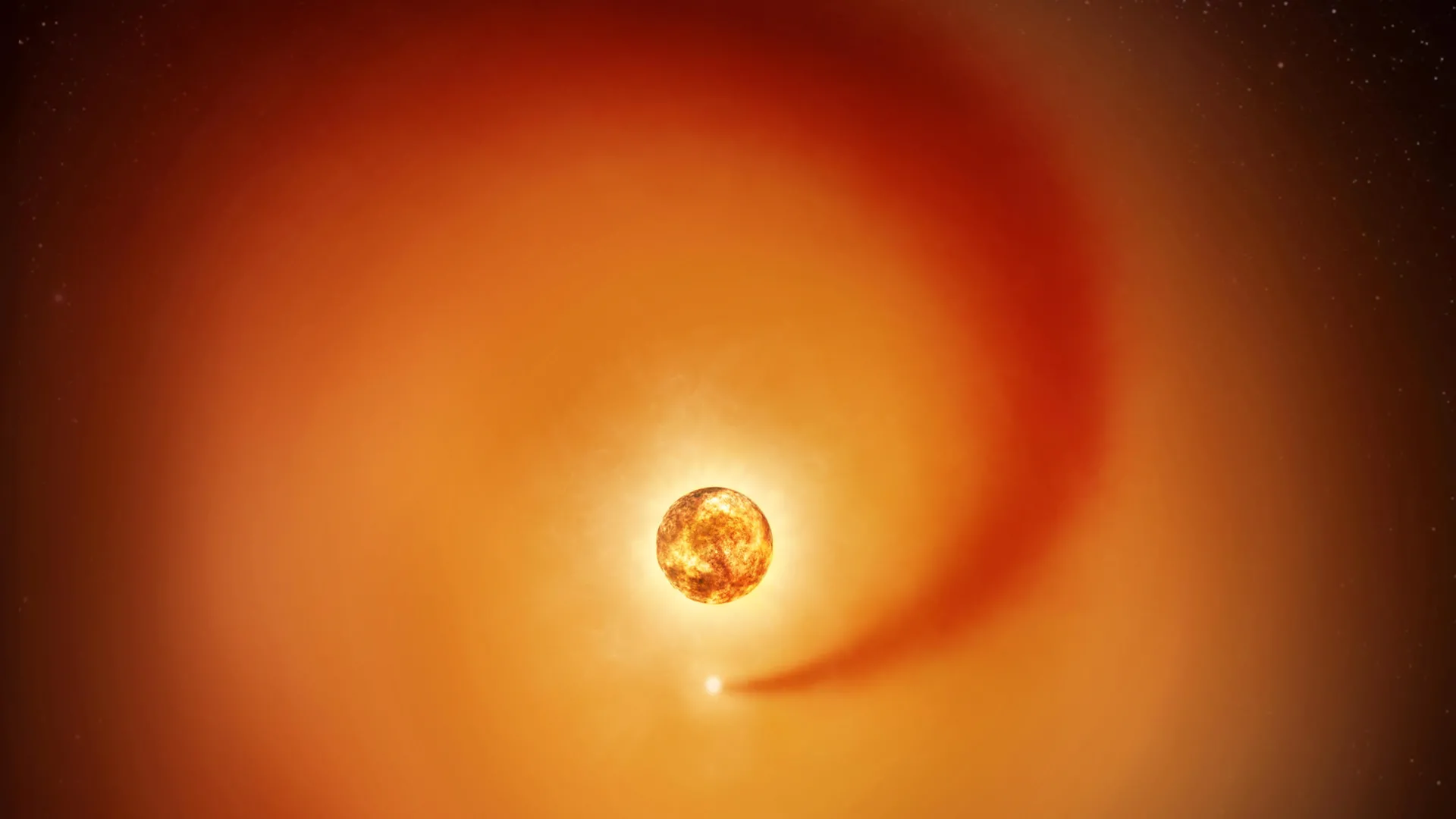
Astronomers analyzing fresh observations from NASA's Hubble Space Telescope and several ground-based observatories have uncovered clear signs that a recently identified companion star is shaping the environment around Betelgeuse. The study, led by researchers at the Center for Astrophysics | Harvard & Smithsonian (CfA), shows that the companion star, called Siwarha, is generating a dense stream of gas as it moves through Betelgeuse's enormous outer atmosphere. This newly observed structure helps explain the unusual and long-running changes seen in the giant star's brightness and atmospheric behavior.
The findings were announced at a news conference during the 247th meeting of the American Astronomical Society in Phoenix and have been accepted for publication in The Astrophysical Journal.
Eight Years of Observations Reveal a Stellar Wake
Researchers identified the influence of Siwarha by carefully measuring subtle changes in Betelgeuse's light over nearly eight years. These long-term observations revealed the effects of a companion star that had previously been suspected but not confirmed. As the companion moves through Betelgeuse's outer layers, it disrupts the surrounding gas, producing a trail of denser material.
This detection resolves one of the most enduring puzzles surrounding Betelgeuse. By confirming the companion's presence, astronomers can now better explain how the star behaves and changes over time. The discovery also provides valuable insight into the later stages of evolution for other massive stars approaching the ends of their lives.
Betelgeuse is located about 650 light-years from Earth in the constellation Orion. It is a red supergiant of extraordinary size, large enough to contain more than 400 million Suns. Because it is both enormous and relatively close to Earth, Betelgeuse is one of the few stars whose surface and surrounding atmosphere can be directly studied, making it a key target for understanding how giant stars grow older, lose material, and eventually explode as supernovae.
Multiple Telescopes Confirm the Companion's Impact
By combining data from Hubble with observations from the Fred Lawrence Whipple Observatory and the Roque de Los Muchachos Observatory, the team identified repeating patterns in Betelgeuse's behavior. These patterns provided strong evidence of the long-suspected companion star and revealed how it affects the red supergiant's outer atmosphere.
Scientists observed changes in the star's spectrum, meaning the specific colors of light produced by different elements, along with shifts in the motion of gas in the outer atmosphere. These changes are linked to a dense wake formed by the companion star. The wake appears shortly after the companion passes in front of Betelgeuse approximately every six years, or about 2,100 days, in agreement with earlier theoretical predictions.
"It's a bit like a boat moving through water. The companion star creates a ripple effect in Betelgeuse's atmosphere that we can actually see in the data," said Andrea Dupree, an astronomer at the CfA and lead author of the study. "For the first time, we're seeing direct signs of this wake, or trail of gas, confirming that Betelgeuse really does have a hidden companion shaping its appearance and behavior."
Decades of Strange Variability Explained
Astronomers have monitored Betelgeuse for decades, tracking changes in its brightness and surface features in an effort to understand its unpredictable behavior. Interest surged in 2020 when the star unexpectedly dimmed after what was described as a stellar "sneeze." Scientists identified two major cycles in Betelgeuse's variability: a shorter 400-day period linked to pulsations inside the star, and a much longer cycle lasting about 2,100 days.
Before this discovery, scientists explored many explanations for Betelgeuse's long-term changes. These included massive convection cells, clouds of dust, magnetic activity, and the potential influence of a hidden companion. Recent studies suggested that the longer cycle was best explained by a low-mass star orbiting deep within Betelgeuse's atmosphere. Although one group reported a possible detection, there was no definitive evidence until now.
The newly detected wake provides the strongest proof yet that a companion star is actively disturbing the atmosphere of this red supergiant.
"The idea that Betelgeuse had an undetected companion has been gaining in popularity for the past several years, but without direct evidence, it was an unproven theory," said Dupree. "With this new direct evidence, Betelgeuse gives us a front-row seat to watch how a giant star changes over time. Finding the wake from its companion means we can now understand how stars like this evolve, shed material, and eventually explode as supernovae."
Looking Ahead to Future Observations
From Earth's perspective, Betelgeuse is currently eclipsing its companion star. Astronomers are planning additional observations when the companion becomes visible again in 2027. Researchers say this discovery could also help solve similar mysteries involving other giant and supergiant stars.
Hubble's Continuing Contributions
The Hubble Space Telescope has been operating for more than 30 years and continues to produce discoveries that deepen our understanding of the universe. Hubble is a collaborative project between NASA and ESA (European Space Agency). NASA's Goddard Space Flight Center in Greenbelt, Maryland, oversees mission operations, with additional support from Lockheed Martin Space in Denver. The Space Telescope Science Institute in Baltimore, operated by the Association of Universities for Research in Astronomy, manages Hubble's scientific operations for NASA.
Cite This Page: