
A breakthrough that could make ships nearly unsinkable
More than a century after the Titanic, the dream of unsinkable ships is still alive, and scientists may be closer than ever.
- Date:
- January 30, 2026
- Source:
- University of Rochester
- Summary:
- Researchers have found a way to make ordinary aluminum tubes float indefinitely, even when submerged for long periods or punched full of holes. By engineering the metal’s surface to repel water, the tubes trap air inside and refuse to sink, even in rough conditions. The technology could eventually be scaled up into floating platforms, ships, or even wave-powered energy systems.
- Share:
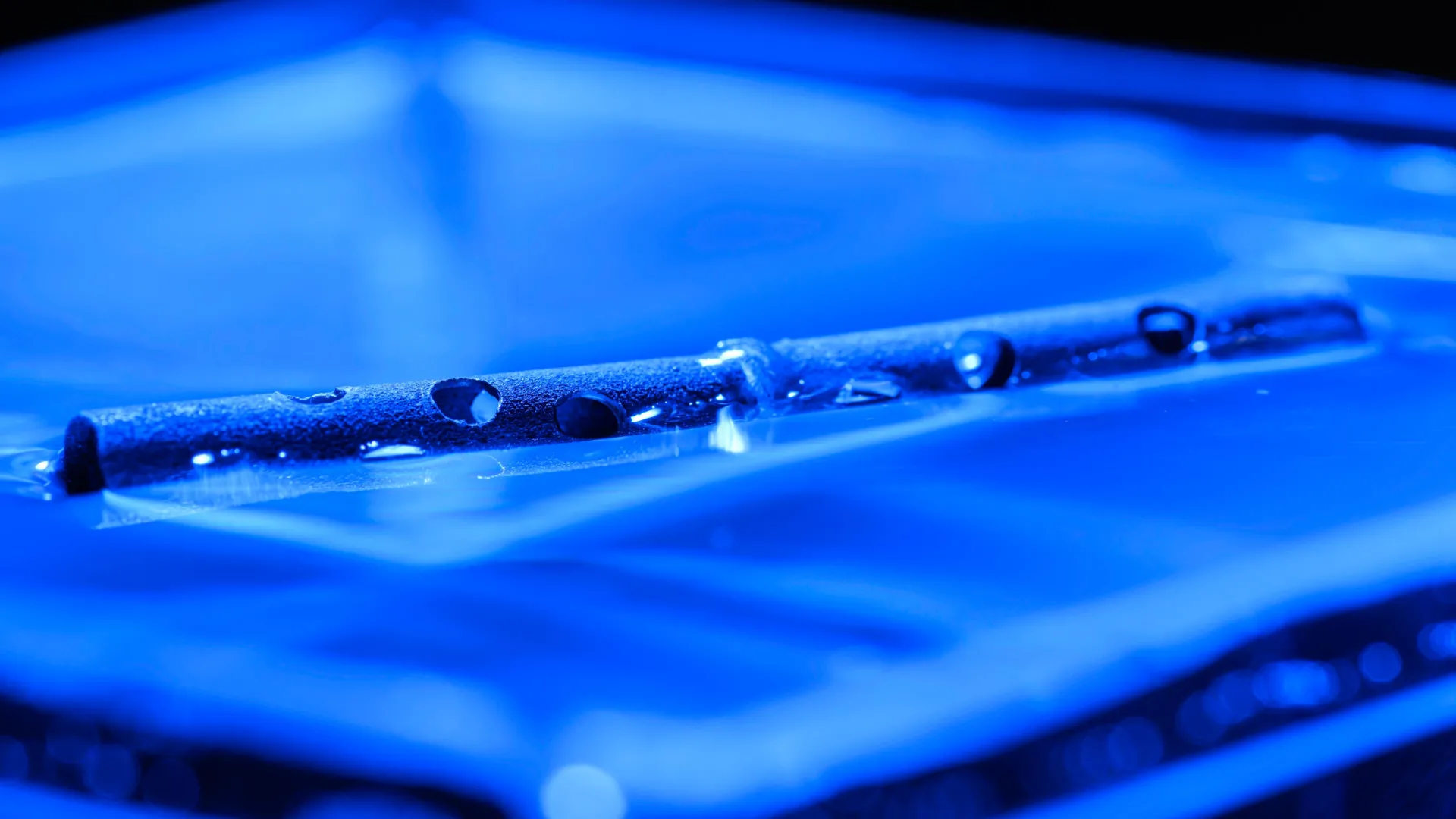
More than 100 years after the sinking of the Titanic, the idea of ships that cannot sink continues to motivate engineers. Researchers at the University of Rochester's Institute of Optics have now taken a significant step toward that long-standing goal. They have developed a technique that makes ordinary metal tubes unsinkable -- meaning the tubes stay afloat regardless of how long they remain underwater or how much damage they sustain.
The work was led by Chunlei Guo, a professor of optics and physics and a senior scientist at URochester's Laboratory for Laser Energetics. Guo and his colleagues detailed the new method in a study published in Advanced Functional Materials. Their approach focuses on modifying the inside surface of aluminum tubes by etching it to create microscopic and nanoscale pits. This textured surface becomes superhydrophobic, allowing it to strongly repel water and remain dry.
How Trapped Air Prevents Sinking
When a treated tube is placed in water, its water-repelling interior captures a stable pocket of air inside. This trapped air keeps water from filling the tube, which prevents it from becoming heavy and sinking. The process resembles natural strategies seen in diving bell spiders, which carry air bubbles underwater, and in fire ants, which form floating rafts using their water-resistant bodies.
"Importantly, we added a divider to the middle of the tube so that even if you push it vertically into the water, the bubble of air remains trapped inside and the tube retains its floating ability," says Guo.
Improved Stability in Rough Conditions
Guo's research group first demonstrated superhydrophobic floating devices in 2019. That earlier design relied on two water-repelling disks sealed together to create buoyancy. While effective, the disks could lose their ability to float when tilted at extreme angles. The newer tube-based design simplifies the structure and offers much greater stability, especially in turbulent environments similar to ocean conditions.
"We tested them in some really rough environments for weeks at a time and found no degradation to their buoyancy," says Guo. "You can poke big holes in them, and we showed that even if you severely damage the tubes with as many holes as you can punch, they still float."
From Floating Rafts to Renewable Energy
The researchers showed that multiple tubes can be connected to form rafts, which could serve as the foundation for ships, buoys, or floating platforms. In laboratory tests, the team experimented with tubes of different lengths, reaching nearly half a meter. Guo says the design can be scaled up to sizes large enough to support heavy loads.
Beyond transportation and infrastructure, the team also demonstrated that rafts made from superhydrophobic tubes could capture energy from moving water. This capability suggests a potential role for the technology in generating electricity from waves, adding a renewable energy application to its list of possibilities.
This project was supported by the National Science Foundation, the Bill and Melinda Gates Foundation, and URochester's Goergen Institute for Data Science and Artificial Intelligence.
Story Source:
Materials provided by University of Rochester. Note: Content may be edited for style and length.
Journal Reference:
- Tianshu Xu, Zhibing Zhan, Yichen Deng, Mohamed Akeel Faris, Subhash C. Singh, Chunlei Guo. Geometry‐Enabled Recoverable Floating Superhydrophobic Metallic Tubes. Advanced Functional Materials, 2026; DOI: 10.1002/adfm.202526033
Cite This Page: