
New forecasts offer early warning of Arctic sea ice loss
A new forecasting breakthrough is giving scientists a clearer look at Arctic sea ice loss before it happens.
- Date:
- February 6, 2026
- Source:
- American Institute of Physics
- Summary:
- Arctic sea ice helps cool the planet and influences weather patterns around the world, but it is disappearing faster than ever as the climate warms. Scientists have now developed a new forecasting method that can predict how much Arctic sea ice will remain months in advance, focusing on September when ice levels are at their lowest. By combining long-term climate patterns, seasonal cycles, and short-term weather shifts, the model delivers real-time predictions that outperform existing approaches.
- Share:
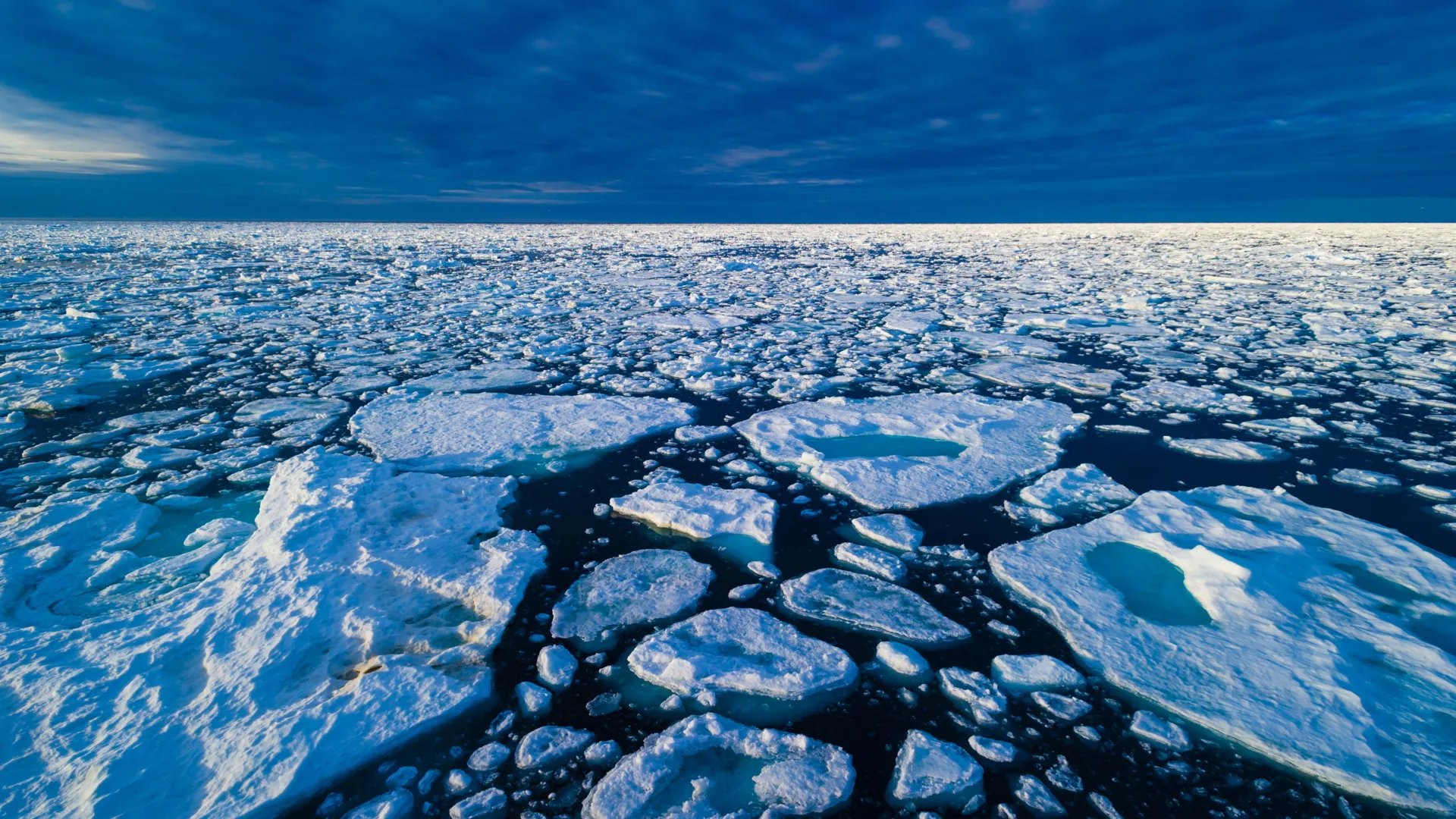
Arctic sea ice plays a major role in shaping Earth's climate system. By reflecting sunlight and helping cool the planet, it influences ocean circulation, atmospheric behavior, and extreme weather patterns far beyond the polar regions. As climate change accelerates the loss of Arctic ice, scientists increasingly rely on real-time measurements of sea ice extent (SIE) -- the area of water with a minimum concentration of sea ice -- to track the condition of the ice cover and understand how quickly it is changing.
In Chaos, published by AIP Publishing, scientists from the United States and the United Kingdom reported a method that delivers accurate, real-time predictions of Arctic SIE. Their work centers on September, when Arctic sea ice reaches its annual minimum. Because this low point reflects the cumulative effects of melting throughout the year, September ice levels are considered one of the most important indicators of overall sea ice health.
Why Accurate Ice Predictions Matter
"Indigenous Arctic communities depend on the hunting of species like polar bears, seals, and walruses, for which sea ice provides essential habitat," said author Dimitri Kondrashov. "There are other economic activities, such as gas and oil drilling, fishing, and tourism, where advance knowledge of accurate ice conditions reduces risks and costs."
Reliable sea ice forecasts can support both traditional livelihoods and modern industries that operate in or near Arctic waters.
Modeling Sea Ice as an Interacting System
Rather than viewing sea ice change as a single process, the researchers modeled it as the result of multiple atmospheric and oceanic influences that change at different speeds -- for example, climate memory at long timescales, annual seasonal cycles, and quickly changing weather -- while remaining interconnected. To identify how these influences interact, the team analyzed average daily SIE data from the National Snow and Ice Data Center, using records that extend back to 1978.
The researchers evaluated their prediction system using real-time data from September 2024 as well as historical data from past Septembers. These tests showed that the method reliably captures sea ice behavior across subseasonal and seasonal timescales. When forecasting SIE one to four months in advance, the model consistently produced more accurate results than other prediction approaches.
Improving Short-Term Arctic Forecasts
Long-term climate projections are generally more stable and reliable than short-term forecasts, which are more sensitive to rapid weather changes. By integrating detailed regional information, the researchers were able to improve short-term estimates of sea ice conditions and related weather patterns.
"The model includes several large Arctic regions composing [the] pan-Arctic," said Kondrashov. "Despite large differences in sea ice conditions from year to year in different regions, the model can pick it up reasonably accurately."
Next Steps for Arctic Sea Ice Prediction
The research team plans to further refine the model by adding more atmospheric and oceanic factors, including air temperature and sea level pressure. These variables can drive rapid shifts and short-term variability that are not yet fully represented. The researchers expect that incorporating these elements will improve forecasts of Arctic sea ice during the summer months, when conditions change most quickly.
Story Source:
Materials provided by American Institute of Physics. Note: Content may be edited for style and length.
Journal Reference:
- Dmitri Kondrashov, Ivan Sudakow, Valerie Livina, Qingping Yang. Accurate and robust real-time prediction of September Arctic sea ice. Chaos: An Interdisciplinary Journal of Nonlinear Science, 2026; 36 (2) DOI: 10.1063/5.0295634
Cite This Page: