
Scientists found a dangerous feedback loop accelerating Arctic warming
Cracks in the ice and oil-field pollution are quietly teaming up to supercharge Arctic warming.
- Date:
- December 29, 2025
- Source:
- Penn State
- Summary:
- The Arctic is changing rapidly, and scientists have uncovered a powerful mix of natural and human-driven processes fueling that change. Cracks in sea ice release heat and pollutants that form clouds and speed up melting, while emissions from nearby oil fields alter the chemistry of the air. These interactions trigger feedback loops that let in more sunlight, generate smog, and push warming even further. Together, they paint a troubling picture of how fragile the Arctic system has become.
- Share:
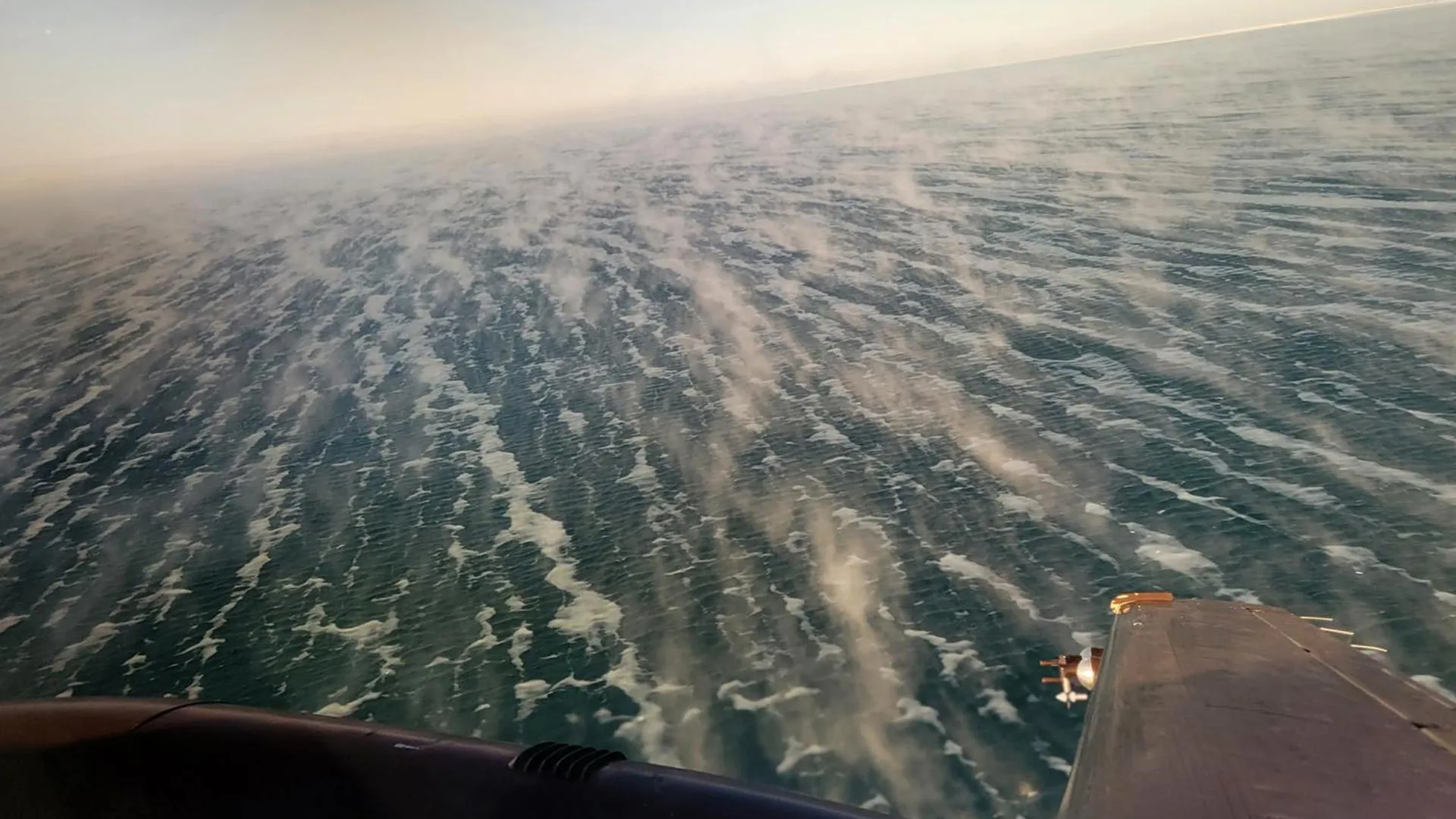
Earth's climate is shifting worldwide, but the fastest changes are happening near the poles. New research from Penn State offers a detailed look at how chemical reactions in the Arctic atmosphere are unfolding, revealing that several distinct processes are interacting at the same time and reshaping the region's climate.
Scientists used two specially equipped research aircraft along with ground-based instruments during a two-month field campaign. Their goal was to compare atmospheric chemistry in two Arctic regions, as well as near the largest oil field in North America, with nearby surrounding areas. From this effort, the researchers identified three major findings. Openings in sea ice -- known as leads -- strongly affect atmospheric chemistry and cloud development. Pollution from oil field operations measurably changes the makeup of the regional atmosphere. Together, these factors form a feedback loop that speeds up sea ice loss and intensifies Arctic warming.
The CHACHA Project and Its Broader Goals
The findings were recently published in the Bulletin of the American Meteorological Society and are part of a broader collaboration known as CHemistry in the Arctic: Clouds, Halogens, and Aerosols, or CHACHA. This multi-institutional project, led by five research organizations, focuses on how chemical changes occur when air near the surface rises into the lower atmosphere. These changes drive interactions between water droplets, low clouds, and pollution.
"This field campaign is an unprecedented opportunity to explore chemical changes in the boundary layer -- the atmospheric layer closest to the planet's surface -- and to understand how human influence is altering the climate in this important region," said Jose D. Fuentes, professor of meteorology in the Department of Meteorology and Atmospheric Science and corresponding author of the paper. "The resulting datasets are producing an improved understanding of the interactions between sea-spray aerosols, surface-coupled clouds, oil field emissions and multiphase halogen chemistry in the new Arctic."
To examine chemical activity in the Arctic boundary layer, the research team collected air samples over snow-covered and newly frozen sea ice in the Beaufort and Chukchi Seas. Measurements were also taken over open leads and across the snow-covered tundra of Alaska's North Slope, including areas near the Prudhoe Bay oil and gas fields. The campaign operated out of Utqiaġvik, Alaska, from February 21 to April 16, 2022. This period followed the polar sunrise -- a stretch of continuous daylight after months of darkness -- when increased ultraviolet light intensifies chemical reactions at the surface and in the lower atmosphere.
How Sea Ice Cracks Accelerate Warming
The researchers discovered that leads, which can range from just a few feet wide to several miles across, generate strong upward air currents and cloud formation. These plumes lift potentially harmful chemicals, aerosol pollutants, and water vapor hundreds of feet into the air -- all factors that can enhance warming. According to Fuentes, this process increases heat and moisture transfer, accelerates sea ice loss, and promotes the formation of even more leads, reinforcing the cycle.
Another feedback loop was identified along Arctic coastlines, where chemicals in salty snowpacks interact with emissions from oil field operations. During the CHACHA campaign, scientists observed bromine production in these saline snowpacks -- a process unique to polar environments. Bromine rapidly removes ozone from the boundary layer, allowing more sunlight to reach the surface. This additional sunlight warms the snow, releasing even more bromine and strengthening the feedback loop.
Pollution and Smog in a Remote Region
The field campaign also revealed major changes in the boundary layer above the Prudhoe Bay oil fields. Gas plumes from extraction activities reacted in the lower atmosphere, increasing acidity and producing harmful compounds and smog, Fuentes said. Researchers also found that halogens interact with oil field emissions to form free radicals, which later become more stable compounds capable of traveling long distances. These substances can contribute to environmental changes well beyond the oil fields themselves.
Fuentes noted that CHACHA scientists are now studying how these chemical reactions affect the broader Arctic environment. One area of concern is the formation of smog plumes that, despite occurring in a region often viewed as pristine, can reach pollution levels similar to major cities such as Los Angeles. During the campaign, nitrogen dioxide concentrations reached about 60-70 parts per billion, levels commonly associated with urban smog.
Improving Climate Models
The next phase of the research will focus on producing detailed datasets that climate modelers can use to better understand how these localized Arctic processes may influence global climate patterns in the future.
The CHACHA team also included researchers from Stony Brook University, the University at Albany, University of Michigan, and the University of Alaska Fairbanks. Funding for the project was provided by the U.S. National Science Foundation.
Story Source:
Materials provided by Penn State. Note: Content may be edited for style and length.
Journal Reference:
- Jose D. Fuentes, Sara Lance, Kerri A. Pratt, Paul B. Shepson, William R. Simpson, Izabella Antczak, Katja Bigge, Nathaniel Brockway, Natasha Garner, Kristian D. Hajny, Daun Jeong, Robert Kaeser, Peter K. Peterson, Miranda Serratos, Tim Starn, Brian H. Stirm, Sarah Woods. Overview of the Chemistry in the Arctic: Clouds, Halogens, and Aerosols (CHACHA) Field Campaign. Bulletin of the American Meteorological Society, 2025; 106 (11): E2276 DOI: 10.1175/BAMS-D-24-0192.1
Cite This Page: