
Scientists discover a hidden gut defense that could prevent colon cancer
- Date:
- November 24, 2026
- Source:
- Rockefeller University
- Summary:
- A common antibody in the gut may be a powerful natural defense against colon cancer, with researchers finding that mice lacking it developed more than twice as many tumors. Restoring the antibody eliminated the increased risk, revealing a promising new avenue for preventing cancer before it starts.
- Share:
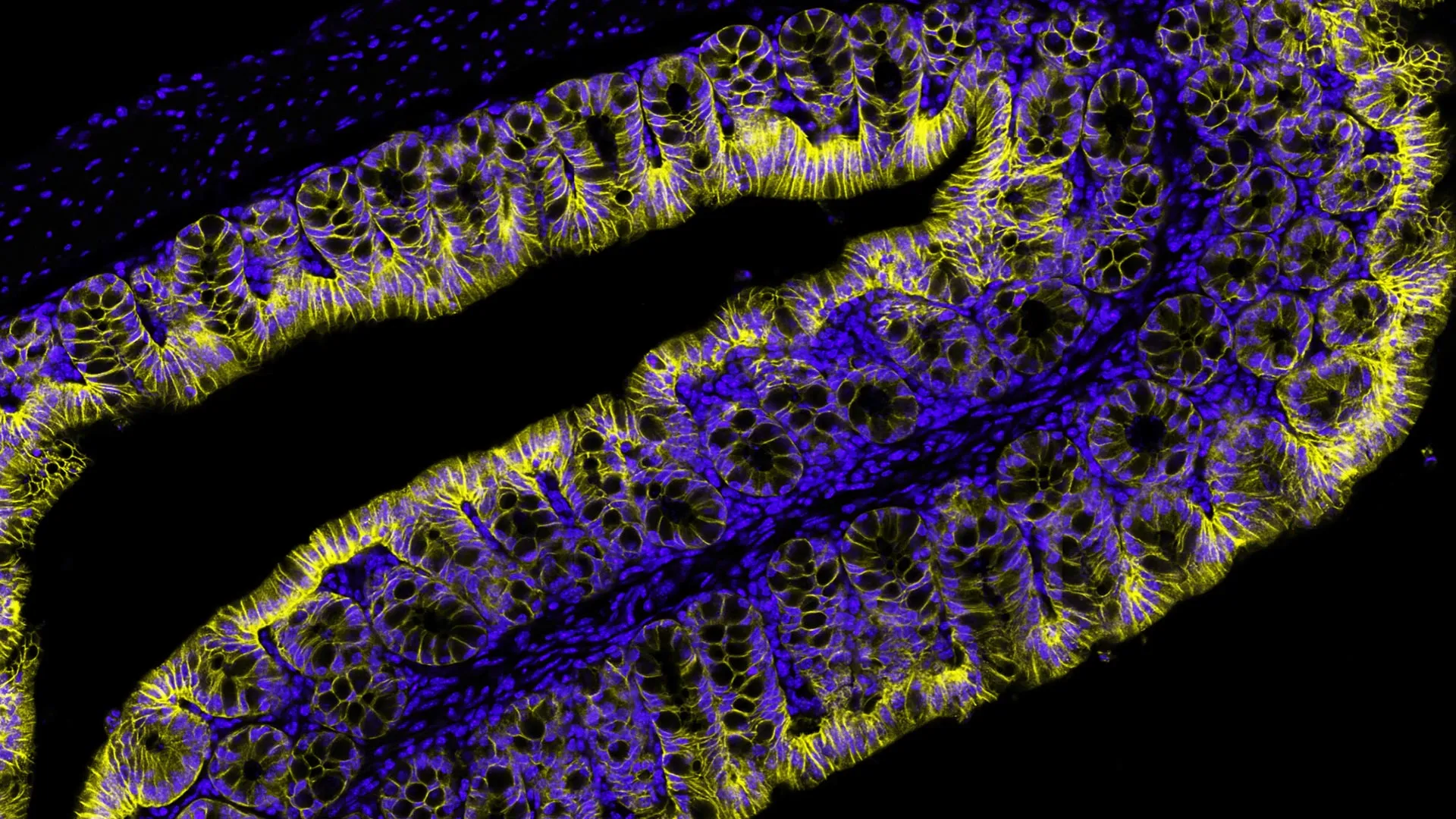
A common antibody found throughout the digestive tract may provide an unexpected defense against colon cancer. Researchers at Rockefeller University have discovered that these immune molecules help regulate the growth of cells lining the intestine, potentially preventing the uncontrolled cell division that can lead to tumors.
In a study published in Nature, scientists found that mice missing a type of antibody known as immunoglobulin A (IgA) developed more than twice as many colon tumors as mice with normal levels of the antibody. The researchers also uncovered how this protection works. IgA attaches to cells along the intestinal lining and helps prevent them from multiplying too rapidly.
Even more promising, when the team administered IgA orally to mice that lacked the antibody, the animals no longer showed an elevated risk of developing tumors.
"One intriguing aspect of this work is that it shows how a natural defense in the gut restrains the cell division that can lead to cancer," says senior author Daniel Mucida, who leads Rockefeller's Laboratory of Mucosal Immunology. "Most cancer research focuses on trying to destroy a tumor that already exists, but what if we could intervene before tumors form?"
The findings may help explain why people with IgA deficiency, a condition in which the body produces little or none of this antibody, face a greater risk of colorectal cancer. They also offer new insight into how gut bacteria, immune defenses, and intestinal cells work together to influence cancer development, potentially even in people with otherwise healthy immune systems.
Why the Gut Contains So Much of This Antibody
IgA is one of the immune system's most abundant antibodies in the digestive tract, where it provides an important early defense against potentially harmful microbes. Unlike antibodies that recognize a single specific target, IgA can interact with many different kinds of gut bacteria and even certain healthy cells belonging to the body.
Scientists have known for decades that the intestines contain unusually large quantities of IgA. However, the reasons for its abundance, and the full range of functions it performs, have remained incompletely understood.
Mucida's laboratory investigates how the intestine manages two essential but sometimes competing responsibilities. It must defend the body against dangerous microorganisms while allowing nutrients from food to pass into the bloodstream. Earlier research from his team has also helped explain how immune cells in the digestive tract contribute to food intolerances and allergies.
For the new study, Gregory Donaldson, a former postdoctoral researcher at Rockefeller who is now an assistant professor at UCLA, set out to better understand how IgA interacts with intestinal bacteria and whether those interactions might influence the development of colon cancer.
"We know these antibodies bind bacteria and, by doing so, can shape the microbiome," he says. "And because IgA deficiency, which affects about 1 in 500 people in the U.S., is linked to colorectal cancer, I wondered whether these interactions might be relevant to the disease."
The microbiome is the community of microorganisms living in and on the body. In the intestines, these microbes perform important functions related to digestion and immune health, but certain bacteria can also contribute to disease under the wrong conditions.
Missing Gut Antibodies More Than Doubled Colon Tumors
To investigate IgA's protective effects, Donaldson compared mice that could not produce the antibody with mice that had normal IgA levels. Both groups were raised together, allowing the researchers to control for differences in food and exposure to microorganisms.
The results revealed a striking difference. Animals without IgA developed substantially more colorectal tumors than their counterparts, consistent with the increased colorectal cancer risk observed in humans with IgA deficiency.
The association was not limited to a single experimental setup. Researchers observed the same pattern using multiple models of colon cancer, strengthening the evidence that IgA plays a meaningful protective role.
"We found this was true for several different kinds of models of colon cancer, so that was a really convincing effect," says Donaldson.
The team then tested whether replacing the missing antibody could reverse the effect. When mice lacking IgA received oral doses of the antibody, their increased susceptibility to colon tumors disappeared.
This result suggested that IgA does more than simply accompany other protective processes in the intestine. Its presence appears to directly influence conditions that determine whether tumors develop.
Scientists Discover a Natural Brake on Cancer Cell Growth
To understand the mechanism behind this protection, the researchers examined epithelial cells, which form the inner lining of the intestine. These cells are particularly important because colon cancer begins when cells in this tissue undergo changes that allow them to grow uncontrollably.
The intestinal lining is constantly renewing itself. Older or damaged cells are replaced by new ones, making controlled cell division essential for keeping the digestive tract healthy. However, when the signals that regulate this process become disrupted, excessive growth can create opportunities for cancer to develop.
In mice without IgA, the researchers identified changes in gene activity associated with cell proliferation, the process through which cells divide and increase in number. Crucially, these changes appeared before any tumors became visible, suggesting that the antibody helps regulate an early step in cancer development.
"We assumed there must be some sort of receptor on the epithelial cells that was mediating this," Donaldson says.
The researchers suspected that IgA was interacting with a specific molecular structure on the surface of intestinal cells, allowing it to influence how those cells behaved.
Gabriella Lima dos Reis, the study's second author and a graduate student working in Gabriel Victora's laboratory, investigated a promising candidate called DMBT1.
DMBT1 is a receptor found on the surface of epithelial cells that can bind to IgA. Previous research had connected it to several types of cancer, but scientists had not established precisely how it functions in the development of colon tumors.
How Gut Bacteria and IgA Control Tumor Formation
Further experiments revealed that DMBT1 plays two very different roles depending on whether IgA is present.
When intestinal bacteria are present, DMBT1 activates signals that encourage epithelial cells to divide. This response is part of the normal activity of the intestinal lining, which must continually replace cells to maintain its protective barrier.
IgA helps keep that growth under control. When the antibody binds to DMBT1, it restrains the receptor's activity, effectively acting as a brake on cell proliferation.
Without IgA, however, DMBT1 signaling can continue without sufficient restraint. Intestinal cells then divide more rapidly than they should, increasing the likelihood that tumors will develop.
The researchers confirmed that this excessive growth depends on several interacting factors. When gut bacteria were absent, DMBT1 signaling was disabled, or normal amounts of IgA were available, epithelial cell division remained under control.
Together, these findings reveal how a common immune molecule helps maintain the delicate balance between necessary tissue renewal and potentially dangerous overgrowth.
"If IgA is missing, epithelial cells that are performing their normal function -- responding to bacteria by producing new cells -- can keep dividing unchecked, leading to cancer," Mucida says. "We think this homeostatic effect is IgA's main function. This was a big surprise."
Homeostasis refers to the body's ability to maintain stable, healthy conditions despite constant changes in its environment. In this case, IgA appears to support that balance by preventing normal intestinal cell renewal from becoming excessive.
A New Possibility for Preventing Colon Cancer
By identifying DMBT1's normal role in intestinal cells, the Rockefeller team has uncovered a potential target for future colon cancer prevention strategies.
Instead of waiting until a tumor develops and then attempting to destroy it, researchers may eventually be able to influence the biological signals that make tumors more likely to form.
"Based on the mechanism we discovered, perhaps we could influence epithelial cells to be less likely to develop into a tumor," Mucida says. "We know, for example, that having polyps increases your chances of getting colon cancer, so we think that there could be an opportunity to target this pathway after polyps are removed. Right now, there are no interventions available at that point."
Colon polyps are growths that develop along the inner lining of the large intestine. Although many are harmless, some can eventually become cancerous. Removing them during a colonoscopy can reduce cancer risk, but researchers are interested in finding additional ways to prevent future tumors from developing.
The newly identified IgA and DMBT1 pathway could offer one such opportunity, although additional research is needed to determine whether targeting it would be effective and safe in humans.
Could Beneficial Gut Bacteria Help Prevent Cancer?
The discovery also raises another intriguing possibility. Certain intestinal bacteria may actively help protect against cancer by influencing how epithelial cells behave or by encouraging the production of protective antibodies.
While much of the research into the gut microbiome and cancer has focused on harmful bacteria that promote tumor formation or accelerate cancer growth, some microbes may have the opposite effect.
"What is potentially even more exciting is that there is evidence that individual species of bacteria can have really specific effects on epithelial cells as well," Donaldson notes. "A lot of research has focused on bacteria that induce tumors or can exacerbate their growth, but we have some evidence that there are bacteria that could do the opposite, just as IgA does. To that end, perhaps we could develop a probiotic supplement that induces a protective IgA response. This is all very speculative, but it's one direction that we could look towards in the future."
Such an approach would aim to use beneficial microorganisms to stimulate the body's existing protective mechanisms rather than directly attacking cancer cells. However, the idea remains speculative, and the mouse experiments do not establish that taking IgA supplements or probiotics can prevent colon cancer in people.
For now, the findings provide a clearer picture of how the immune system and gut microbiome cooperate to maintain healthy intestinal tissue. They also suggest that some of the body's most important defenses against cancer may operate long before the disease becomes detectable.
Mucida adds, "Overall, there is a lot more to learn about how the dance between bacteria, antibodies, and epithelial cells in the gut works to maintain health."
Story Source:
Materials provided by Rockefeller University. Note: Content may be edited for style and length.
Journal Reference:
- Gregory P. Donaldson, Gabriella Lima dos Reis, Marwa Saad, Christopher Wichmann, Izabela Mamede, Guo Chen, Caroline E. Harrer, Nicole L. DelGaudio, Dayu Zhang, Begüm Aydin, Tiago B. R. Castro, Sergei I. Grivennikov, Bernardo S. Reis, Elise G. Liu, Stephanie C. Eisenbarth, Kivanç Birsoy, Sohail F. Tavazoie, Beth M. Stadtmueller, Gabriel D. Victora, Daniel Mucida. Suppression of epithelial proliferation and tumorigenesis by IgA. Nature, 2026; DOI: 10.1038/s41586-026-11264-2
Cite This Page: