
“Purifying” photons: Scientists found a way to clean light itself
Researchers have found a way to produce ultra-pure light for next-generation quantum technology.
- Date:
- December 23, 2025
- Source:
- University of Iowa
- Summary:
- A new discovery shows that messy, stray light can be used to clean up quantum systems instead of disrupting them. University of Iowa researchers found that unwanted photons produced by lasers can be canceled out by carefully tuning the light itself. The result is a much purer stream of single photons, a key requirement for quantum computing and secure communication. The work could help push photonic quantum technology closer to real-world use.
- Share:
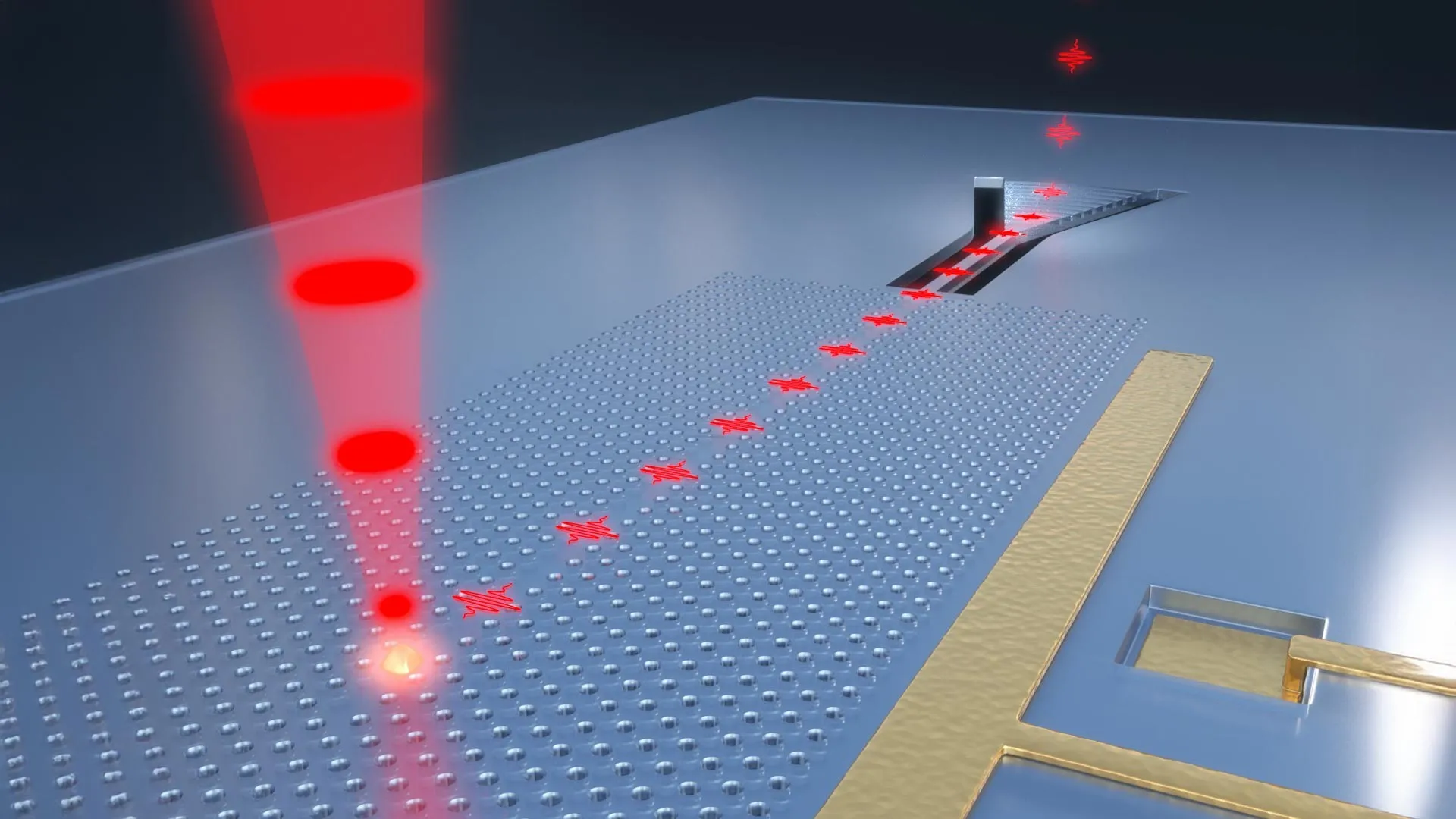
Researchers at the University of Iowa have identified a new way to "purify" photons, a development that could improve both the performance and security of light based quantum technologies. By refining how single particles of light are produced, the approach aims to overcome long standing limitations in optical quantum systems.
The team focused on two major obstacles that make it difficult to generate a reliable stream of single photons, which are essential for photonic quantum computers and secure communication networks.
One challenge is known as laser scatter. When a laser shines on an atom to trigger the release of a photon, the process can also produce extra, unwanted photons. These additional particles act like interference in an optical circuit, reducing efficiency in much the same way stray electrical current disrupts a conventional circuit.
A second issue arises from the way atoms sometimes respond to laser light. In rare cases, an atom emits more than one photon at a time. When that happens, the precise order needed for quantum operations breaks down, since the extra photons interfere with the intended one by one flow.
Using Laser Noise to Cancel Unwanted Light
In the new study, Matthew Nelson, a graduate student in the Department of Physics and Astronomy, found an unexpected connection between these two problems. He discovered that when an atom releases multiple photons, the resulting wavelength spectrum and wave form closely match those of the laser light itself.
According to the researchers, this similarity means the two signals can be carefully adjusted to cancel each other out. In effect, the laser scatter that usually causes trouble can be used to suppress the unwanted photon emissions.
"We have shown that stray laser scatter, typically considered a nuisance, can be harnessed to cancel out unwanted, multi-photon emission," says Ravitej Uppu, assistant professor in the Department of Physics and Astronomy and the study's corresponding author. "This theoretical breakthrough could turn a long-standing problem into a powerful new tool for advancing quantum technologies."
Why Single Photons Matter for Quantum Computing
Photonic computing relies on light rather than electricity to perform calculations, offering the potential for faster and more efficient systems. Conventional computers operate using bits -- streams of electrical or optical pulses that represent ones or zeroes. Quantum computers instead use qubits, which are often subatomic particles such as photons.
Many emerging technology companies believe photonic platforms will play a key role in the future of quantum computing. A stable, well controlled stream of single photons is central to making that vision practical.
An orderly photon stream is easier to manage and scale, and it also improves security. The researchers compare it to guiding students through a cafeteria line one at a time rather than letting them move as a crowd. In the same way, a neat single photon line reduces the risk of data being intercepted or overheard.
Precision Control for Cleaner Photon Streams
Uppu explains that careful control of the laser beam is the key to the new method. "If we can control exactly how the laser beam shines on an atom -- the angle at which it's coming, the shape of the beam, and so on -- you can actually make it cancel out all the additional photons that the atom likes to emit," he says. "We would be left with a stream that is actually very pure."
The work shows, in theory, that two major barriers to faster photonic circuitry can be addressed at the same time. If confirmed experimentally, the technique could help accelerate the development of advanced quantum computers and more secure communication systems. The researchers plan to test the idea in future experiments.
Study Details and Funding
The study, "Noise-assisted purification of a single-photon source," was published in the journal Optica Quantum.
Funding for the research came from the Office of the Under Secretary of Defense for Research and Engineering within the U.S. Department of Defense. Additional support was provided through a seed grant from the University of Iowa Office of the Vice President for Research via the P3 program, which helped launch the project.
Story Source:
Materials provided by University of Iowa. Note: Content may be edited for style and length.
Journal Reference:
- Matthew D. Nelson, Ravitej Uppu. Noise-assisted purification of a single-photon source. Optica Quantum, 2025; 3 (6): 500 DOI: 10.1364/OPTICAQ.565878
Cite This Page: