
Scientists say a critical Atlantic Ocean current is weakening and the effects could be global
A major Atlantic current system that helps regulate Earth’s climate has been weakening for nearly 20 years, raising concerns about future shifts in weather and sea level.
- Date:
- September 23, 2026
- Source:
- University of Miami Rosenstiel School of Marine, Atmospheric, and Earth Science
- Summary:
- Scientists have found strong observational evidence that a key part of the Atlantic Meridional Overturning Circulation has been weakening across a wide stretch of ocean for nearly two decades. The slowdown could eventually reshape weather patterns, rainfall, storms, winters, and coastal sea levels around the Atlantic.
- Share:
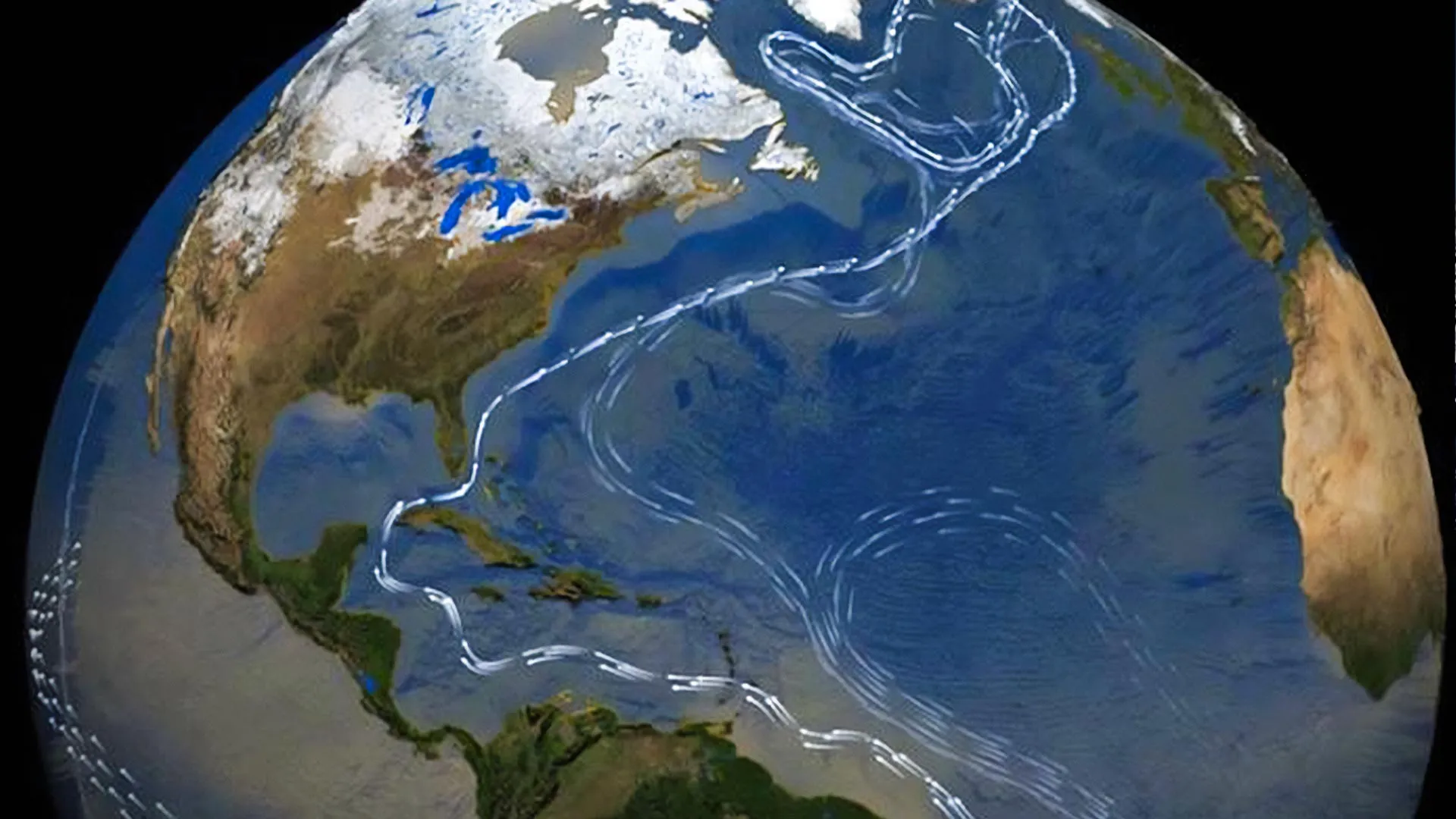
A major Atlantic Ocean circulation system that plays a central role in regulating Earth's climate has been weakening across a broad region for nearly two decades, according to new research. The trend could have important consequences for weather, rainfall, storms, and sea level in regions around the Atlantic and beyond.
The study, led by researchers at the University of Miami Rosenstiel School of Marine, Atmospheric and Earth Science, provides some of the clearest direct observational evidence so far that the Atlantic Meridional Overturning Circulation (AMOC) is losing strength.
AMOC is a vast system of ocean currents that moves warm water northward near the surface and transports colder, denser water southward at greater depths. By redistributing enormous amounts of heat through the Atlantic, it helps shape regional temperatures, rainfall patterns, sea level, and weather.
"A weaker AMOC can shift weather patterns, potentially leading to more extreme storms, changes in rainfall, or colder winters in some regions," said Shane Elipot, a senior author of the study and physical oceanographer at the Rosenstiel School. "It can also influence sea-level rise along coastlines, affecting communities and infrastructure."
Tracking Changes Deep Beneath the Atlantic
To investigate how the circulation has changed over time, the researchers examined long term observations from four ocean monitoring arrays positioned along the western edge of the North Atlantic. These sites extend from tropical waters into higher latitudes, giving scientists a broad view of changes across the basin.
The monitoring systems use instruments anchored to the seafloor that continuously measure pressure, temperature, density, and ocean currents.
Researchers used the same analytical method at all four locations. In particular, they examined changes in pressure at the ocean bottom to estimate the movement of deep water below about 1,000 meters.
By comparing measurements across both time and location, the team was able to look for persistent changes in the strength of the overturning circulation rather than relying on observations from a single part of the Atlantic.
A Consistent Decline Across a Huge Region
The data revealed a similar pattern at several different latitudes. A key component of the AMOC along the western boundary of the North Atlantic has been declining from the subtropics into the mid latitudes (about 16.5°N to 42.5°N).
Because the weakening appears across such a large geographic area, the researchers say it is more consistent with a broad shift in Atlantic circulation than with a short-lived regional fluctuation.
That distinction matters because the AMOC is one of the major systems responsible for moving heat around the planet. Changes in its strength can influence climate conditions far from the locations where the currents themselves are measured.
Why the AMOC Matters
The AMOC is especially important for climate around the North Atlantic. Its transport of heat helps influence temperatures in Europe and North America, while also affecting rainfall, storms, and sea level.
If the circulation continues to weaken, the effects could include changes in European winters, shifts in rainfall patterns, altered hurricane activity, and changes in coastal sea levels.
Researchers are therefore closely watching the system for signs of long term change.
The new findings suggest that measurements along the western side of the Atlantic could provide a particularly useful warning signal. Scientists compare the idea to a canary in a coal mine, because changes there may offer an efficient way to detect broader shifts in the climate regulating circulation.
A Potential Early Warning Signal
"This research helps scientists better predict how the climate may change in the coming decades -- information that governments, businesses, and communities use to prepare for future environmental conditions," said Elipot.
Long term ocean observations are especially valuable because natural changes in currents can occur over years or even decades. Maintaining measurements over extended periods helps researchers distinguish temporary variability from persistent changes in the underlying circulation.
The study, titled "Meridionally consistent decline in the observed western boundary contribution to the Atlantic Meridional Overturning Circulation," was published in the April 8 issue of Science Advances.
The study was supported by grants from the U.S. National Science Foundation (OCE-2148723 and OCE-2334091) and UK Natural Environment Research Council grants (NE/Y003551/1 and NE/Y005589/1).
Story Source:
Materials provided by University of Miami Rosenstiel School of Marine, Atmospheric, and Earth Science. Note: Content may be edited for style and length.
Journal Reference:
- Qianjiang Xing, Shane Elipot, William E. Johns, David A. Smeed, Ben I. Moat, John W. Loder. Meridionally consistent decline in the observed western boundary contribution to the Atlantic Meridional Overturning Circulation. Science Advances, 2026; 12 (15) DOI: 10.1126/sciadv.adz7738
Cite This Page: