
A tiny supercurrent could unlock quantum information without destroying it
Scientists have developed a promising new method that could read quantum information with 99.85% accuracy while barely disturbing the qubit itself.
- Date:
- November 4, 2026
- Source:
- Fundação de Amparo à Pesquisa do Estado de São Paulo
- Summary:
- Researchers have proposed a breakthrough technique for reading quantum information without destroying the delicate states that make quantum computers work. By detecting an electrical signal generated by the qubit itself, their method achieved up to 99.85% accuracy in simulations and could make future quantum computers simpler and more efficient.
- Share:
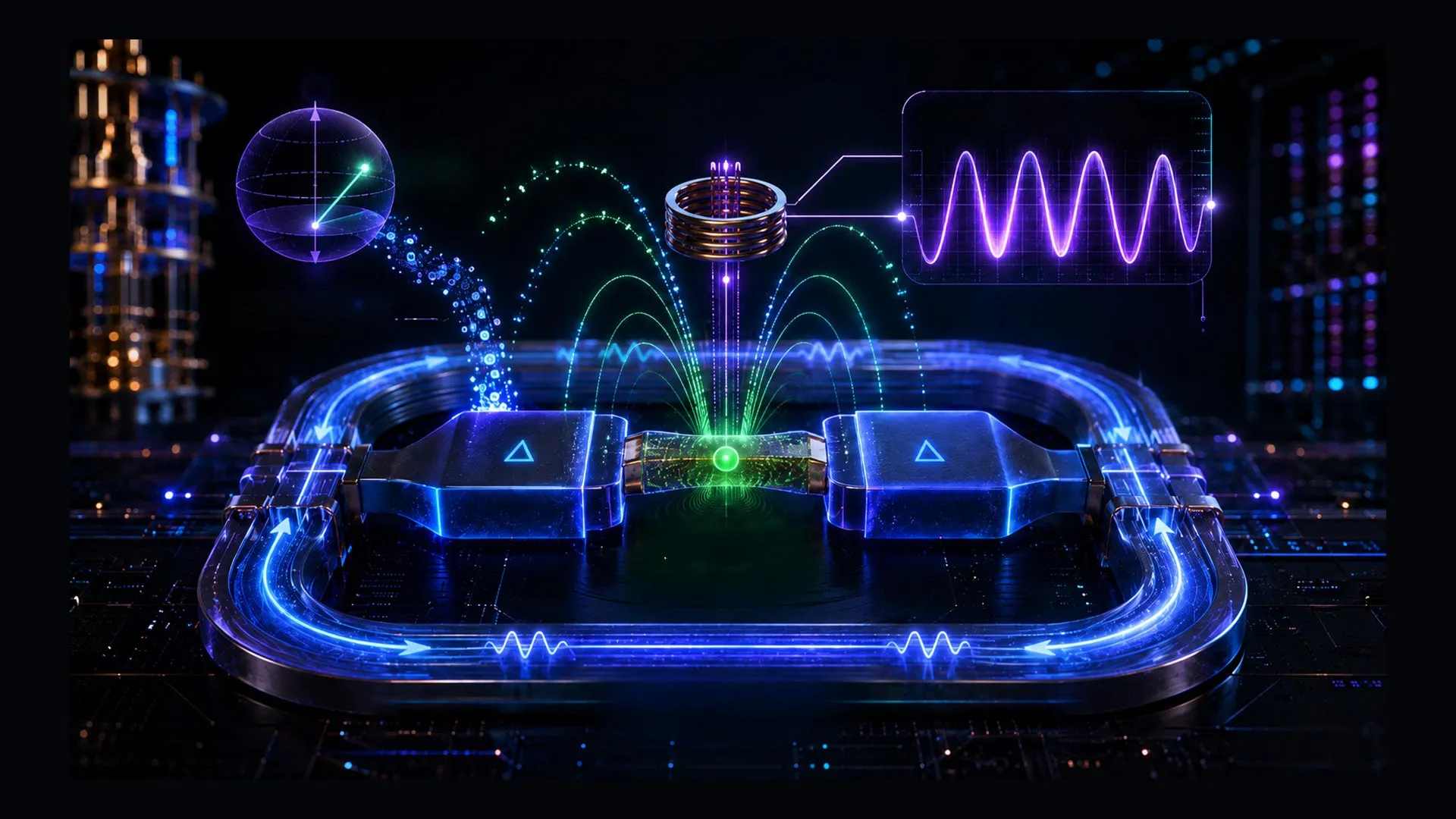
One of the biggest obstacles in quantum computing is surprisingly simple to describe: how do you read information without changing or destroying it? Unlike the bits used in ordinary computers, quantum bits, or qubits, are extraordinarily sensitive to measurement. Trying to determine their state can cause that state to collapse, potentially erasing the very information scientists want to retrieve.
Researchers have now proposed a way to overcome much of this difficulty by using an unusual electrical signal produced by the qubit itself. Their approach focuses on a special type known as an "Andreev qubit," which can generate an oscillating electric supercurrent through its own quantum behavior. By monitoring this current, scientists may be able to determine the qubit's state without directly measuring it or significantly disturbing the information it contains.
The research, supported by FAPESP, was published in Physical Review B Letters. It was led by José Carlos Egues, a full professor at the São Carlos Institute of Physics at the University of São Paulo (IFSC-USP) in Brazil, and Yugui Yao of the School of Physics at the Beijing Institute of Technology in China. If experimentally confirmed, their method could simplify quantum computing by removing the need for extra qubits used in certain measurement techniques.
Why Measuring Quantum Information Is So Difficult
Conventional computers store information in bits that have one of two values, 0 or 1. These values can be checked repeatedly without changing the information. Quantum computers work differently because their qubits can exist in superpositions, meaning they can combine the states 0 and 1 in ways that are not possible with conventional bits.
This unusual ability is central to the potential power of quantum computing. However, it also creates a major vulnerability. Quantum states can be disrupted by interactions with their surroundings, including the instruments scientists use to examine them.
"In the conventional formulation of quantum mechanics, a projective measurement causes the system to assume one of the states associated with the measured quantity. Thus, if a qubit has been prepared in a certain superposition of 0 and 1, its direct measurement tends to destroy that superposition and, consequently, the information it contained," says Egues.
To minimize this problem, physicists developed techniques known as "quantum nondemolition measurements," or QND. Many of these approaches use an additional quantum system called an ancilla. Rather than measuring the original qubit directly, researchers transfer information to the ancilla and measure that auxiliary system instead.
The term "ancilla" comes from a Latin word meaning "slave" or "servant." In modern scientific usage, it describes something that performs a supporting function. Here, the ancilla acts as an intermediary, allowing researchers to obtain information while preserving the original qubit as much as possible.
Although effective, these procedures come with practical disadvantages. Scientists must prepare the auxiliary qubits, connect them to the qubits being studied, transfer information between them, and perform repeated measurements. These additional steps require time and equipment, and the complexity becomes increasingly significant as the number of qubits grows.
"Our strategy is different. Instead of transferring the information to an auxiliary qubit, we seek to obtain it from a signal produced by the qubit under study itself," says the researcher.
A Special Quantum Bit That Produces Its Own Signal
The proposed technique relies on the unusual properties of an Andreev qubit. Its name honors Soviet physicist Alexander Andreev (1939-2023), who identified a distinctive quantum process in 1964 that occurs where normal materials meet superconductors.
Superconductors are materials that can conduct electricity without electrical resistance under appropriate conditions. At the boundaries involving these materials, special quantum states known as "Andreev states" can form. In the system studied by the researchers, these states are confined to an extremely small region between two superconducting materials.
These quantum states can represent the basic values 0 and 1, along with superpositions of those values, making them suitable for storing quantum information.
"In the system under consideration, this region is a quantum dot - that is, a nanoscale structure in which electrons are spatially confined - formed in an indium arsenide [InAs] nanowire connected to superconducting materials on both sides. It's in this environment that the states characterizing the Andreev qubit are formed," Egues explains.
The key to the new approach is an electrical phenomenon called a "supercurrent." Unlike the current flowing through ordinary electrical conductors, a supercurrent moves without resistance.
The researchers found that when the Andreev qubit exists in a superposition, the supercurrent develops a component that oscillates over time. These fluctuations arise from quantum interference between the different states making up the superposition.
Crucially, the oscillations are not random. Their behavior contains information about the qubit's underlying quantum state, potentially allowing scientists to determine what that state is without directly measuring the qubit.
"It's precisely that property that we use to read the qubit. It's that supercurrent that lies at the heart of our proposal," the researcher points out.
How a Tiny Electrical Current Reveals Quantum Information
To understand how the technique works, it helps to consider how physicists describe a qubit's state mathematically.
One common representation is the "Bloch sphere," a geometric model in which every possible pure state of a single qubit corresponds to a point on the surface of a sphere. Two angles determine the location of that point.
The first angle describes how much each of the two basic states contributes to the superposition. The second describes their relative phase, which specifies how the quantum components are aligned with one another. Together, these two measurements provide the information needed to identify the qubit's state.
According to the new research, both pieces of information can be extracted from the supercurrent. Its steady component and the size of its oscillations reveal the relative contributions of the two basic states. Meanwhile, the timing of the oscillations provides information about their phase relationship.
"Our study showed that this information is encoded in the supercurrent itself. The supercurrent has a constant component and a fluctuating component. The value of the constant component and the amplitude of the oscillation reveal the proportion of each state (0 and 1) in the superposition, and the moment when that oscillation begins reveals the phase relationship between them. Thus, by measuring how the current varies over time, it's possible to reconstruct the initial state of the qubit," Egues explains.
This means the electrical current effectively carries a signature of the quantum information stored in the system. By observing how that signature changes over time, researchers could reconstruct the qubit's original state.
A Supercurrent That Oscillates Without Voltage
Another surprising feature of the proposed system is that the electrical current can oscillate without an externally applied voltage.
Ordinarily, producing an oscillating supercurrent in this type of superconducting system requires a voltage. This familiar phenomenon is called the "AC Josephson effect."
The researchers predict something different in their Andreev qubit. Here, the current's oscillations arise naturally from the qubit's own quantum evolution. No outside voltage is required to generate them.
"Our system generates a supercurrent that varies over time like an alternating current but without voltage. It's the very evolution of the qubit's state that produces that oscillation," says Egues.
This behavior is important because it transforms quantum activity occurring on an extraordinarily small scale into a detectable electrical signal. The current provides a connection between the microscopic world of quantum states and the larger physical systems scientists can measure.
That connection is what makes the proposed reading technique possible.
Detecting Quantum States With an Extremely Sensitive Sensor
The researchers envision placing the Andreev qubit inside a closed superconducting circuit, allowing its supercurrent to circulate continuously.
Next to the circuit would sit a SQUID (superconducting quantum interference device), a highly sensitive instrument capable of detecting extremely weak magnetic fields.
Whenever an electric current flows, it produces a magnetic field. Because the supercurrent in this system oscillates, the magnetic field it generates also changes over time.
The nearby SQUID could detect these tiny magnetic variations and use them to determine the behavior of the circulating current. Since the current contains information about the qubit's quantum state, the researchers could then reconstruct that state without measuring the qubit directly.
Egues compares the arrangement to two compasses that interact through a magnetic field.
"We can think of the qubit as one compass and the SQUID as another compass. The current in the circuit produces a magnetic field, and the SQUID 'senses' that field. Since the coupling between the two is very weak, the effect of the measuring instrument on the qubit tends to be very small."
The weak interaction between the sensor and the qubit is especially important. It offers a way to gather information while minimizing the disturbance that normally accompanies quantum measurements.
Reading Quantum Information With Almost No Disturbance
In quantum physics, observing a system is not necessarily a harmless process. A measuring instrument interacts with whatever it is attempting to measure, and that interaction can change the system's behavior.
This fundamental difficulty puzzled the earliest researchers studying quantum mechanics. It remains an unavoidable feature of quantum measurements today.
The proposed technique does not eliminate this effect entirely. The SQUID still interacts with the circuit, creating a small amount of feedback that can influence the qubit. However, the team's simulations suggest that this disturbance can be reduced to a level so small that it becomes effectively negligible.
"Our method doesn't eliminate the fundamental problem of quantum measurement. But it can approach the limit of a non-destructive readout and, at the same time, avoid the use of auxiliary qubits - the ancillas - employed in other non-destructive quantum measurement protocols," Egues notes.
The approach could also remove another complication found in some existing techniques. Because researchers would not need to restore the qubit to its original state after every measurement, they could make repeated observations as the state changes.
This would allow scientists to follow the qubit's quantum evolution over time, rather than obtaining information only through separate measurement and reset cycles.
Simulations Achieve Up to 99.85% Accuracy
To investigate whether the method could work outside ideal theoretical conditions, the researchers performed computer simulations designed to account for imperfections that would arise in real experiments.
These calculations included measurement noise, as well as the small amount of feedback introduced by the detection coil. The goal was to determine whether the qubit's state could still be reconstructed accurately despite these disturbances.
The results were encouraging. Depending on the number of measurements used, the simulations produced accuracies of 99.52%, 99.81%, and 99.85%.
According to the researchers, these values fall within the standard thresholds used in quantum error correction schemes, which are designed to manage errors in quantum information processing.
The findings suggest that the method could provide highly accurate quantum state reconstruction without the additional complexity of auxiliary qubits.
However, the technique has not yet been demonstrated experimentally. The results come entirely from theoretical analysis and computer simulations, so researchers still need to establish whether a physical device can achieve comparable performance.
Could This Make Quantum Computers Simpler?
Despite the lack of experimental confirmation, the researchers emphasize that their proposal does not depend on technologies that have yet to be invented.
The calculations use realistic properties drawn from existing quantum systems, and SQUID sensors are already established tools for detecting exceptionally weak magnetic fields and electric currents.
What remains to be built is the specific arrangement of components required to implement the proposed measurement technique.
"All the numbers we used are realistic. In principle, this can be achieved. In fact, we used parameters from existing systems in our calculations. What doesn't yet exist is that geometry, that setup that we proposed," he argues.
This makes the approach different from theoretical concepts that cannot be realized until scientists develop entirely new materials or manufacturing techniques. In principle, the necessary components already exist, although assembling them into the proposed configuration and demonstrating the predicted behavior remain important challenges.
The research offers two potentially significant advances.
From the standpoint of fundamental physics, it predicts that a qubit can produce an oscillating supercurrent resembling the AC Josephson effect, but without requiring an external voltage. Instead, the oscillations emerge from the qubit's own coherent quantum evolution.
From a technological perspective, the study shows how those oscillations could serve as a measurable signature of the qubit's internal state. By analyzing the electrical current, researchers could recover quantum information while causing very little disturbance to the system.
If future experiments confirm these predictions, the method could make reading Andreev qubits substantially simpler. Eliminating auxiliary qubits and repeated resets could reduce the equipment and procedures needed to retrieve quantum information.
More fundamentally, the work points toward an intriguing possibility: information hidden in the microscopic quantum world may be accessible through an electrical current produced by the quantum system itself, offering a promising new way to observe delicate quantum states without destroying them.
Story Source:
Materials provided by Fundação de Amparo à Pesquisa do Estado de São Paulo. Original written by José Tadeu Arantes. Note: Content may be edited for style and length.
Journal Reference:
- Xian-Peng Zhang, Chuanchang Zeng, Zhen-Biao Yang, Jose Carlos Egues, Yugui Yao. Andreev qubit readout from dynamic interference supercurrent. Physical Review B, 2026; 114 (8) DOI: 10.1103/6gkt-hghj
Cite This Page: